

 Chris BerryFounder, Wine Underdogs — chasing the world’s overlooked grapes
Start with Xynisteri for a white and Maratheftiko for a red. That is the advice of Anastasia Konstantopoulou, Head Oenologist at LionSpirit Winery & Distillery in Cyprus, and she gives it for a practical reason: understand those two and you have somewhere to stand when you meet the rarer ones.
I sent her ten questions about the island's indigenous grapes. She answered every one at length, and on two of them she politely declined the premise I had built into the question. Those two answers are the best things in this piece. Her words are quoted as she wrote them; the framing between them is mine.
Cyprus is a small wine country with a large inheritance. Phylloxera never reached the island, so its vineyards were never torn out and replanted on American rootstock the way most of Europe's were. What that left behind is the subject of her second answer, and it is not what the romance says.
Where to start: one white, one red
I asked what a reader in the States who has never knowingly had a Cypriot wine should reach for first.
For Xynisteri, I would look for a dry, clean, unoaked expression, preferably from a higher-altitude site, so the character of the variety is as clear as possible. I would expect citrus, white or stone fruit, some floral or herbal notes, and, in the better examples, good texture without heaviness. What I find interesting about Xynisteri is that it can remain fresh and very drinkable while showing much more aromatic and textural detail than its old reputation suggests.
At the table, I would pair it with grilled fish or seafood - something Mediterranean such as sea bream, octopus or grilled halloumi would be ideal.
For the red:
For the red, I would choose Maratheftiko. I would expect more colour and structure, ripe red and dark fruit, herbal or spicy notes and noticeable tannins, but with enough acidity to keep the wine balanced. Again, for a first introduction I would prefer a version where oak supports the variety rather than dominates it.
I would put that next to lamb, souvla or another grilled meat. The protein and fat work well with the tannins, while Mediterranean herbs match very naturally with the more savoury and spicy side of the variety.
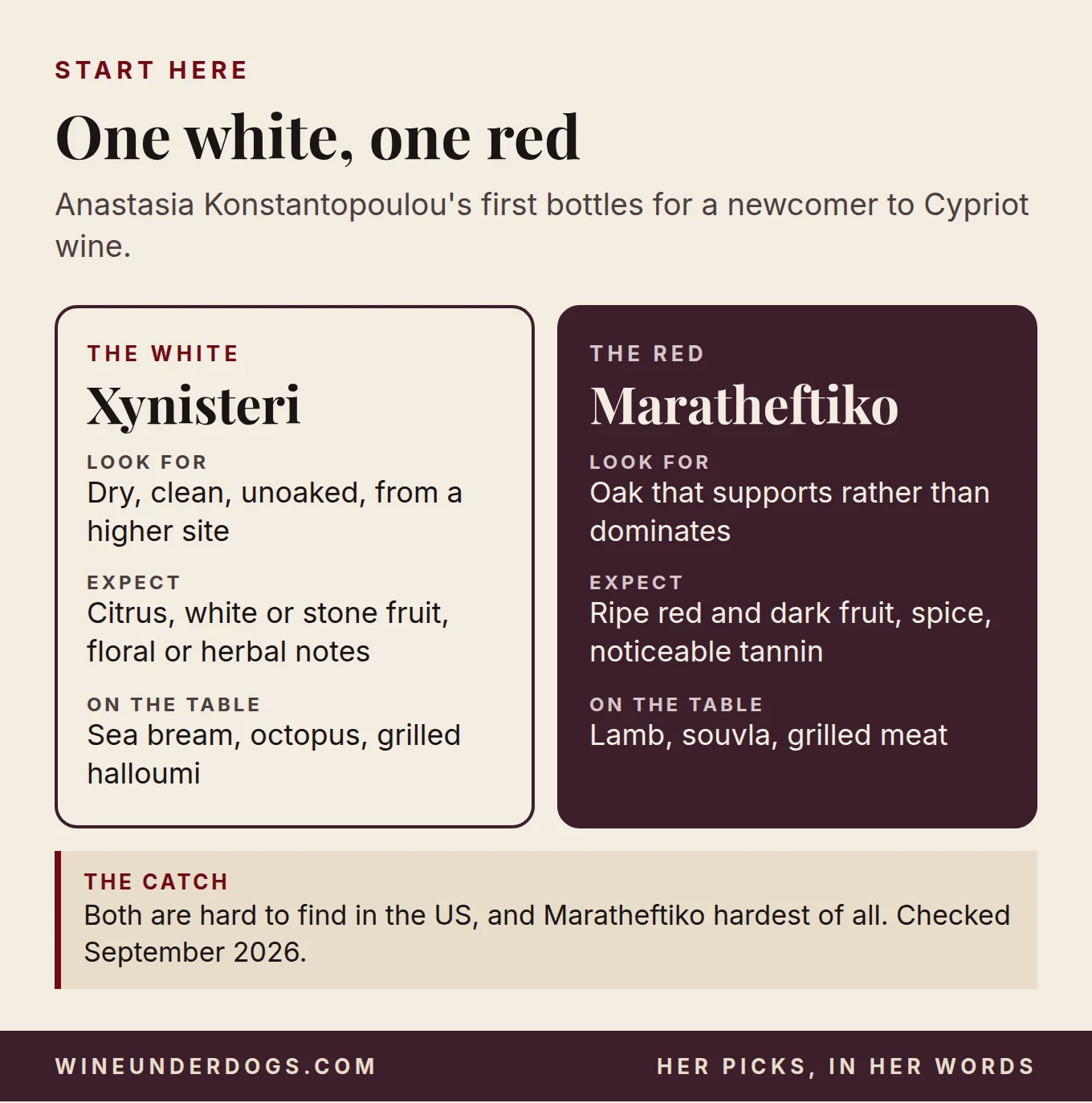
She could have named something rarer, and she said so. "I could choose something rarer, such as Promara or Yiannoudi, but for a first introduction I think Xynisteri and Maratheftiko make better reference points."
The rescue never ended
My first question assumed a turning point: a moment when Cyprus stopped rescuing these grapes and started competing with them. She would not give me a date.
I wouldn't put a single date on that transition, because I don't think the rescue phase ever really ended.
She traces the change to the 1980s and 1990s, when systematic work began on old plant material and smaller regional wineries brought winemaking closer to the vineyards. Then she explains why the question itself is too tidy:
But I think it is important to say that we are still in that process today. Not all Cypriot varieties are at the same stage. With Xynisteri and Maratheftiko, we now have considerably more research, commercial experience and different stylistic expressions. With varieties such as Promara, Vasilissa and Morokanella, we are still experimenting and learning what their real potential and typicity are, how they behave under different conditions and which winemaking approaches express them best.
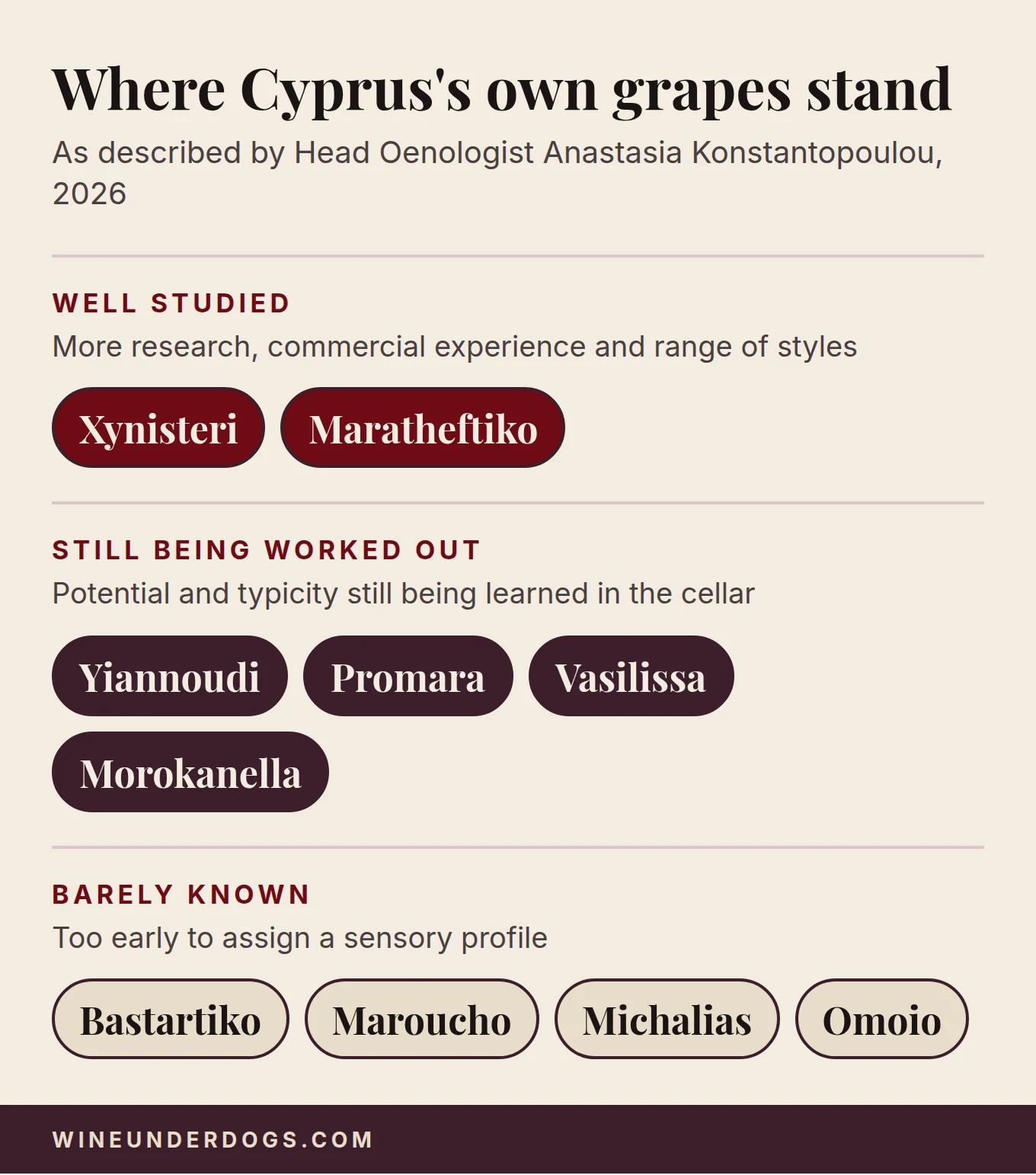
So, for me, rescue and competition are not two separate eras. Cyprus is still doing both at the same time. Some indigenous varieties are already being asked to compete at a serious quality level, while others are still being understood.
What the own-rooted vines actually give you
This is where I expected romance and got a scientist. I asked whether ungrafted fruit shows up differently in the glass.
I'd be very cautious about claiming that ungrafted vines have a specific or recognisable 'taste.'
Rootstocks can influence acidity, pH, phenolics, aroma and mouthfeel, she writes, but not consistently enough across sites and varieties to define a single ungrafted signature. What phylloxera's absence did preserve is something else:
In Cyprus, I think the more important value of being phylloxera-free is actually continuity rather than flavour. We still have old vines, old plant material and a great deal of genetic diversity that survived without the large-scale uprooting and replanting that transformed so much of European viticulture. That means we have retained old populations, local biotypes and rare indigenous material that might otherwise have disappeared.
For me, that is actually more interesting than the romantic version. The real importance of Cyprus's own-rooted vineyards is not that they give us some mystical pre-phylloxera taste, but that they preserve a living continuity of vines and genetic material that is increasingly rare in Europe.
That is also the more useful version for you. Nobody should pay extra for the taste of ungraftedness, and here is someone who works with these vines saying it cannot be isolated. The reason to care about Cyprus's old vineyards is that the grapes in the rest of this piece still exist because of them.
Xynisteri was judged by where it grew
Xynisteri has a reputation for being light and low in acid. I asked her whether it deserves it. She thinks the reputation says as much about the vineyards as about the grape.
I think Xynisteri's reputation for being light and low in acid says at least as much about how and where it was historically grown as it does about the variety itself.
Altitude matters, she explains, not because higher simply means more acidity, but because cooler sites slow the ripening and widen the window for flavor and for the harvest decision. On what taking the grape seriously means:
For me, taking Xynisteri seriously is not about trying to make it bigger, heavier or more obviously 'premium.' It is about becoming more precise with it - choosing the right site, controlling yield and canopy, understanding the ripening curve, and picking at the point where freshness, flavour and phenolic maturity are in balance. In the cellar, that may mean very little intervention, or it may involve lees ageing, skin contact or barrel work, but the technique should serve the variety rather than cover it.
So I would not say that altitude turns Xynisteri into a completely different grape. It allows a different side of the variety to emerge. At its best, it can retain the lightness and drinkability that are naturally part of its character, while gaining much more aromatic definition, texture and sense of place.
Maratheftiko, the red that needs a partner
Maratheftiko cannot reliably pollinate itself, so growers plant a partner such as Spourtiko alongside it. I asked whether that single fact shapes what the wine can become. Her answer separates the vineyard problem from the wine:
But that does not mean the pollinizer determines the character of the wine. Spourtiko helps you obtain the crop; it does not contribute its identity to the Maratheftiko grape. The style of the final wine is still shaped by the site, the maturity of the fruit, the quality of the skins and seeds, extraction, maceration and the choices made in the cellar.
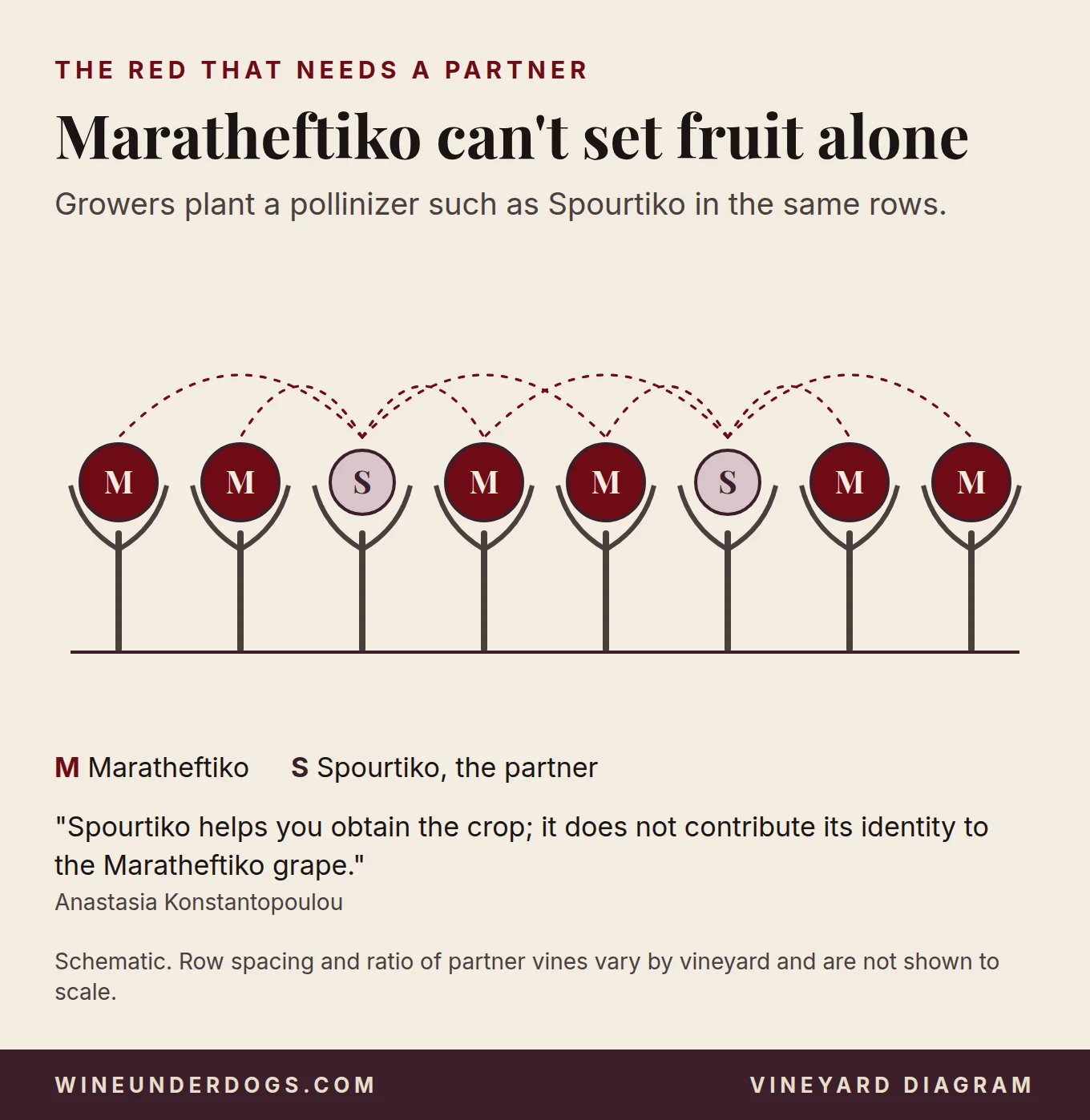
What the biology does create is variability: uneven bunches, uneven berry size, uneven ripeness. That means stricter selection in some years and a careful hand with extraction.
So I would say it is first a problem you have to manage, and then a trait you learn to work with. I would not describe poor pollination as a quality advantage in itself. The skill is in understanding the variability it creates and adapting both vineyard and cellar decisions around it.
Heat tolerance buys time, not immunity
A three-season study in Cyprus, published in OENO One in 2020, grew Xynisteri and Maratheftiko beside Shiraz and Sauvignon Blanc and found the Cypriot pair tolerated hot, dry conditions better. I asked whether that had changed how she picks and ferments.
Yes, it does - but for me climate resilience does not mean that I can simply leave the fruit on the vine and assume everything will remain in balance. It gives me a wider window, not immunity from heat and drought.
The extra time lets her wait for acidity, flavor and phenolic ripeness rather than picking because the fruit is starting to collapse. But the grapes that arrive after that wait decide the cellar protocol, from sulfur at reception to yeast choice.
So climate resilience actually makes the decision-making more precise, not less. A drought-tolerant variety may give me more time in the vineyard, but I still have to read what happened to the berries during that extra time. The vine's resilience gives me options; the condition and chemistry of the grapes tell me what to do with them in the cellar.
Mavro, judged by the wrong criteria
Mavro has the worst name on the island: the workhorse red behind a great deal of forgettable wine. I asked whether a genuinely good one is waiting to be made.
I do think genuinely good Mavro can be made, but perhaps not by asking it to become the kind of red wine it was never naturally equipped to be.
Push it toward color and power, she says, and you gain astringency rather than quality. And decades of farming it for volume make it hard to judge what it could do.
What I find interesting now is that some producers are beginning to work with its natural character rather than trying to correct it. Old vines, higher-altitude sites, lower yields and gentler extraction can lead to a very different expression - more emphasis on fruit and freshness, and less on colour and power. Rose, lighter reds and even reds that can be served slightly chilled seem to me very logical directions for the variety.
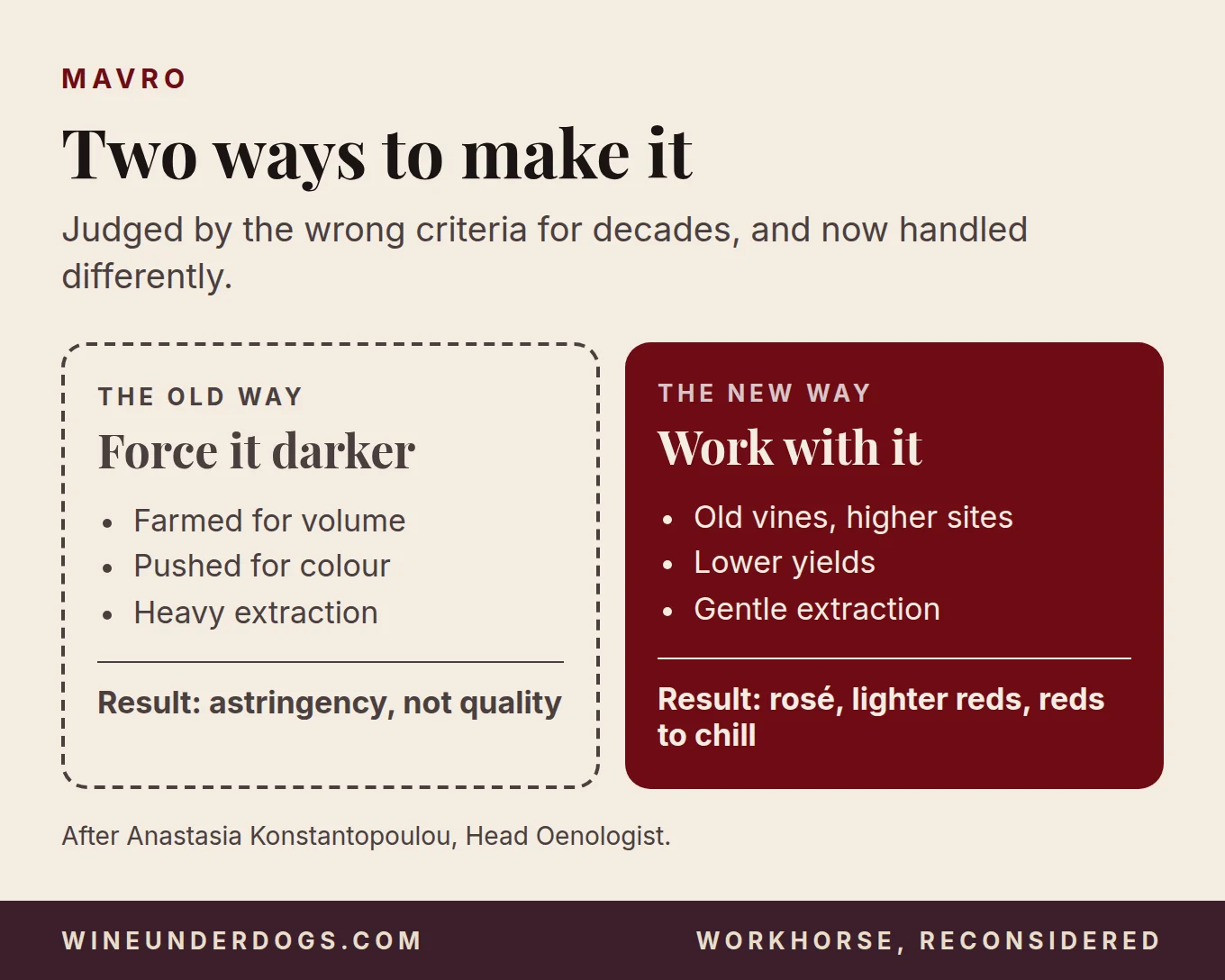
If you see a Mavro rosé or a light red meant for the fridge, that is the direction she is describing, not a compromise.
Commandaria is about balance, not less sugar
Commandaria is Cyprus's sun-dried sweet wine, often called the oldest named wine still in production, and for a long stretch it meant something heavy and oversweet. I assumed the modern fix was simply less sugar. She disagreed.
The best modern examples, in my view, are not trying to remove those characteristics. They are managing them more carefully. Greater attention to fruit quality, harvest and drying time, more controlled fermentation and more deliberate ageing can preserve more fruit and freshness while still producing something that is unmistakably Commandaria.
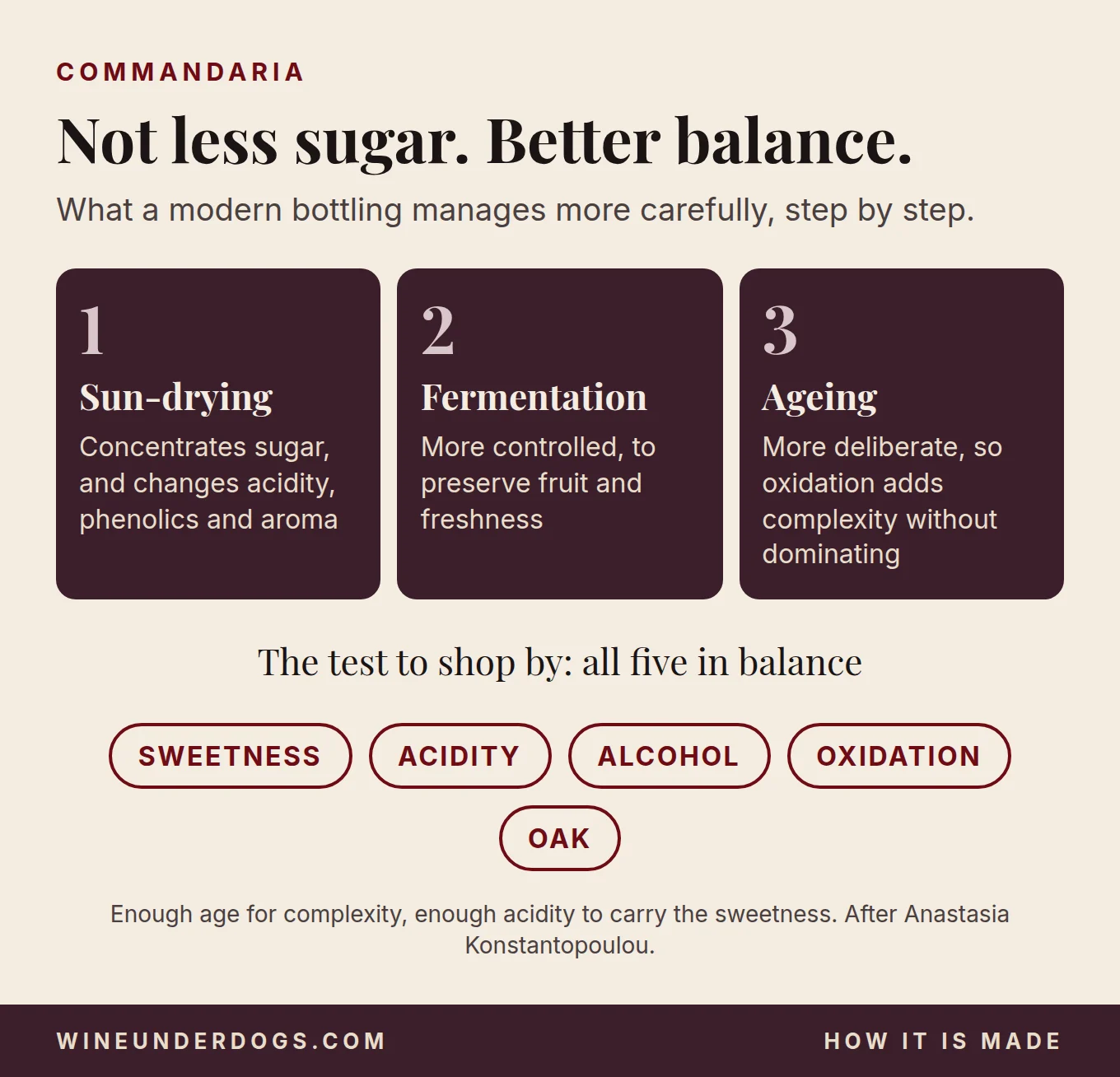
I asked for one bottle to hand a skeptic. She would not name a label, and gave me a description to shop by instead:
I would choose a wine with enough age to show the complexity of the category, but still with the acidity and freshness to carry its sweetness. I would want the oxidative character to add complexity without dominating the fruit, and the alcohol and oak to feel integrated rather than heavy.
I am not going to name a bottle on her behalf. Her test is the better tool anyway: age for complexity, acidity to carry the sugar.
The grapes with no rulebook yet
Yiannoudi was brought back from near disappearance only recently. I asked how anyone decides what a correct version looks like when there is almost no modern track record.
I don't think we have a single reference for Yiannoudi yet, and I'm not sure we should be in a hurry to create one.
That also makes me cautious about imposing too much winemaking style too early. Heavy extraction, a lot of new oak or a very dominant cellar signature can easily become the reference before we have properly understood the variety itself. In this phase, I think observation and comparison are extremely important - allowing the grape to show us what it can do before deciding what it should become.
Then the four that almost nobody has tasted: Bastartiko, Maroucho, Michalias and Omoio. She would not rank them, but she named the one she is most curious about.
If I had to choose the one that makes me personally most curious, though, it would probably be Omoio. The fact that it was originally identified because of its resemblance to Maratheftiko makes me want to see how close - or how different - it really is.
So I would not want to start with the expectation that Omoio should taste like Maratheftiko. For me, the interesting part would be discovering where the similarity ends and where its own identity begins.
Where to find a bottle
An honest answer first: in the United States, Cypriot wine is hard to find. On 25 September 2026, wine.com, the retailer this site works with, carried none at all, so there is no buy link on this page.
It is not impossible. The same day, Wine-Searcher's US listings for Xynisteri showed five bottles from sellers shipping to Florida, from producers including Tsiakkas, Vouni Panayia and Zambartas, at roughly $20 to $30. Maratheftiko was much thinner, with a single visible US listing. Commandaria is the easiest of the three: Wine-Searcher showed 28 US listings, most of them KEO St. John in a half bottle at around $18 to $25. Whether a seller can ship to you depends on your state.
Those names are what is on the shelf, not Anastasia's picks or mine. Take her descriptions to the shop and hold the bottle to them.
What to take from it
Cyprus is doing two jobs at once. It is still recovering grapes it nearly lost, and it is already asking the best-known two to stand beside anything in the world. Hearing someone in the cellar describe it is like hearing a people write the grammar for a language they have always spoken.
For you, the practical part is short. Ask for a dry, unoaked Xynisteri from a high site and a Maratheftiko where the oak stays in the background. Put the first beside grilled fish and the second beside lamb. If you find a pale, chillable Mavro, try it on her terms rather than as a lesser red. And if a Yiannoudi or a Promara ever crosses your path, you are drinking a rulebook still being written.
Every grape in this piece
Each has its own page, and each name is said by Anastasia Konstantopoulou herself. The last four share one page, Cyprus's lost grapes.
- Xynisteri ksee-nee-STEH-ree
- Maratheftiko mah-rah-THEF-tee-koh
- Spourtiko SPOOR-tee-koh
- Mavro MAH-vroh
- Commandaria koh-mahn-dah-REE-ah
- Yiannoudi yah-NOO-dee
- Promara proh-MAH-rah
- Vasilissa vah-SEE-lee-sah
- Morokanella moh-roh-kah-NEH-lah
- Bastartiko bah-STAR-tee-koh
- Maroucho mah-ROO-khoh
- Michalias mee-khah-LYAHS
- Omoio OH-mee-oh
With thanks to Anastasia Konstantopoulou, Head Oenologist at LionSpirit Winery & Distillery, who answered all ten questions in writing in September 2026 and recorded every grape name on these pages. Her answers are quoted as she wrote them.
New to wine? Start here

Wine Match
Five guilty pleasures, yes or no. Ben finds the wine you’d actually like. You don’t need to know anything about wine. Ben certainly doesn’t.
Wine Underdogs is for readers of legal drinking age.
BenFive things. Yes or no. I'll do the rest.
Every wine fact here comes from the grape guides on Wine Underdogs. Ben has never opened a bottle, and neither does this game. For readers 21 and over.
Frequently asked questions
What are the indigenous grapes of Cyprus?
Xynisteri (white) and Maratheftiko (red) are the best understood and the best place to start. Mavro, long the island's workhorse red, is being reconsidered. Yiannoudi, Promara, Vasilissa and Morokanella are still being worked out in the cellar, and Bastartiko, Maroucho, Michalias and Omoio are barely known beyond research plots.
Do ungrafted Cypriot vines taste different?
Not in a way anyone can isolate, according to Head Oenologist Anastasia Konstantopoulou. Phylloxera never reached Cyprus, so the vines grow on their own roots, but she says the real value is continuity: old vines and rare genetic material that survived where most of Europe replanted.
What food goes with Xynisteri and Maratheftiko?
Konstantopoulou pairs a dry, unoaked Xynisteri with grilled fish or seafood such as sea bream, octopus or grilled halloumi, and Maratheftiko with lamb, souvla or other grilled meat, where the fat and protein meet its tannins.
JOIN THE PACK
Whatever you drink now, there's an underdog you'd like more.
One overlooked wine at a time: what it tastes like, the famous one it can replace, and the catch. Free.