
 Chris BerryFounder, Wine Underdogs — chasing the world’s overlooked grapes
Here is the honest version: you cannot buy any of these four grapes, and very little is known about them. We are giving them one page rather than four because almost everything written about them traces back to the same two sources: Akis Zambartas's own account of the research he led at KEO (Zambartas Wineries), and a 2017 article by the grape geneticist José Vouillamoz (JancisRobinson.com). Other sources repeat one or both.
Vouillamoz writes that Zambartas and the ampelographer Pierre Galet found all four in old Cypriot vineyards in the 1980s. He also describes them as no longer cultivated, apart from a few vines kept for study at Vouni Panayia's 70-year-old vineyard.
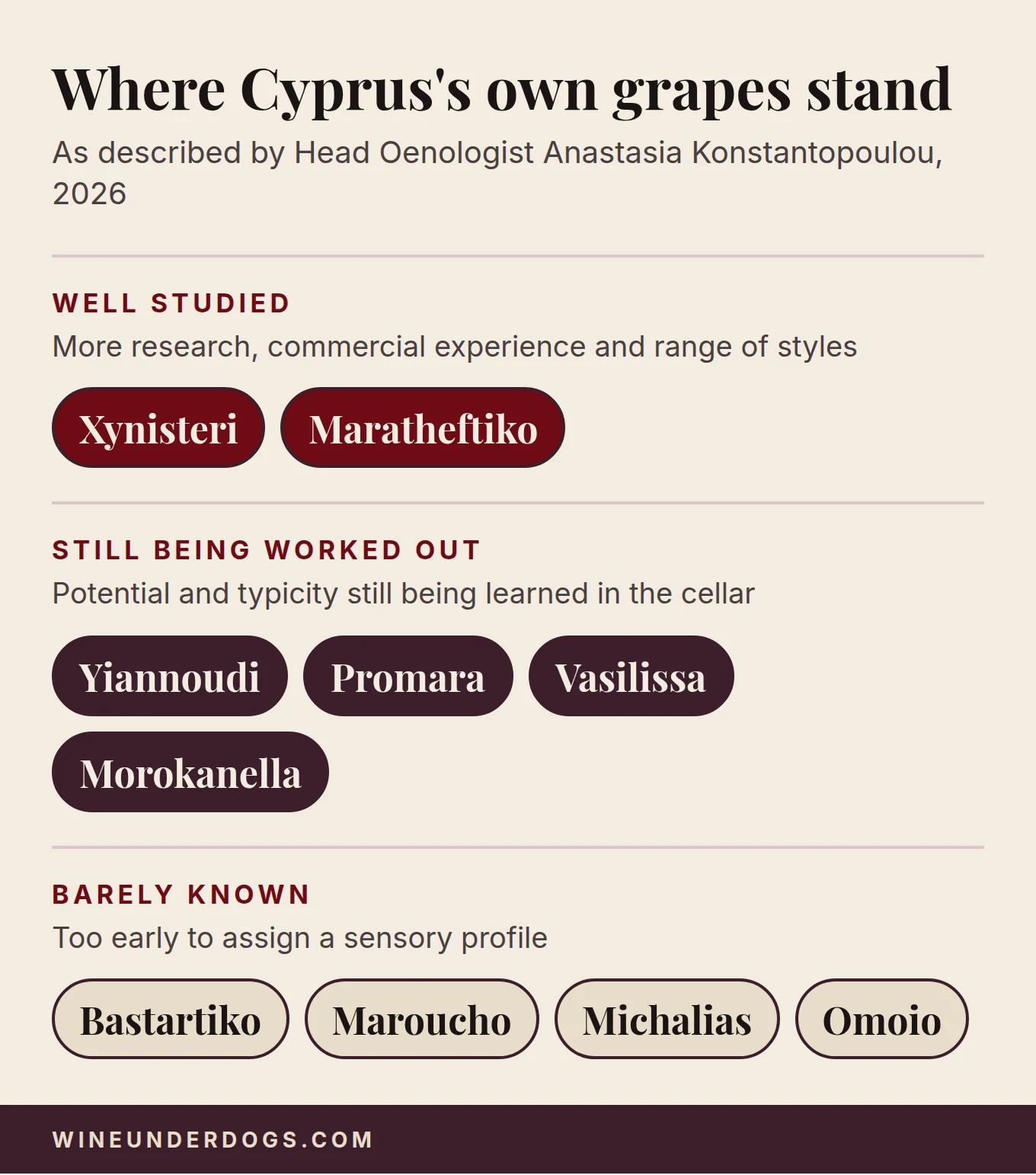
Bastartiko (white)
Say it: bah-STAR-tee-kohrecorded by Anastasia Konstantopoulou
The name means "bastard" (Vouillamoz). It may not be a separate variety at all: Vouillamoz suggests it is possibly a clone of Promara, and wein.plus says much the same. Oenou Yi winery goes further and calls it identical to Promara, without giving a source.
Maroucho (red)
Say it: mah-ROO-khohrecorded by Anastasia Konstantopoulou
Named after the Marouchos vineyard in Panayia where it was found. Wein.plus records no plantings in 2016, though Vouillamoz's article shows Yiannis Kyriakides of Vouni Panayia beside a surviving Maroucho vine. Galet listed it in his survey of Cypriot varieties, as cited in a 2020 genetics paper in Plants.
Michalias (white)
Say it: mee-khah-LYAHSrecorded by Anastasia Konstantopoulou
Named after the owner of a vineyard in Panayia (Zambartas; Vouillamoz). Galet also recorded it. Beyond that, the record is nearly empty.
Omoio (red)
Say it: OH-mee-ohrecorded by Anastasia Konstantopoulou
The name means "similar," because the grape looks like Maratheftiko. Every source that explains the name says so, but nobody has tested whether the resemblance is genetic. Wein.plus records no plantings in 2016.
Omoio is the one Head Oenologist Anastasia Konstantopoulou of LionSpirit Winery & Distillery would most like to work with:
If I had to choose the one that makes me personally most curious, though, it would probably be Omoio. The fact that it was originally identified because of its resemblance to Maratheftiko makes me want to see how close - or how different - it really is.
So I would not want to start with the expectation that Omoio should taste like Maratheftiko. For me, the interesting part would be discovering where the similarity ends and where its own identity begins.
What we do not know
None of the four has been DNA-profiled in any paper we could find. None has a tasting description from a named source. None is sold. Wine writer Demetri Walters mentions Bastartiko, Michalias and Maroucho among Vouni Panayia's experimental micro-vinifications (Demetri Walters), which is as close as any of them has come to a bottle.
If that changes, this page will too.
Read more in Cyprus wine grapes, from a head oenologist.
New to wine? Start here

Wine Match
Five guilty pleasures, yes or no. Ben finds the wine you’d actually like. You don’t need to know anything about wine. Ben certainly doesn’t.
Wine Underdogs is for readers of legal drinking age.
BenFive things. Yes or no. I'll do the rest.
Every wine fact here comes from the grape guides on Wine Underdogs. Ben has never opened a bottle, and neither does this game. For readers 21 and over.
Frequently asked questions
Can you buy Bastartiko, Maroucho, Michalias or Omoio wine?
No. We found no commercial bottling of any of the four. Some have appeared only in experimental small-batch wines.
What does Omoio mean?
Omoio means 'similar'. The grape was named because it looks like Maratheftiko, according to both Akis Zambartas and José Vouillamoz.
JOIN THE PACK
Whatever you drink now, there's an underdog you'd like more.
One overlooked wine at a time: what it tastes like, the famous one it can replace, and the catch. Free.