

 Chris BerryFounder, Wine Underdogs — chasing the world’s overlooked grapes
Maratheftiko is Cyprus's most serious red grape, and it has a strange weakness: it cannot fertilize itself. Its flowers are functionally female, so without a partner vine nearby it sets little or no fruit. Everything about how the grape is grown follows from that one fact.
Say it: mah-rah-THEF-tee-kohrecorded by Anastasia Konstantopoulou
If you are going to try one Cypriot red, make it this one.
The grape in brief
The grape register VIVC lists it as Maratheftico, a black grape from Cyprus, and records its flower sex as female. It carries 14 synonyms. The best known is Vamvakada, which, as Cyprus Mail explains, comes from vamvaki, the Greek for cotton, after the white down under its leaves.
It was rediscovered in the 1980s, when a three-year survey by Akis Zambartas, then oenologist at KEO, found it scattered through old vineyards, according to Zambartas Wineries. How much is planted today is hard to pin down: sources give figures from under 1% to 7% of the island's vineyard, and none is an official register, so we are not printing one.
The partner vine
Growers interplant a pollinizer, most often Spourtiko, a white grape that flowers at the same time. Head Oenologist Anastasia Konstantopoulou of LionSpirit Winery & Distillery is clear that the partner makes the crop possible, not the wine:
But that does not mean the pollinizer determines the character of the wine. Spourtiko helps you obtain the crop; it does not contribute its identity to the Maratheftiko grape.
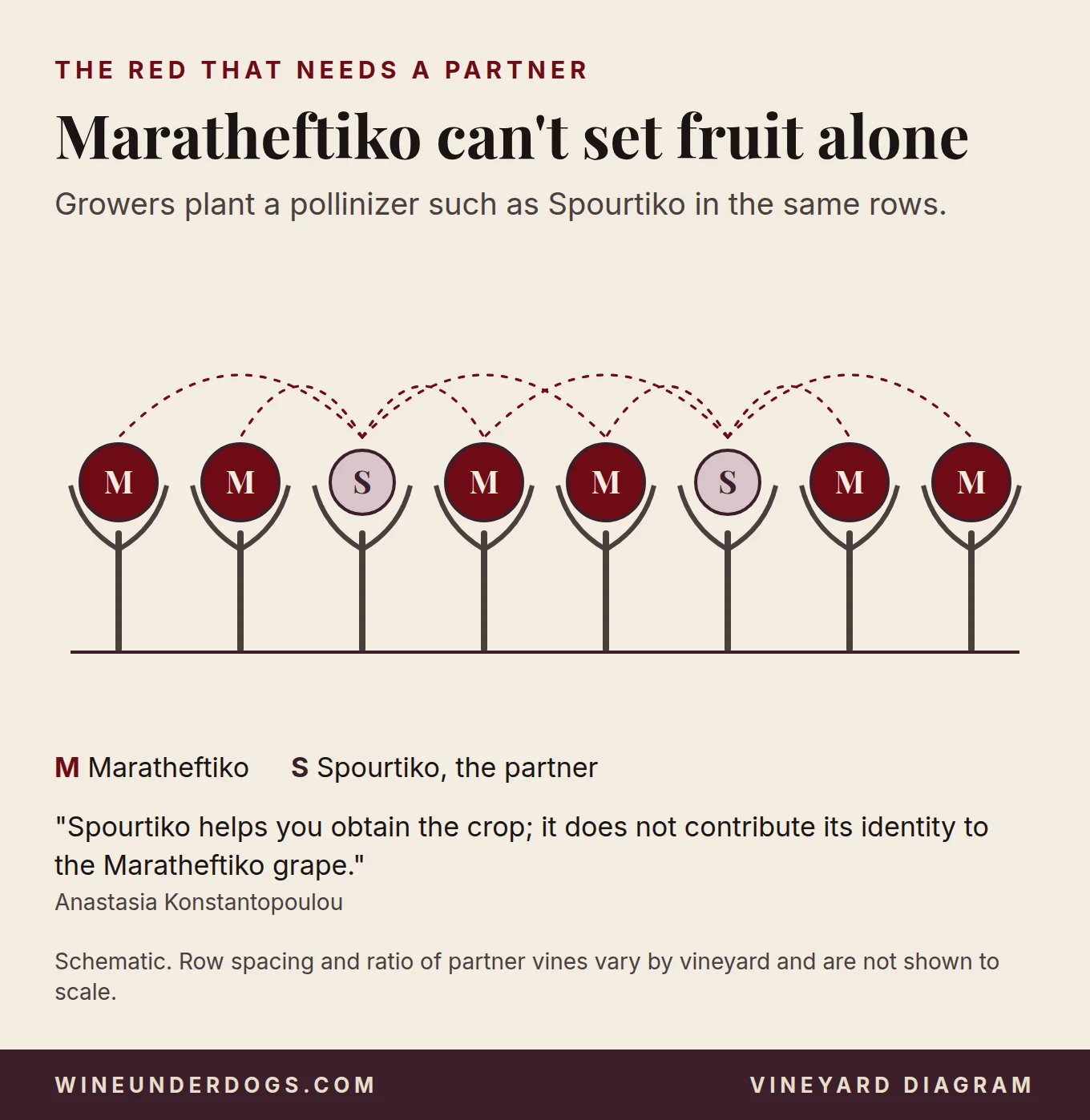
What the biology does cause is unevenness: bunches with berries of different sizes and different ripeness, which several sources describe as millerandage. Yields are low and hard to predict. In her words, "it is first a problem you have to manage, and then a trait you learn to work with."
What it tastes like, according to whom
- Jancis Robinson, on a 2015 Zambartas: rose petals, violets and freshly crushed blackberries, with fine tannins.
- Cyprus Mail: a violet bouquet, cherry flavors, firm tannins and fresh acidity.
- Konstantopoulou, for a first bottle: "more colour and structure, ripe red and dark fruit, herbal or spicy notes and noticeable tannins, but with enough acidity to keep the wine balanced."
Research on a high vineyard at Omodos, 944 meters up, found the color compounds in the grapes swing sharply from year to year, nearly four times higher in 2022 than in 2021 (Beverages, 2023). Vintage matters more than usual with this grape.
Built for a hotter climate
The same 2020 study that tested Xynisteri found Maratheftiko handled heat and drought better than Shiraz and Sauvignon Blanc grown beside it (OENO One). Konstantopoulou's caution applies here too: a drought-tolerant vine gives the winemaker time, and the winemaker still has to judge what that time did to the grapes.
How to drink it
Choose a bottle where the oak supports the grape rather than dominates it, and serve it with lamb, souvla or other grilled meat. Robinson gave the 2015 Zambartas a drinking window of 2018 to 2025, which suggests the better bottles will keep for several years.
What to eat with it
This is the island's special-occasion red, so cook accordingly. Lamb and pork, grilled or slow-roasted. Souvla. Afelia. Stifado, the tomato-and-cinnamon stew, is close to a perfect match, because the wine's structure was built for exactly this kind of rich, spiced meat. Hard aged cheese belongs here too. Give a young bottle air and a cool room, and it opens into something worth the trouble it took to grow.
Where to find a bottle
It is scarce in the United States. On 25 September 2026 wine.com had none, and Wine-Searcher's US listings showed a single visible listing, a case of six from Makarounas. If you see one on a shelf, take it.
Read more in Cyprus wine grapes, from a head oenologist and the page on its partner, Spourtiko.
New to wine? Start here

Wine Match
Five guilty pleasures, yes or no. Ben finds the wine you’d actually like. You don’t need to know anything about wine. Ben certainly doesn’t.
Wine Underdogs is for readers of legal drinking age.
BenFive things. Yes or no. I'll do the rest.
Every wine fact here comes from the grape guides on Wine Underdogs. Ben has never opened a bottle, and neither does this game. For readers 21 and over.
Frequently asked questions
Why does Maratheftiko need another grape planted with it?
Its flowers are functionally female: the grape register VIVC records the flower sex as female, so it cannot reliably pollinate itself. Growers plant a partner such as Spourtiko in the same vineyard to supply pollen.
What does Maratheftiko taste like?
Jancis Robinson described a Zambartas bottling as rose petals, violets and crushed blackberries with fine tannins. Head Oenologist Anastasia Konstantopoulou says to expect deep color, ripe red and dark fruit, spice and noticeable tannin with enough acidity to balance it.
Is Maratheftiko the same as Vamvakada?
Yes. Vamvakada, from the Greek word for cotton, is a synonym that refers to the white down on the underside of its leaves.
What food pairs with Maratheftiko?
Cyprus's heartier cooking: grilled and roasted lamb and pork, souvla and afelia, tomato-and-cinnamon stews like stifado, and hard aged cheese. Its structure suits rich, spiced meat, and a young bottle benefits from air and a cool room.
JOIN THE PACK
Whatever you drink now, there's an underdog you'd like more.
One overlooked wine at a time: what it tastes like, the famous one it can replace, and the catch. Free.