
 Chris BerryFounder, Wine Underdogs — chasing the world’s overlooked grapes
Sagrantino has spent decades being sold on its tannin. The man who runs the appellation now says that is the wrong headline.
In June I published a piece here called Sagrantino: Italy's Most Tannic Grape. It is accurate and it ranks, and I am no longer sure it is the most useful thing to tell you.
I put that to Paolo Bartoloni, president of the Consorzio Tutela Vini Montefalco, the body that has represented the appellation since 1981. His answer was direct.
"That is no longer the whole story. Sagrantino has changed its expression significantly over the past several years and today increasingly shows elegance and suppleness. Its tannic character is, of course, intrinsic and unmistakable, but after years of experimentation with different winemaking approaches, we are now able to bring out the softer, more refined side of Sagrantino that we had long been seeking."
— Paolo Bartoloni, President, Consorzio Tutela Vini Montefalco
Nobody in the wine trade says a grape has become less itself. So the follow-up mattered more than the claim: what actually changed?
Old vines and small crops did most of the work
Not a technique. Time.
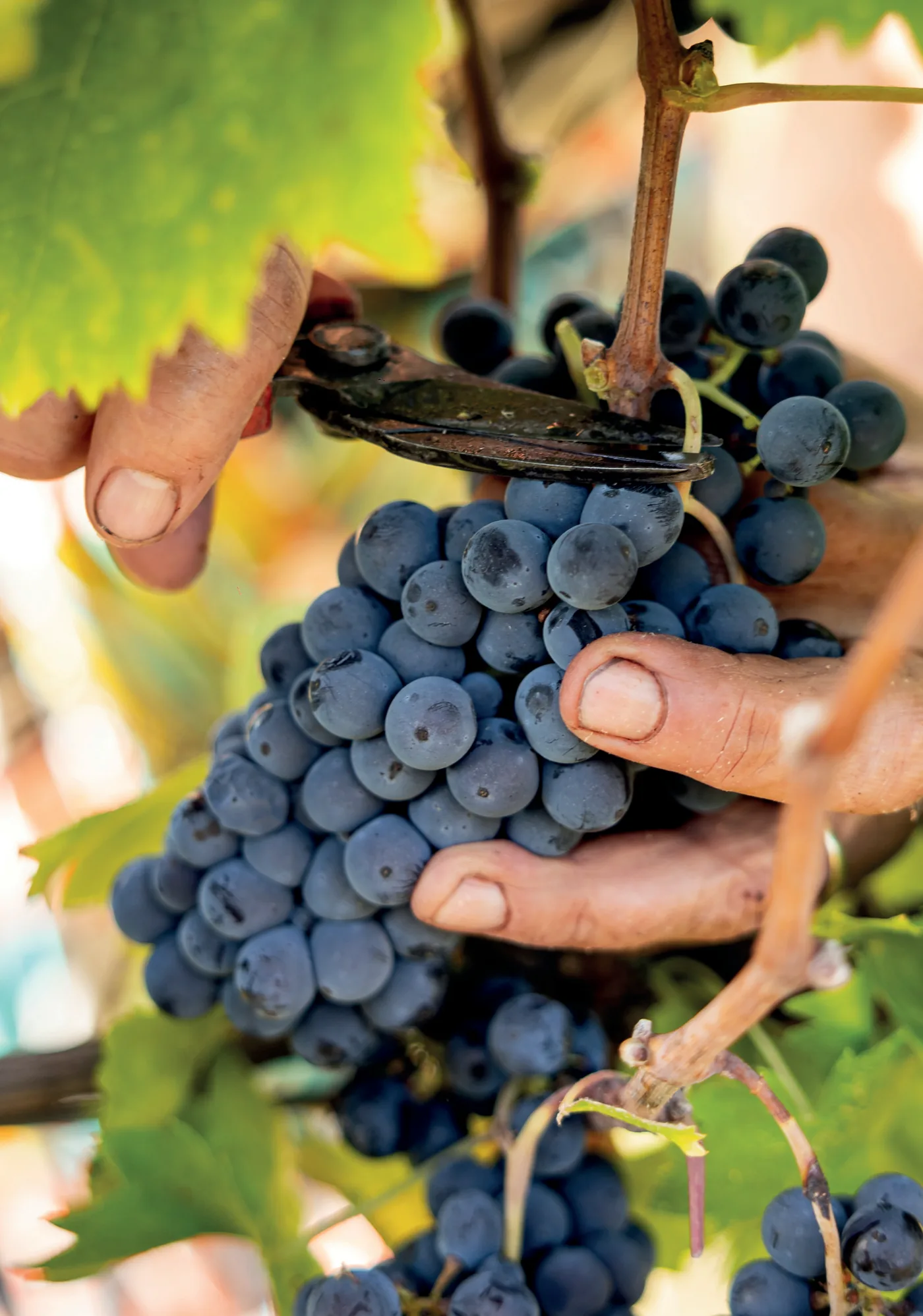
"We should also remember that today our vineyards have an average age of around 30 years. The vines are therefore at a very mature stage, while naturally producing lower yields — in recent years, around five tonnes per hectare on average. This gives us less fruit, but healthier grapes and tannins that are naturally sweeter and more mature."
Five tonnes a hectare is a small crop by any measure, and it is not a marketing decision. Vines planted in the appellation's expansion years have simply aged into it. The wines people are drinking now come off plants that were young when Sagrantino was still an obscurity outside Umbria.
The cellar work went in several directions at once, which is worth knowing if you are told there is one modern Sagrantino style. There is not.
"Some use longer macerations, others micro-oxygenation; many have extended ageing periods and changed their approach to oak, moving beyond barriques and making greater use of large casks. Some are experimenting with amphorae, others with concrete, while others choose to keep the wine longer in bottle before releasing it onto the market."
The chemistry, in plain language
Bartoloni's explanation of why riper fruit tastes softer is the clearest I have heard from anyone running an appellation, so here it is nearly whole.
Sagrantino ripens late, generally harvested around mid-October. That long hang gives high sugar, which is why the wines often land near 15% alcohol. It also pushes phenolic ripeness a long way.
"As the tannin-polysaccharide complexes become larger, they evolve into more stable and less soluble structures, reducing the sensation of astringency."
Bigger tannin molecules dissolve less readily, and a tannin that stays out of solution is a tannin your mouth does not feel. The grip is still measurable in the glass. You just stop being punished by it.
The variable he is watching is acidity, which collapses fast in extreme heat. His word for the autumn rains that have so far arrived in time to restore it was fortunately. That is a man describing a system holding, not one that has been solved.
Now the number that makes this an underdog story
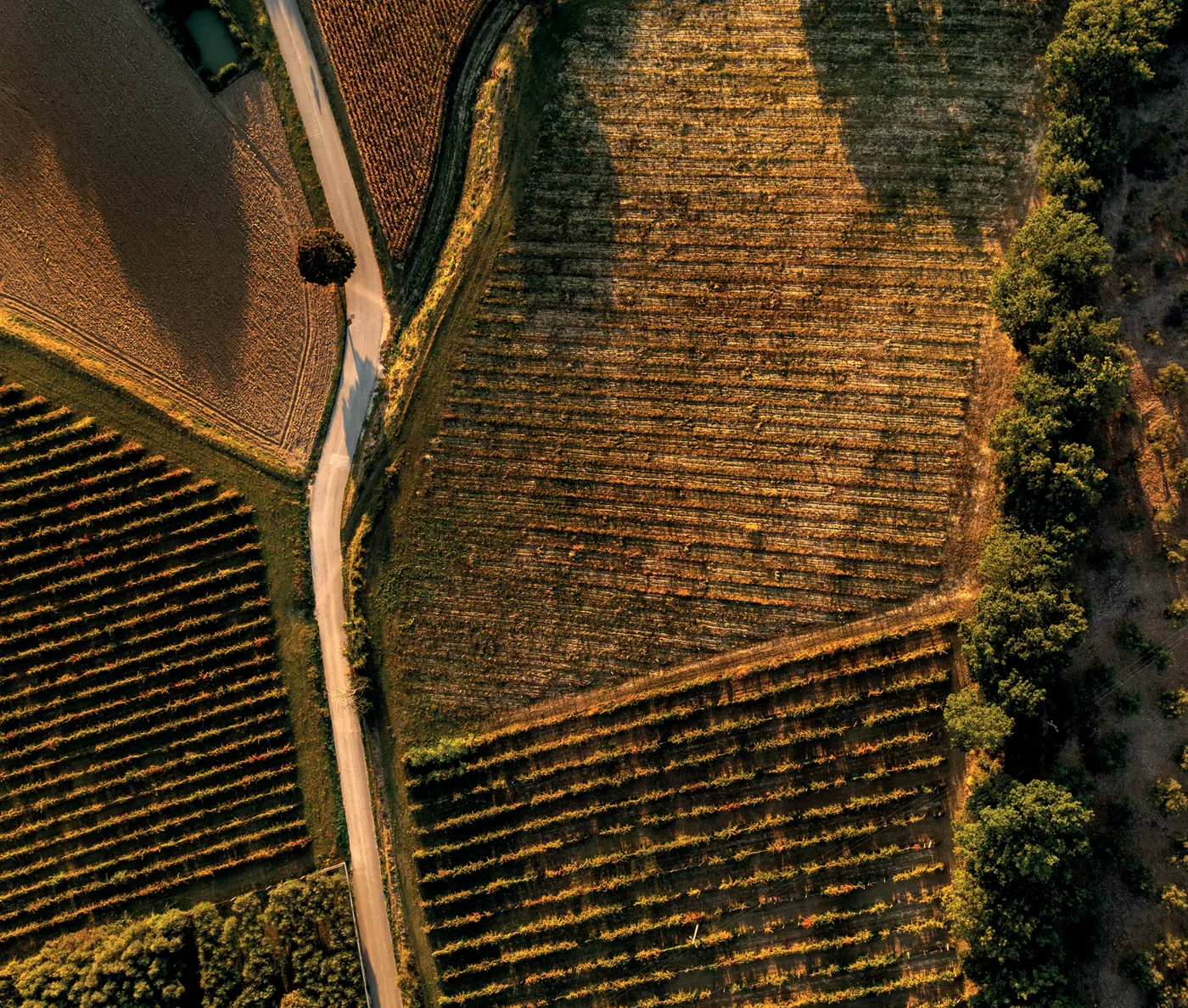
Montefalco Sagrantino DOCG is registered at around 380 hectares. All of it. For scale, that is a rounding error against Chianti Classico.
Exports run at about 12.5% of the Consorzio's production, and the United States takes about 27% of those exports. Multiply the two and roughly one bottle in thirty of everything Montefalco makes reaches America.
That is the entire reason this grape stays cheap relative to what it is. Scarcity usually raises a price. Scarcity plus obscurity lowers it, because there is no crowd bidding.
Bartoloni is unsentimental about the position:
"Montefalco is performing well, especially when compared with appellations such as Brunello, Barolo and Amarone... we see this stability as a positive result. In that sense, Montefalco can consider itself something of a fortunate island — albeit a small one in terms of production volumes."
Flat, in a year when red wine generally was not, is a good result. He says so without dressing it up, which is more than most trade bodies manage.
Where to start, according to the people who make it
I asked whether a newcomer should chase a particular producer's style or start with Montefalco Rosso. He would not name a producer, which I expected, but the rest of the answer was specific.
"Montefalco Rosso is certainly our main calling card... Montefalco Rosso was born to accompany the classic Mediterranean table, so I would pair it with traditional foods such as cured meats and cheeses, handmade pasta with meat sauces, or a grilled veal steak."
Montefalco Rosso is Sangiovese-led with up to 20% Sagrantino in the blend. It costs less, opens earlier, and carries enough of the appellation's signature to tell you whether you want the full version.
If you go straight to the Sagrantino, buy two.
"I would suggest buying more than one bottle: open one soon after purchase, then enjoy the others gradually after a few years of ageing... A Montefalco Sagrantino can comfortably reach a beautiful stage of maturity after around ten years."
Which years reach it first is a separate question, and the Consorzio answers it in public: it has rated every harvest since 1975. I have put the whole record in one place, with what I would do with each year, in the Montefalco Sagrantino vintage guide.
He would not name a producer. His own members' list does.
Trade bodies never pick favourites, and Bartoloni did not. But the Consorzio publishes its roster of member wineries (65 of them), which is the same answer arrived at from the other direction.
The name most likely to reach an American shelf is Arnaldo Caprai. Caprai bought the estate in 1971, when Sagrantino had come close to disappearing altogether after the war. His son Marco joined in 1986 and ran the clonal research with the University of Milan that worked out which selections could make a serious dry red rather than the sweet passito the grape had always been. If Sagrantino is drinkable today as a dry wine at all, that work is a large part of why.
Arnaldo Caprai died on 4 January 2026, aged 92. The softening Bartoloni describes is, in a real sense, the second act of something Caprai started.
The other name worth knowing for a different reason is Tenute Lunelli – Carapace, whose cellar is housed inside a copper sculpture by Arnaldo Pomodoro that you can walk into. Twenty years old now, and still the strangest building in Umbrian wine.
Beyond those two, these are all Consorzio members and all worth a search at a shop that imports Italy seriously:
Antonelli · Paolo Bea · Còlpetrone · Scacciadiavoli · Tabarrini · Adanti · Perticaia · Milziade Antano
I am naming them because they appear on the Consorzio's own roster and are the ones most likely to have an American importer, not because I have tasted them against each other. That is a different article, and it requires bottles.
The body behind the roster is worth knowing on its own terms. I have written it up in a profile of the Consorzio Tutela Vini Montefalco, which also exists in Italian.
Where to actually buy it
Bartoloni's advice was Montefalco Rosso first. Here is that advice with a price on it, checked 31 August 2026.
Arnaldo Caprai Montefalco Rosso 2021, $22.97. The entry point, from the estate that saved the grape. Sangiovese-led with Sagrantino in the blend, which is exactly the introduction he described.
Lunelli Ziggurat Montefalco Rosso 2022, $31.99. The Carapace estate's Rosso, if you would rather start with the house in the sculpture.
Then, when you want the full-strength version:
Còlpetrone Memoira Sagrantino di Montefalco 2017, $27.97. The cheapest way into the DOCG on an American shelf. It is a three-star vintage, which is part of why it costs this, so drink it rather than keep it.
Arnaldo Caprai Montefalco Sagrantino Collepiano 2020, $53.99. The 2020 is the highest-rated Sagrantino vintage the Consorzio has ever published. Buy two, per the man's own advice.
Milziade Antano Montefalco Sagrantino 2021, $53.99. Another Consorzio member, from the 94-point 2021.
Disclosure: some links here are affiliate links — if you buy through them I may earn a small commission, at no extra cost to you. Learn more You must be 21+ to buy alcohol in the United States.Wine.com is the seller: they take the payment, ship the bottle and handle returns, and what's available depends on the state you pick at checkout. I never see your order.
The one nobody imports
Before the dry red existed, Sagrantino was a passito. The bunches dry on racks for at least two months, then ferment on their skins, and the wine comes out sweet but finishes oddly dry, because even raisined Sagrantino cannot stop being tannic.
It is now 3.4% of the DOCG's production. An underdog inside an underdog, and the version the friars would recognise.
What I have tasted, and what I have not
I have not tasted the new-style Sagrantino. I have now tasted its nearest relative.
Donnachiara Campania Aglianico 2022, which is about as close to Sagrantino as a Florida shelf gets on a weeknight. Plum, high in minerals, medium-bodied, tannins a shade past medium, a long finish. Southern Italian, high-acid, dark-fruited, built on the same frame. An entry-tier bottle, not the grape at full weight.
That is the family Bartoloni is describing when he says the tannin is intrinsic and the fruit has finally caught up with it. Having met the shape of it in one grape, at the friendly end, I have some idea what he means. I still cannot tell you whether he is right about Sagrantino, because the wine that would settle it has not been in my mouth.
Everything above is Bartoloni's account and the Consorzio's technical data, and I have not sat down with a range of recent bottles to test whether the softening he describes shows up in the glass the way he says it does. When I do, you will read whether I agreed with him. Until then, treat the claim as sourced rather than confirmed, and note that it comes from a man whose job includes selling the region.
What I can say is that his explanation is falsifiable, which is rare in wine marketing. Older vines, lower yields, later picking, larger tannin polymers. Those are checkable, and none of them are adjectives.
The falcons
One story, because it explains the name on the label.
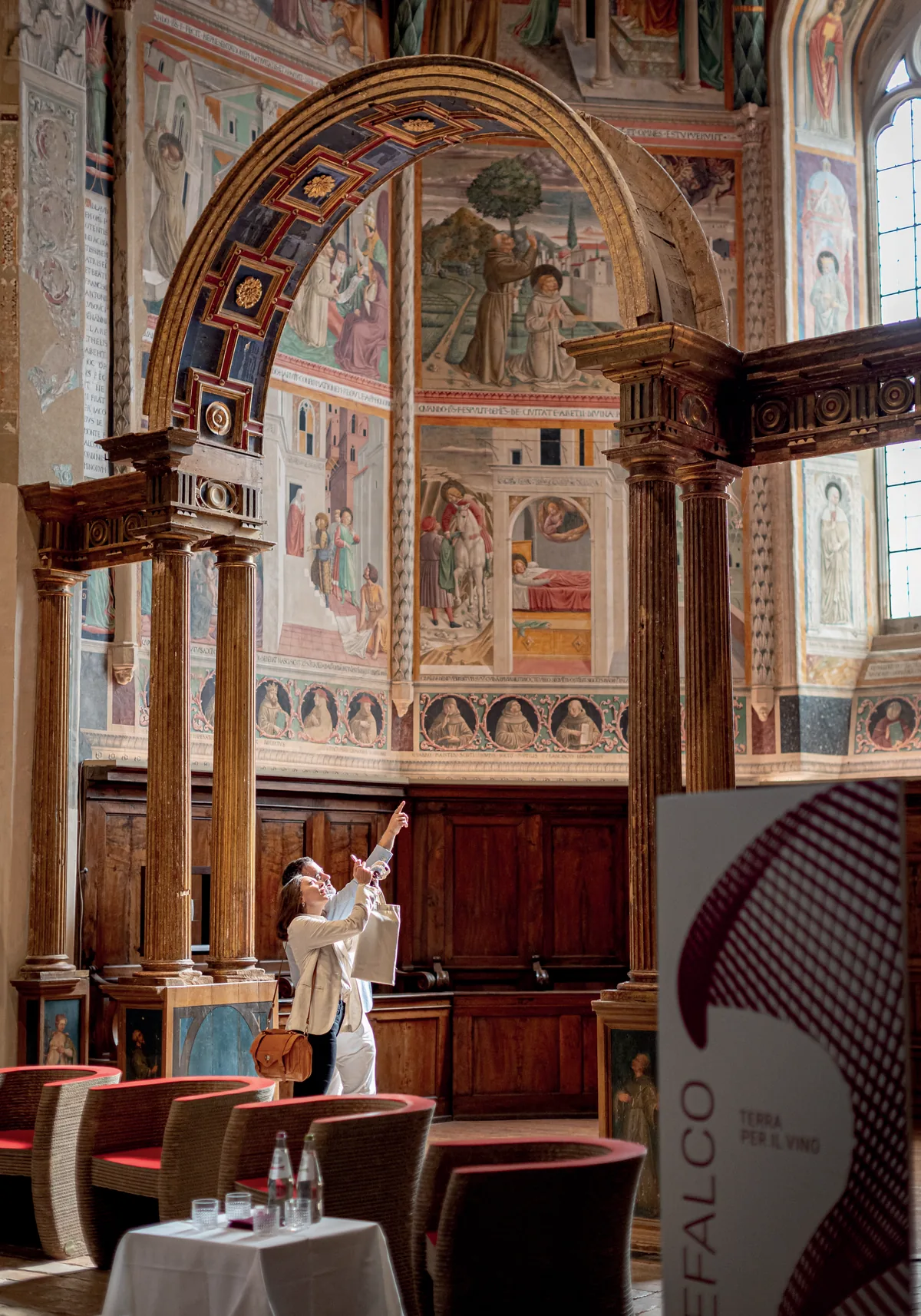
In February 1240, in an Umbrian castle called Coccorone, the sacred falcons kept by Emperor Federico fell sick. Theodore of Antioch prescribed an infusion of sugar, alcohol and violet petals. The birds recovered, the wine used to make it became Sagrantino, from falco sagro — sacred falcon — and the town renamed itself Montefalco, the falcon's mountain. Benozzo Gozzoli was commissioned in 1451 and painted a bottle of red into the frescoes of its church of San Francesco the following year.
A grape named after a bird's medicine, in a town named after the bird. You can see why it survived.
If you already drink the famous version
Sagrantino sits in the same structural family as Barolo's Nebbiolo and southern Italy's Aglianico: high acid, firm tannin, built to wait. If that architecture is what you are after and you would rather not pay Piedmont prices, this is the address.
And Sagrantino is on the Underdog 101 ballot. The vote decides which guides get deepened first, so if you want more of this one, say so.
Frequently asked questions
Is Sagrantino still the most tannic grape in the world?
By polyphenol content it remains at the top. But Paolo Bartoloni, president of the Consorzio Tutela Vini Montefalco, says the label is no longer the whole story: after years of experimentation the grape 'increasingly shows elegance and suppleness.' The tannin is intrinsic and is not going anywhere. What has changed is how ripe and how round it arrives.
How long should you age Montefalco Sagrantino?
Bartoloni's advice is to buy more than one bottle: open one soon after purchase and drink the rest gradually over the following years, so you taste the evolution yourself. He says a Montefalco Sagrantino can comfortably reach a beautiful stage of maturity after around ten years, depending on the vintage.
What is the difference between Montefalco Rosso and Montefalco Sagrantino?
Montefalco Sagrantino DOCG is 100% Sagrantino. Montefalco Rosso DOC is a Sangiovese-based blend that may include up to 20% Sagrantino. Rosso is the friendlier, earlier-drinking wine, and it is the one the Consorzio itself recommends as the entry point to the area.
How do you pronounce Sagrantino?
Sah-grahn-TEE-noh. The town is Montefalco, mon-teh-FAL-koh, meaning falcon's mountain.
Why is Montefalco wine hard to find in America?
Because there is very little of it and most of it stays in Italy. Exports account for about 12.5% of the Consorzio's production and the United States takes about 27% of those exports, which works out to roughly one bottle in thirty crossing the Atlantic. Montefalco Sagrantino DOCG is registered at around 380 hectares in total.
FREE DOWNLOAD
Get the Underdog Starter List
10 lesser-known bottles under $25 worth chasing — plus the weekly underdog read. No snobbery, just good wine.