
 Chris BerryFounder, Wine Underdogs — chasing the world’s overlooked grapes
Open their PDO Monemvasia-Malvasia first: grapes dried in the sun before pressing, two years in old oak, and a wine that hadn't been made in its own town for five hundred years until this family brought it back.
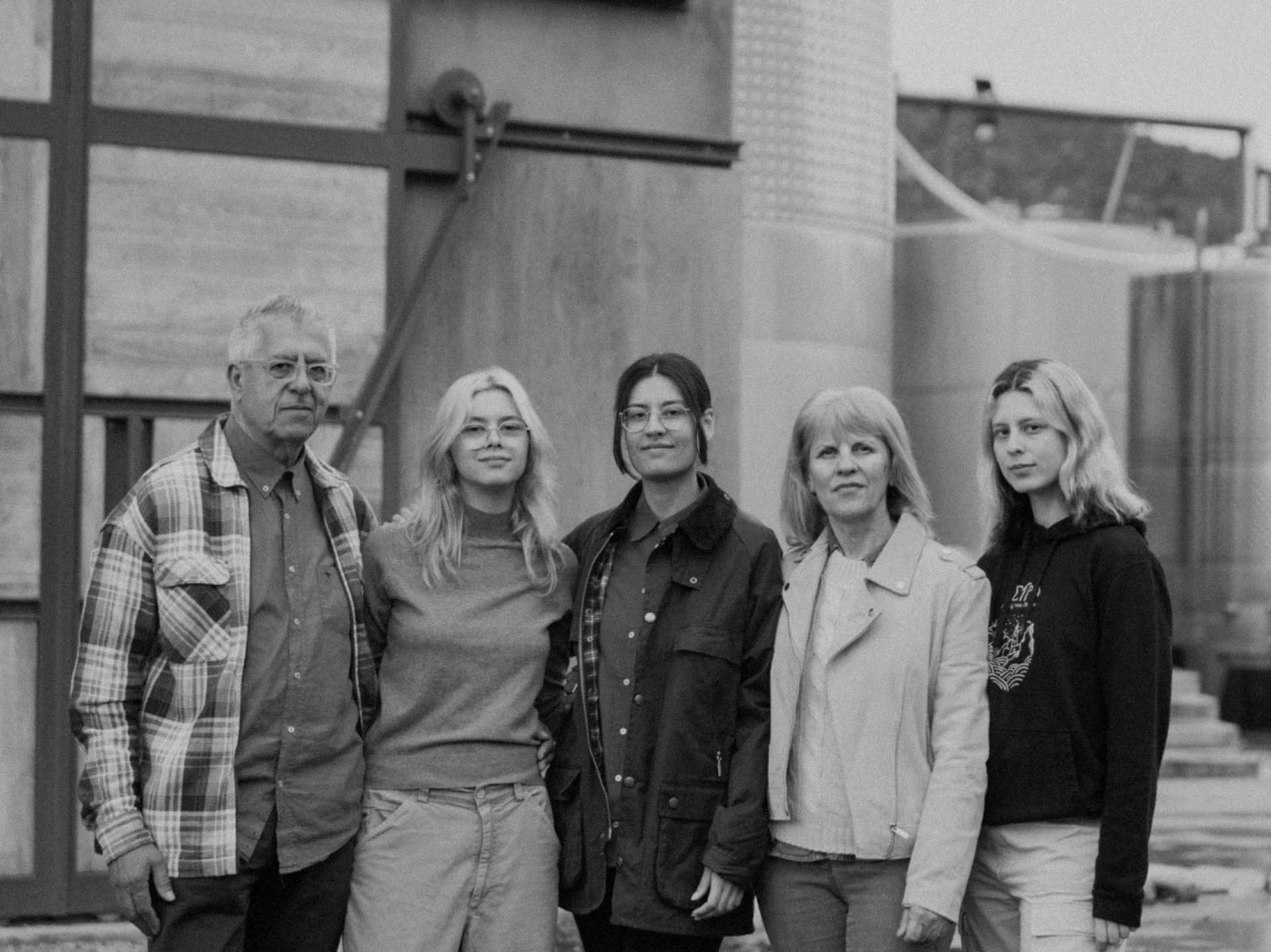
My friend Demetra Kyriakoulis remembers this winery fondly, which is how I came to write to it. Yorgos and Elli Tsimpidi answered my questions through their daughter Marialena, between the end of this year's harvest and her return to the office.
Where Malvasia got its name
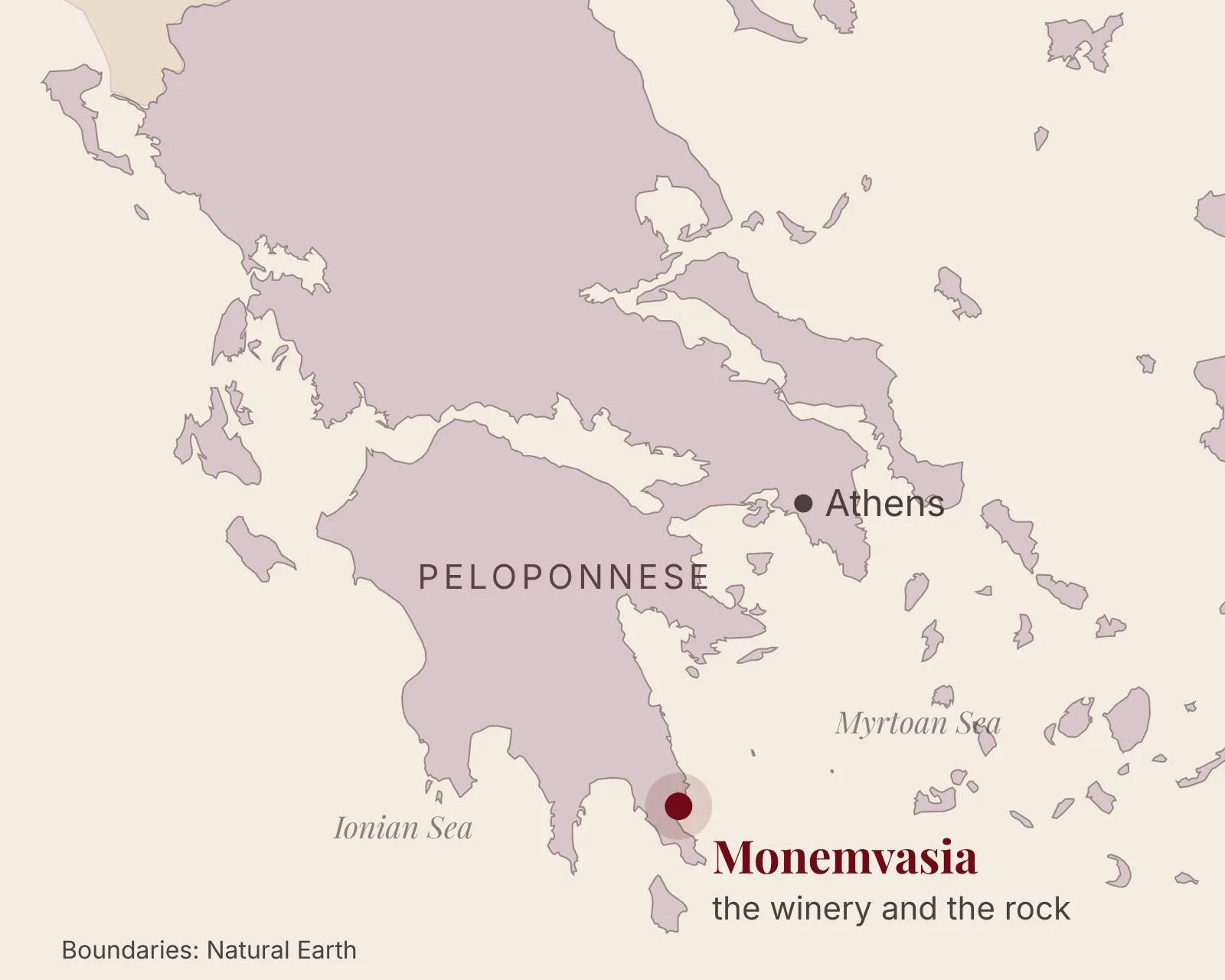
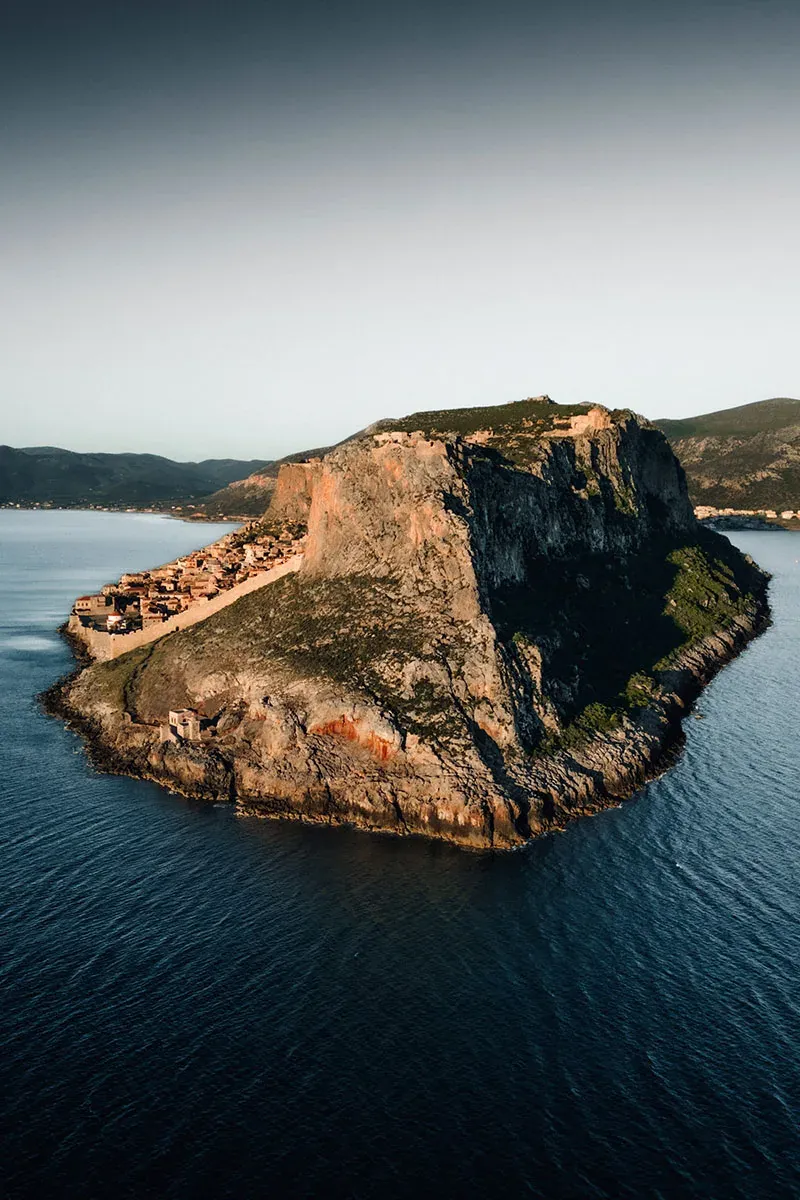
Monemvasia is a fortified rock off the southeast coast of the Peloponnese, joined to the mainland by a causeway. In the Middle Ages its port supplied ships running between East and West, and the sweet wine shipped from it took the port's name. As the winery tells it, Frankish traders called the local sun-dried wine Malvasia, after the castle town. In English it became malmsey.
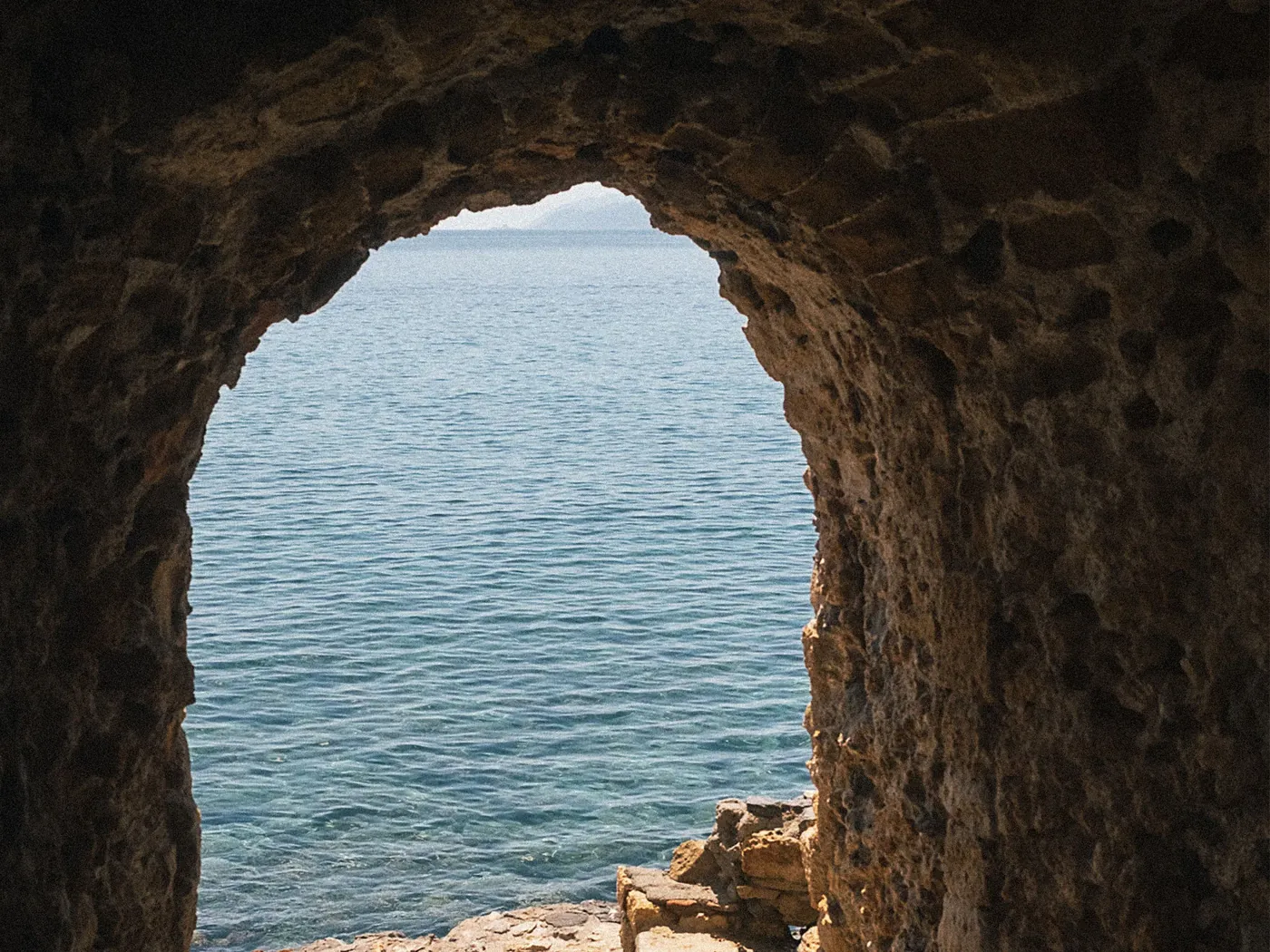
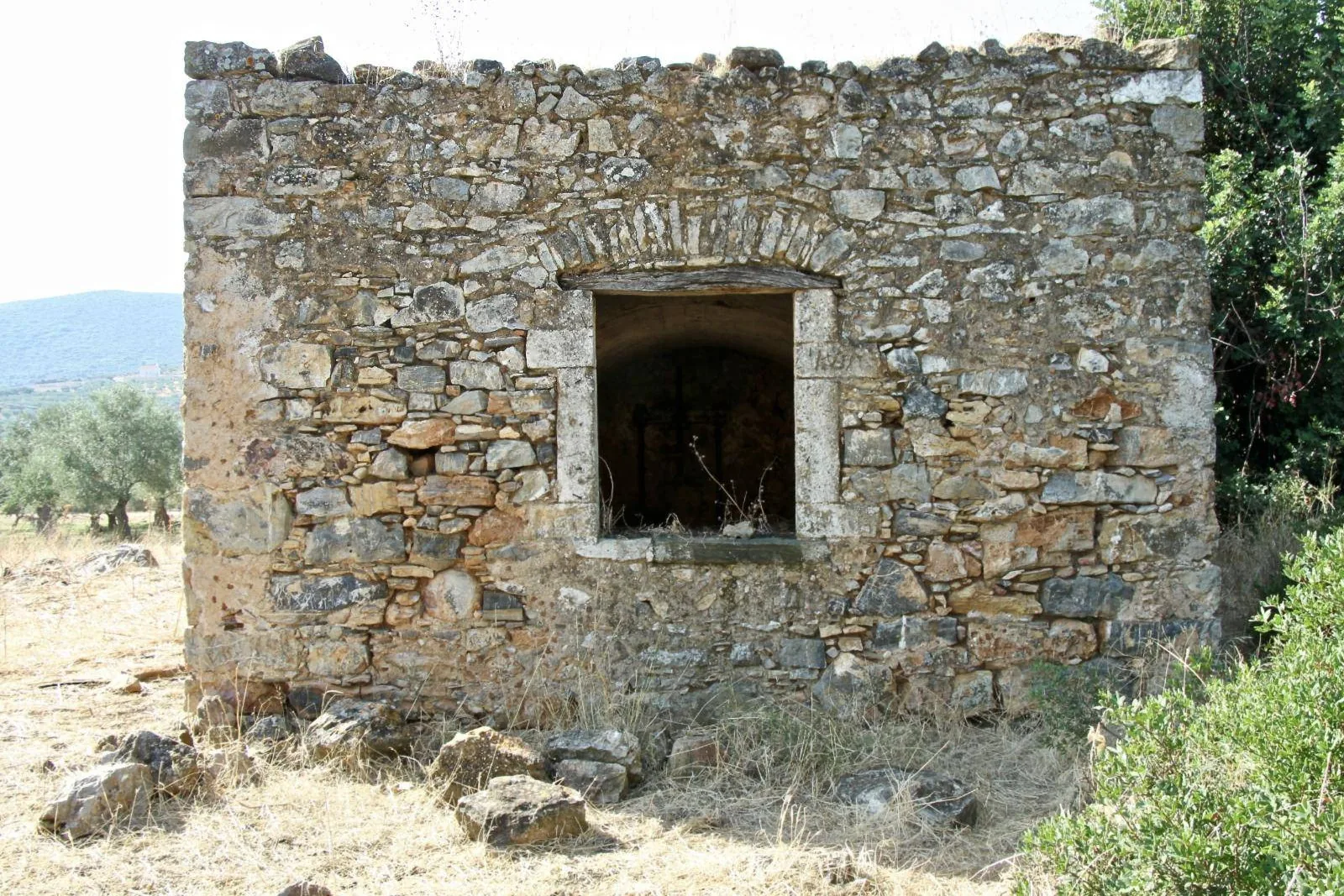
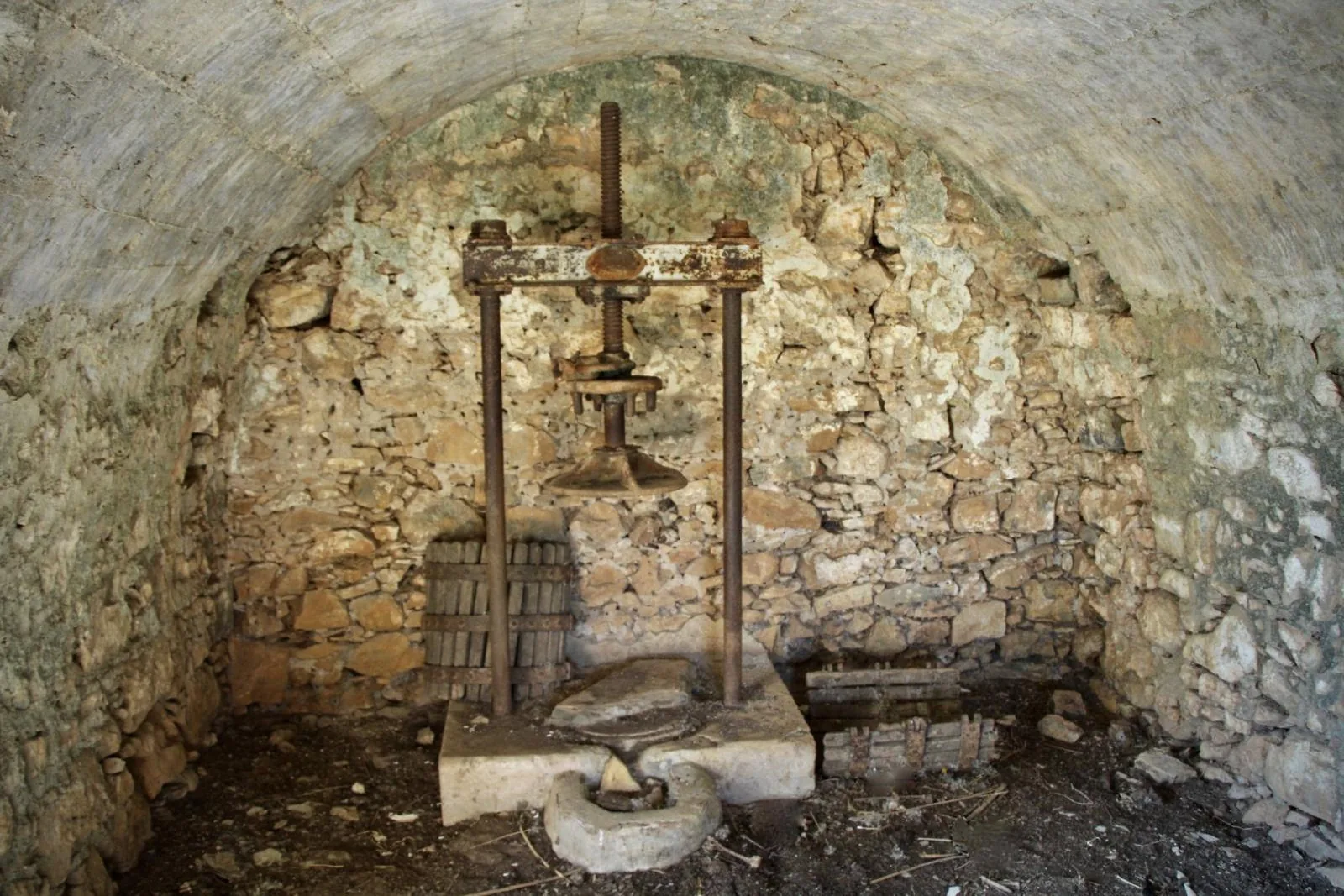
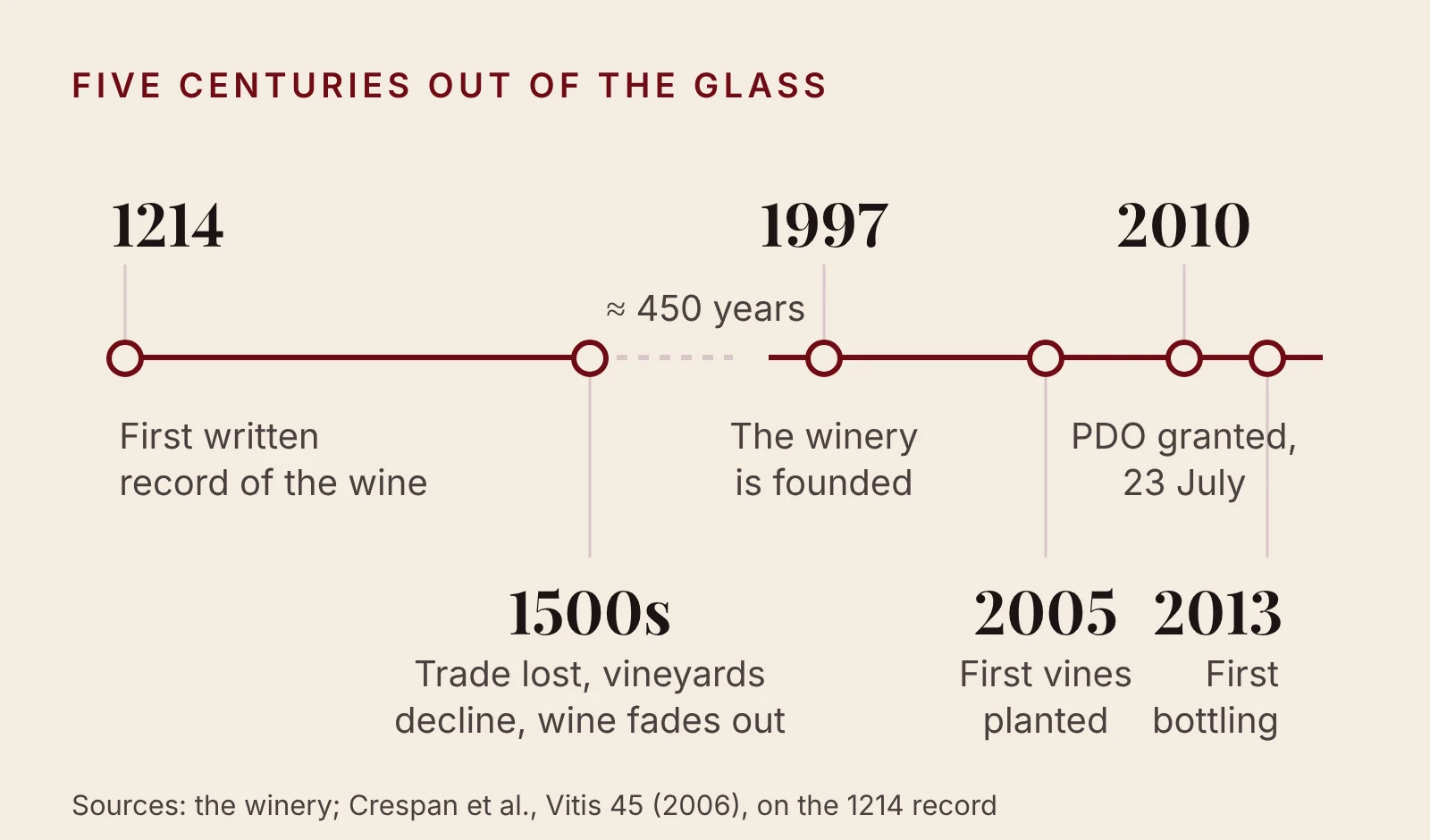
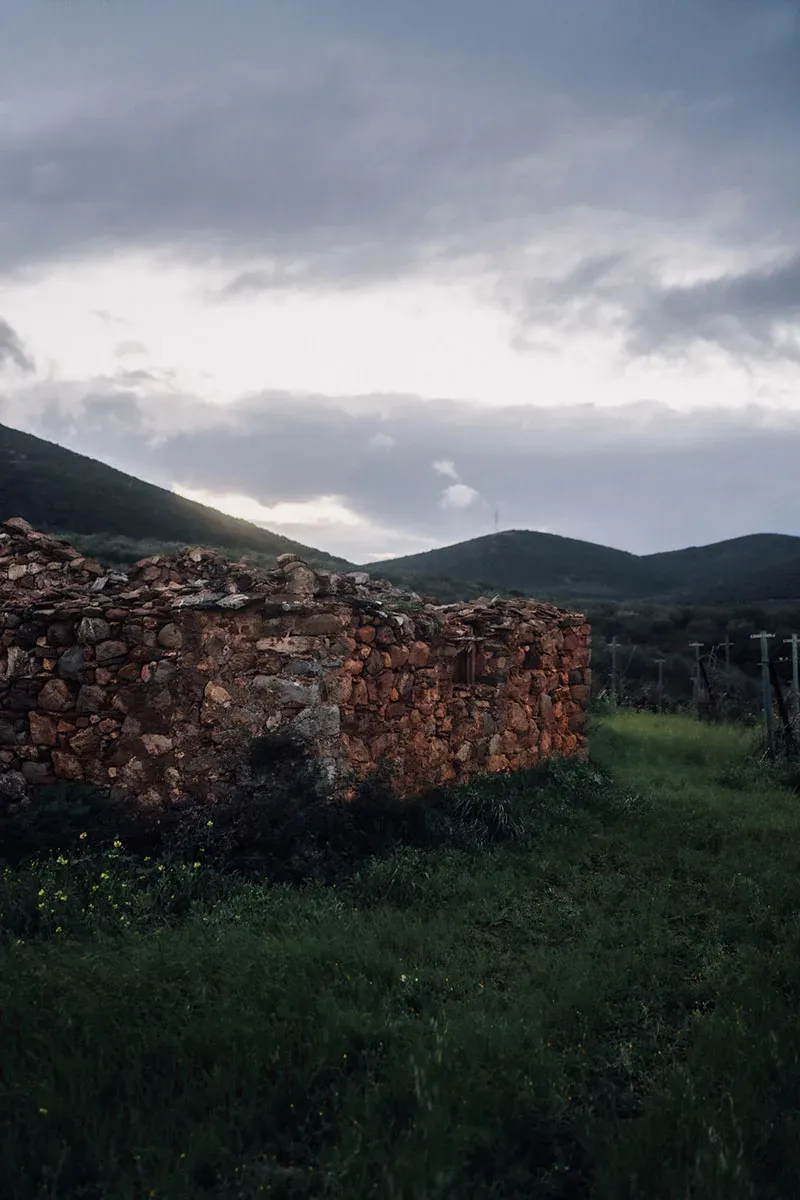
The oldest written record of the wine dates to 1214. By the winery's account, the end came slowly. After the Byzantine Empire fell, Monemvasia lost its place in the wine trade, war destroyed part of the vineyards, and the vines that remained went into a long decline. Stone wine presses still sit in the fields.
Faith first, then proof
I asked what made them believe, in 1997, that the wine could come back.
"In the beginning, it was above all a matter of faith in this historical legacy, love for our region, and a sense of duty to reclaim this part of our heritage and local tradition. Later, our experimental winemaking confirmed that the wines had real promise in terms of quality and character."
— Yorgos and Elli Tsimpidi, by email, 31 October 2026
Faith took a long time to become paperwork. They spent their first years documenting local varieties, planted their first vines in 2005, and after twelve years of effort the wine became a Protected Designation of Origin on 23 July 2010, the anniversary of Monemvasia's liberation from the Ottomans. The first bottle reached the market in 2013.
The name traveled. The vine may not have.
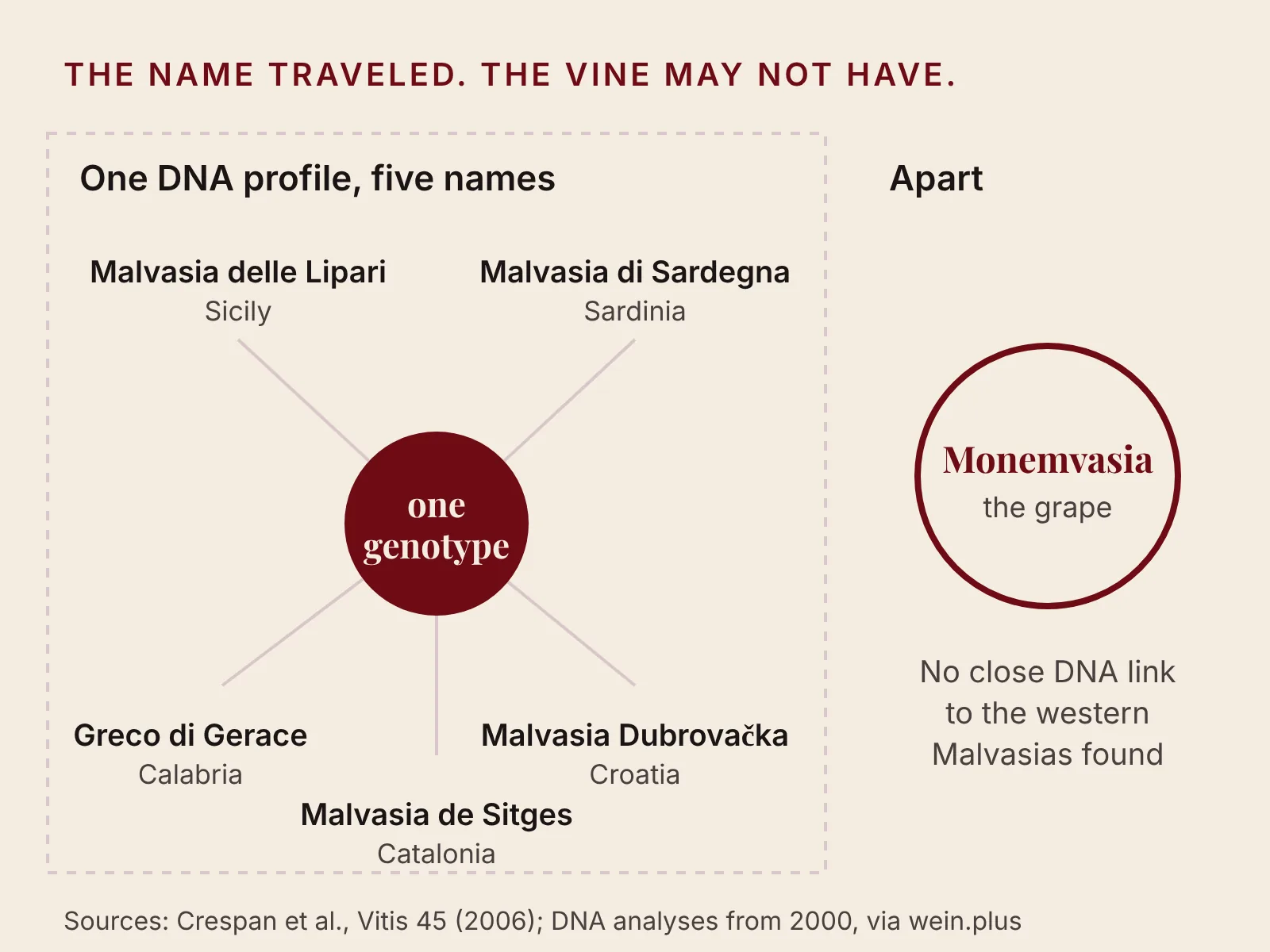
Here is the reason this winery belongs on this site. "Malvasia" now labels dozens of grapes from Croatia to the Canary Islands, and science has spent twenty-five years sorting out which of them are related.
In 2006 a team of Italian, Spanish and Croatian researchers showed that five grapes long thought distinct share one DNA profile across fifteen markers: Malvasia delle Lipari, Malvasia di Sardegna, Greco di Gerace, Malvasia de Sitges and Malvasia Dubrovačka. One vine, carried along the old trade routes, picked up a new name at every port (Crespan et al., Vitis, 2006).
The Monemvasia grape is not in that family. DNA work since 2000 has found no close relationship between it and the Malvasias of the west. The name left with the wine. Whether the original vine went with it is still open, and nobody in this story should pretend otherwise. What the PDO protects is a place and a method, sun-dried grapes from this peninsula, which is the older and truer meaning of the word.
The research they say is missing, and some they did
I asked what is hardest about working only with Greek varieties.
"One of the hardest parts is that sometimes you do not fully know a grape variety's true character before investing in planting a vineyard. There is still insufficient research on the multitude of indigenous Greek varieties, which means that you have to discover a great deal through your own experience."
They have also been filling the gap themselves. Yorgos Tsimpidis (credited as G. Tsimbidis) is a co-author of a 2023 study in the journal Sustainability that took apart the Asproudi in their own vineyard (Merkouropoulos et al., 2023). Asproudi simply means "little white one," and the researchers found it isn't one variety at all but a population of different genotypes, some of which matched nothing in the national reference collection. Each made a measurably different wine. In a field of white grapes everyone called by one name, there were several grapes, and some of them still have no name.
The second half of their answer is the problem every winery on this site shares:
"When you want to introduce a lesser-known variety to a wider audience, the challenge is twofold: you often need to establish your own vineyards while also convincing consumers to give the wine a chance."
Kydonitsa, and the quieter grape
Kydonitsa takes its name from kydoni, the Greek for quince, and the winery calls it the flagship of Laconian terroir. It was the grape that first surprised them, with "vibrant aromas and refreshing acidity" in a climate that ought to flatten both. Lately their attention has moved to the Monemvasia grape itself, which they describe as having a "quieter charm." It has gone into sweet wine for centuries. Made dry, they say, it turns "rich and persistent." A dry white from that grape is the bottle I most want to try from this cellar.
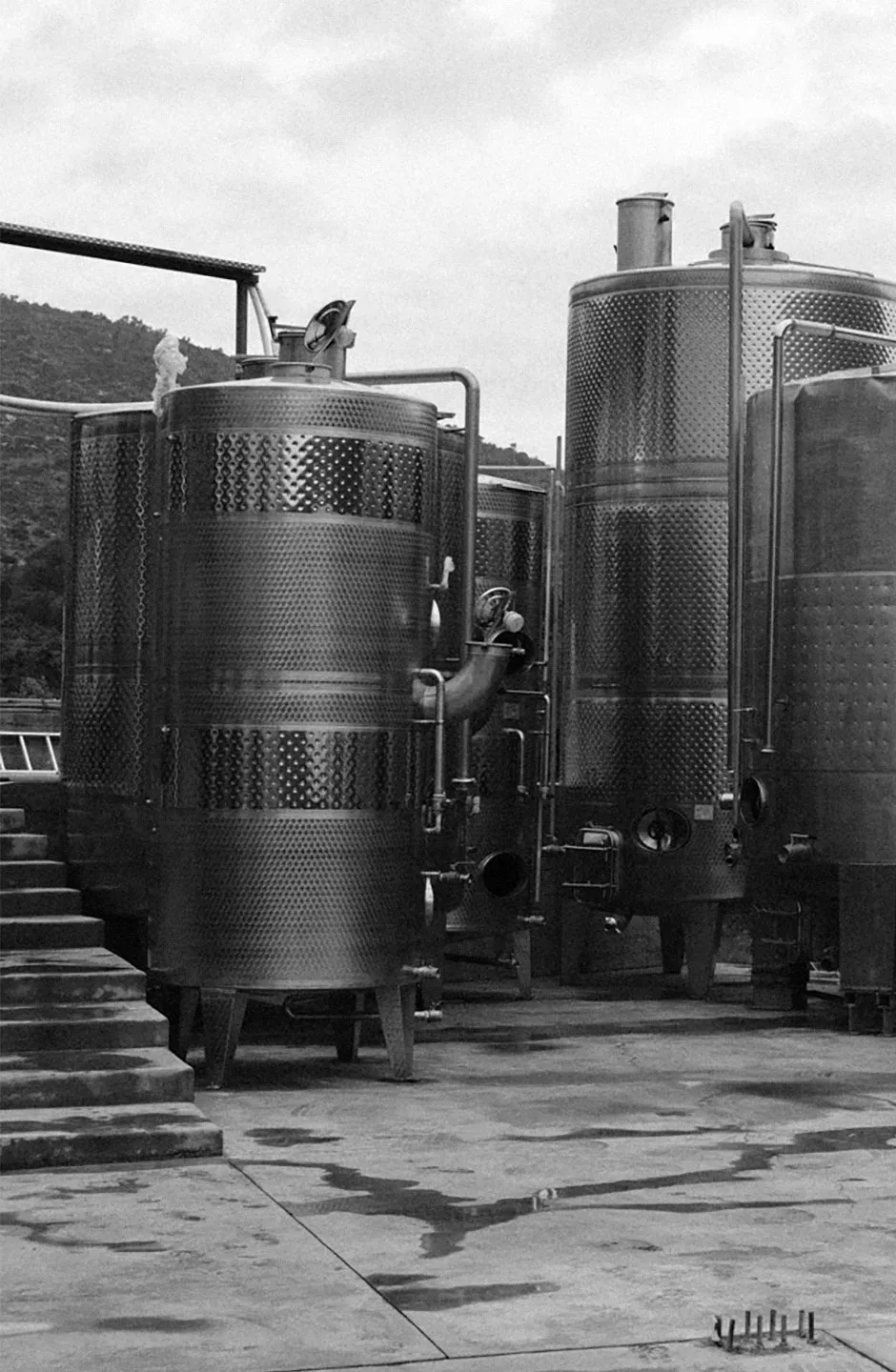
They farm 30 hectares organically in the villages of Velies and Agios Dimitrios, about 10 kilometers from the sea at 250 to 300 meters. The soils are mostly schist and clay-loam. The dry season runs from late March to early October, and the northeast meltemi winds are what get the vines through August. Yields stay low, close to 3,500 kilos a hectare in some parcels, and the work is done by hand.
The bottle to open first
"Made from sun-dried grapes and aged in oak barrels, it combines the richness of dried fruit and caramel with a refreshing acidity. We would simply pair it with sun-dried figs, or enjoy it on its own at the end of a meal with our friends and family close by."
— Yorgos and Elli Tsimpidi, on their PDO Monemvasia-Malvasia
The family gives the blend as 60% Monemvasia, 20% Kydonitsa, 10% Assyrtiko and 10% Asproudi. Their US importer's technical sheet fills in the 2012: about 184 grams of sugar per liter held up by 7.2 grams of acidity, and two years in used French barriques.
Where to find them
In the US, the family names five importers: Salveto Imports, Skurnik Wines, Hogshead Wine Company, WineWise, and Fotis and Sons in Chicago and California. Their oldest American customer is the Greek Islands restaurant in Chicago. I couldn't find a bottle in stock online on 1 November 2026, so the honest route is a shop. Show this to one, or paste it into an email:
"Could you order the Monemvasia Winery PDO Monemvasia-Malvasia, from Laconia in Greece? Skurnik Wines lists it, including a 375 ml half bottle."
In Greece, the winery runs tastings by booking, from a four-wine tour to a six-wine Terroir tasting, through its own site. They've also invited me for a tasting, which I hope to take up and write about.
If you want the rest of the country first, start with Greece, the underdog wine country, then Assyrtiko and Agiorgitiko, two grapes this cellar also grows.