
 Chris BerryFounder, Wine Underdogs — chasing the world’s overlooked grapes
If you learn two Armenian grapes, make them Areni Noir and Voskehat. Armenia grows hundreds of varieties, and those two are the ones its winemakers are putting in front of the world: one red, one white, both pronounceable, both impossible to confuse with anything else on the shelf.
That isn't my reading. It's the reading of Sharon Nagel, a judge at the Concours Mondial de Bruxelles for more than ten years, who tasted through Armenia's wines at the competition and answered my questions about what she found.
Why two grapes, and not two hundred
The numbers she brought back explain the strategy. "Experts I met told me that Armenia has nearly 200 documented grape varieties out of a total of around 450 varieties," she wrote. "Of those, around 50 are commonly grown across the country (all uses), but many have quite obscure names and are relatively marginal."
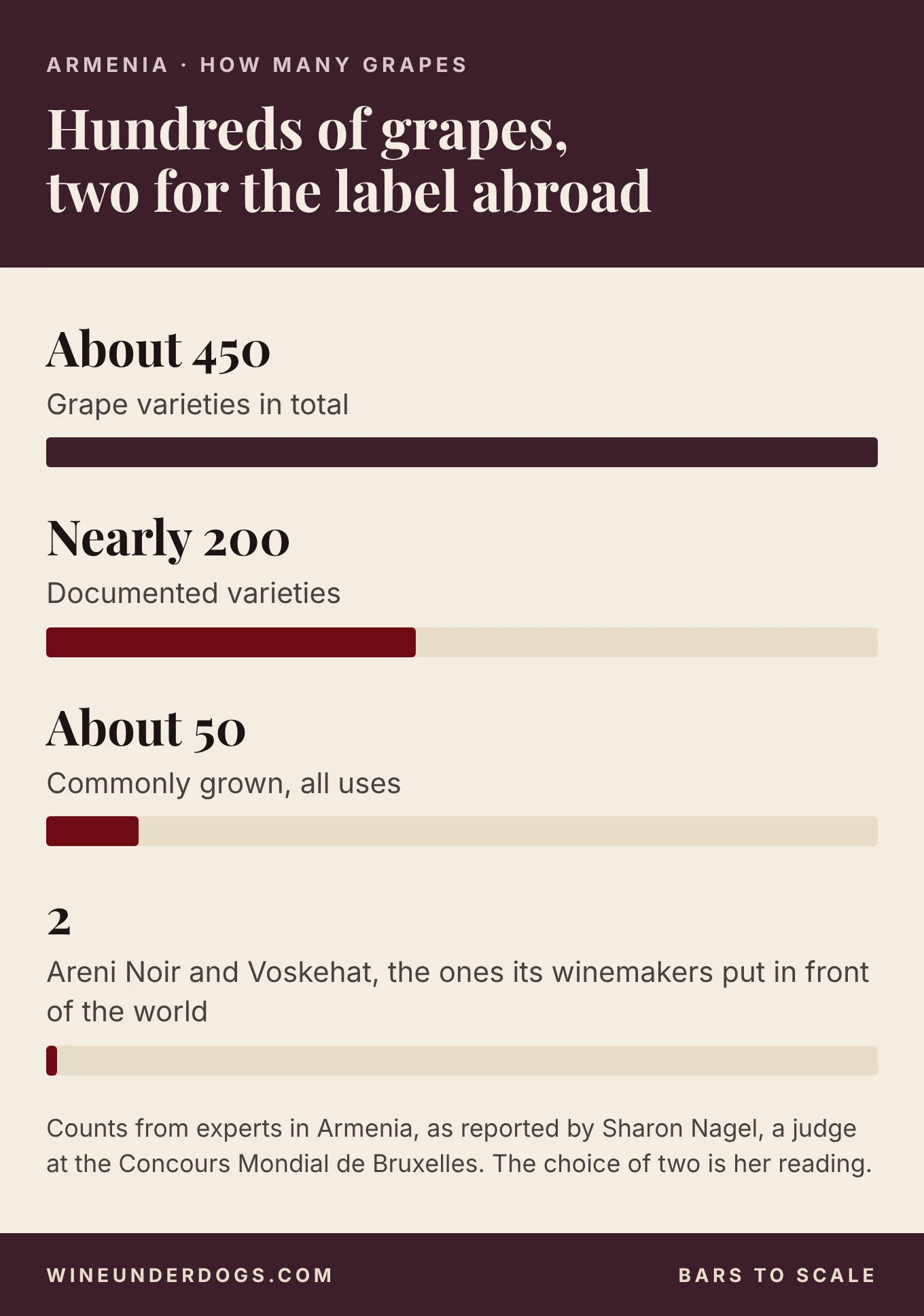
A wine country with that many grapes has a choice to make about which ones to put on a label abroad. Nagel's view is that Armenia has made it. "Many producer countries around the world, particularly ones that are (re-)emerging on the international stage, tend to focus on emblematic varieties, and it seems to me that these are the two grapes that could become immediately recognisable to consumers – albeit informed consumers."
She was blunt about the alternative. Armenia grows international grapes too, and she doesn't think they'll help it:
"In my opinion, these would get lost in the global ocean of Chardonnays, Sauvignons, Cabernets and Pinots."
She has a point. A Chardonnay, wherever it's grown, is about as easy to pick out as a gray rental car in an airport lot at midnight.
Areni Noir, the red with the history
Areni carries the weight because of where it comes from. The grape takes its name from the village near the Areni-1 cave, where archaeologists found a press, a fermentation vat and storage jars dated to about 4100 BC: the oldest known winery. That's a narrower title than "oldest wine," and an honest one. Georgia's Neolithic sherds carry older chemical traces of grape wine, and Iran's Hajji Firuz Tepe has the longest-standing earlier claim. Armenia holds the winery. I covered the cave in an earlier piece on Armenia.
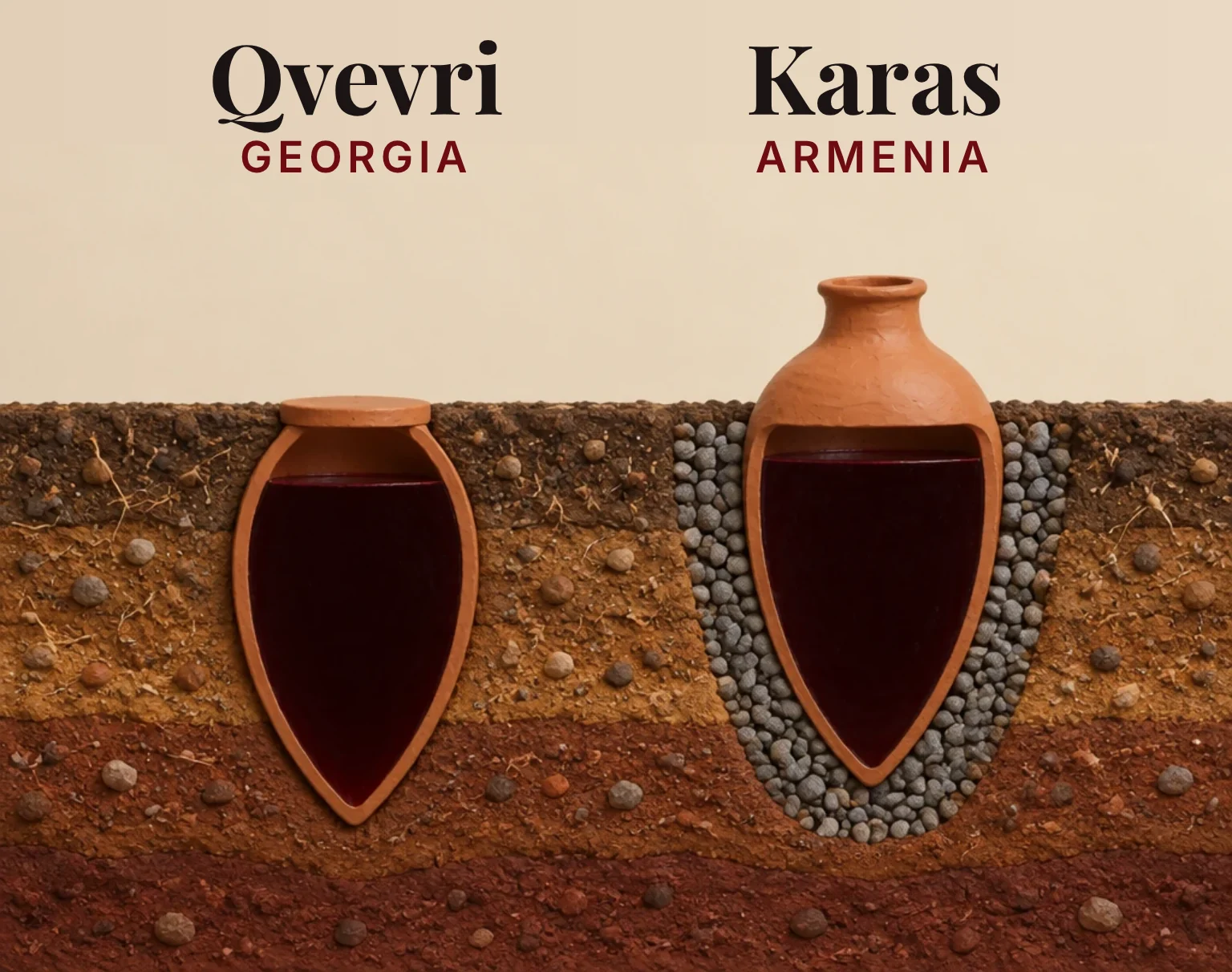
In the glass, Wine Folly describes Areni as light in color, with fresh acidity, soft tannins and sour cherry, herb and spice, sometimes like a cross between Pinot Noir and Sangiovese. It grows high. The Vayots Dzor estate Zorah farms it at about 1,400 meters (4,500 feet), on vines growing on their own roots, and ages it in karases, clay vessels buried three-quarters deep.
If that sounds like Georgia's qvevri, it's a close cousin, but the two aren't the same thing. Both are egg-shaped clay jars that ferment and age wine in the ground. A qvevri goes in almost to its neck and is often lined inside with beeswax. Its makers thinned to a handful, but enough of them survived for UNESCO to list the Georgian method in 2013, and Georgia now trains new ones. The karas wasn't so lucky. By the middle of the last century Armenia had all but stopped making them, so Zorah went looking for old ones in village cellars, and sometimes had to take down a basement wall to get a jar out. Same family, different history, and each one keeps its own name.
Voskehat, the white nobody agrees about
Voskehat is the less familiar of the two, and the more interesting, because the sources can't agree on it.
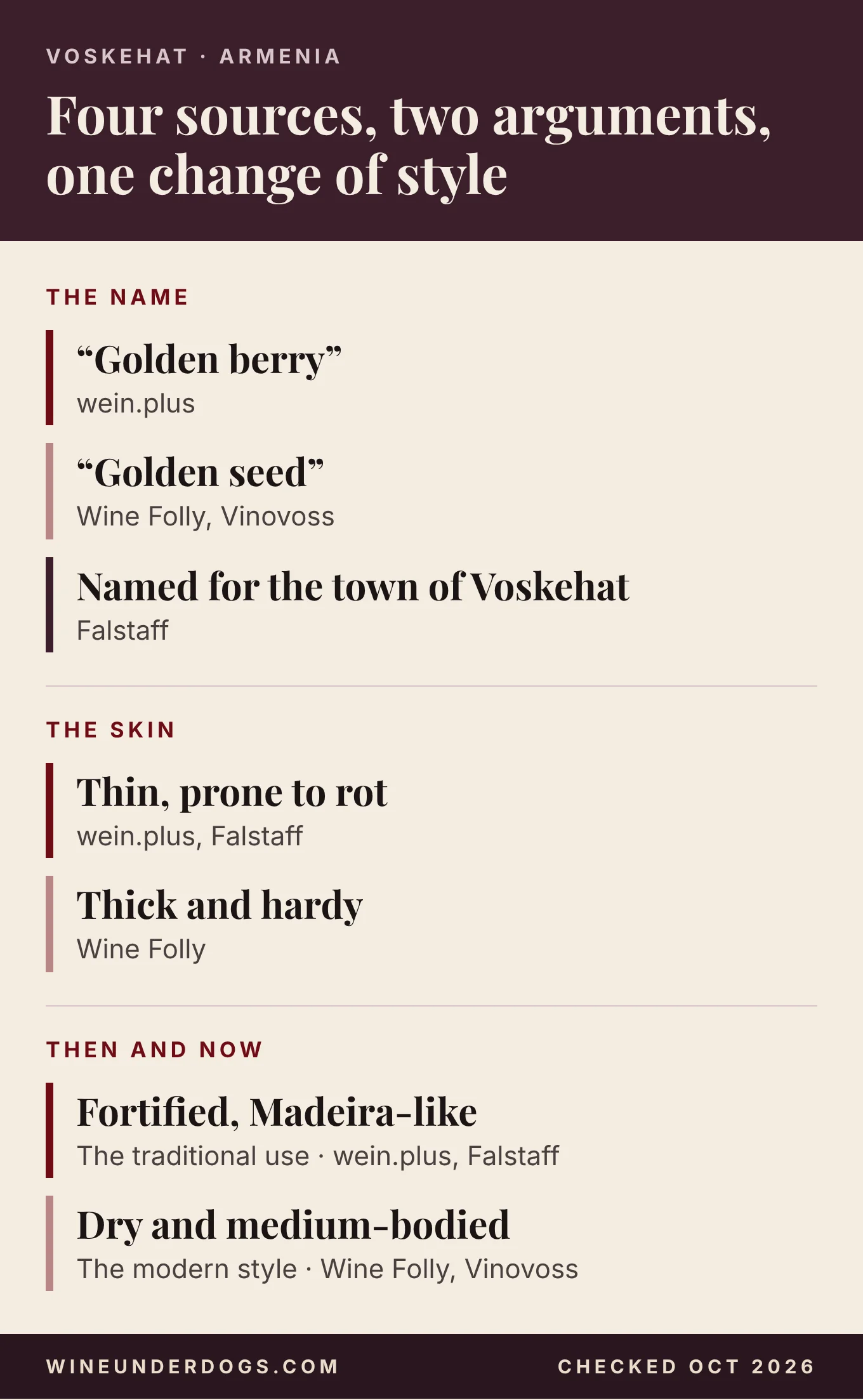
I can't settle the name or the skin from Florida, and I'd rather show you the disagreement than pick a side and pretend. What the sources do agree on is the direction of travel. Falstaff and wein.plus both describe a grape long used for sweet, fortified wine because it can reach very high sugar. Wine Folly calls it the poster child of Armenian white wine, used by nearly every white winemaker in the country. Somewhere between those two descriptions, Voskehat was reinvented as a dry white.
That modern style is the one to look for. Vinovoss describes apricot, pear and quince with white blossom and a mineral edge, and crisp enough acidity for fish and roast chicken.
Say it: vohs-keh-HAHT
The catch: these aren't cheap
Here's the part Nagel didn't soften. The examples she tasted "stood up very well to scrutiny, though the wines tend to be relatively expensive, even in their own country. A lot of money has been spent, particularly by expats returning to Armenia on state-of-the-art winemaking equipment and viticulture."
That sounds odd next to Armenia's export figures. According to the Vine and Wine Foundation of Armenia, as reported by PAN.am in February 2026, the average export bottle was worth about $3.24 in 2025, and Russia took 72% of the volume. Exports to the United States fell. My reading is that the two facts describe different trades: the cheap bottles go east in bulk, and the ones that reach an American shelf come from a small number of ambitious estates, priced for their investment. You won't find a bargain Voskehat here. You'll find a deliberate one.
What to take from it
A country with hundreds of grapes chose two, and chose them for reasons a wine shop can use: you can say them, you can't mistake them, and almost nobody else grows them. Start with the white, because it's the one fewer people have tried.
— Chris Berry
US availability · the federal record
Is Voskehat even in the United States?
Yes, though your shop will have to order it.
In the twelve months to 23 October 2026, six American importers cleared ten approved labels across ten brands.
- Terra Sancta Trading CompanyJacksonville, Florida · permit FL-I-211653 labels
- Pacific Wine & SpiritsGlendale, California · permit CA-I-165902 labels
- Vinum DivinumFresno, California · permit CA-I-242332 labels
- Ararat Import Export Co.Raleigh, North Carolina · permit NC-I-8191 label
A shop that cannot find Voskehat can still order it, because it buys from a distributor who buys from one of these companies. The deepest book is Terra Sancta Trading Company in Florida.
A label approval is not a bottle on a shelf. It means the wine was cleared to enter the country, not that it reached your state.
All six importers
| Importer | Where | Labels |
|---|---|---|
| Terra Sancta Trading Company | Jacksonville, FL | 3 |
| Pacific Wine & Spirits | Glendale, CA | 2 |
| Vinum Divinum | Fresno, CA | 2 |
| Ararat Import Export Co. | Raleigh, NC | 1 |
| Importers Direct Wholesale | Glendale, CA | 1 |
| Waters Edge Winery Rose District | Broken Arrow, OK | 1 |
Source: TTB Public COLA Registry, approved labels only, origin Armenia, read 25 October 2026. The varietal is recorded on 78% of approved records, so every count here is a floor rather than a total. Company names and cities come from TTB’s own permittee list; no contact details are published.
New to wine? Start here

Wine Match
Five guilty pleasures, yes or no. Ben finds the wine you’d actually like. You don’t need to know anything about wine. Ben certainly doesn’t.
Wine Underdogs is for readers of legal drinking age.
BenFive things. Yes or no. I'll do the rest.
Every wine fact here comes from the grape guides on Wine Underdogs. Ben has never opened a bottle, and neither does this game. For readers 21 and over.
Frequently asked questions
What is Voskehat?
Armenia's leading white grape. Modern dry versions show apricot, pear and quince with white-flower notes. Historically much of it went into fortified, Madeira-style wine, and some still does.
What does Areni Noir taste like?
A light-colored red with fresh acidity and soft tannins, with sour cherry, herb and spice. Wine Folly compares it to a cross between Pinot Noir and Sangiovese.
Why are Armenian wines expensive in the US?
The bottles that reach American shelves are the top of a small export trade. Armenia's average export bottle was worth about $3 in 2025, but most of that volume goes to Russia, and the ambitious estates that ship to the US price their wines well above that average, even at home.
JOIN THE PACK
Whatever you drink now, there's an underdog you'd like more.
One overlooked wine at a time: what it tastes like, the famous one it can replace, and the catch. Free.