 Chris BerryFounder, Wine Underdogs — chasing the world’s overlooked grapes
Vidal Blanc is the grape behind most of the icewine you have seen in a Canadian duty-free shop, and behind a lot of crisp, fruity whites from Virginia to Michigan. It was never meant for either job. It was bred to be distilled into Cognac.
If you want the short version: expect grapefruit and pineapple, bright acidity, and a style that swings from dry to syrupy depending on who made it. Read the label twice.
A brandy grape that missed its calling
Jean-Louis Vidal, a French breeder who lived from 1880 to 1976, created the grape in the 1930s. His aim was a better vine for Cognac production in the Charente-Maritime, in western France.
One of its parents tells you why. DNA markers recorded by the Vitis International Variety Catalogue confirm it as a cross of Ugni Blanc, the main grape of Cognac, and Rayon d'Or, itself a French hybrid from the Seibel program. The catalogue's only official synonym for it is the breeder's number, Vidal 256.
France did not keep it. Vidal Blanc is no longer authorised for planting there, and only a few old vines remain in the Charente-Maritime. The grape went to Canada instead.
The cold was the point
Vidal Blanc's great talent is surviving winter. It is very winter hardy, able to come through long spells of deep cold and still produce fruit. It also has a thick, tough skin.
Those two traits make it close to ideal for icewine, where grapes are left on the vine until they freeze and are pressed while still frozen. A thin-skinned grape splits or rots long before that. Vidal hangs on.
The enologist Adhémar de Chaunac brought it to Ontario in the late 1940s, and by 2008 Canada had about 777 hectares of it. Ontario's Niagara Peninsula is its heartland, with plantings in British Columbia, Quebec and Nova Scotia too. In the United States it grows in New York, Virginia, Michigan, Missouri, Indiana, Illinois, Pennsylvania, Ohio and beyond.
What is in the glass
The fruit is the story: grapefruit and pineapple, and none of the musky "foxy" character that puts some drinkers off other hybrids.
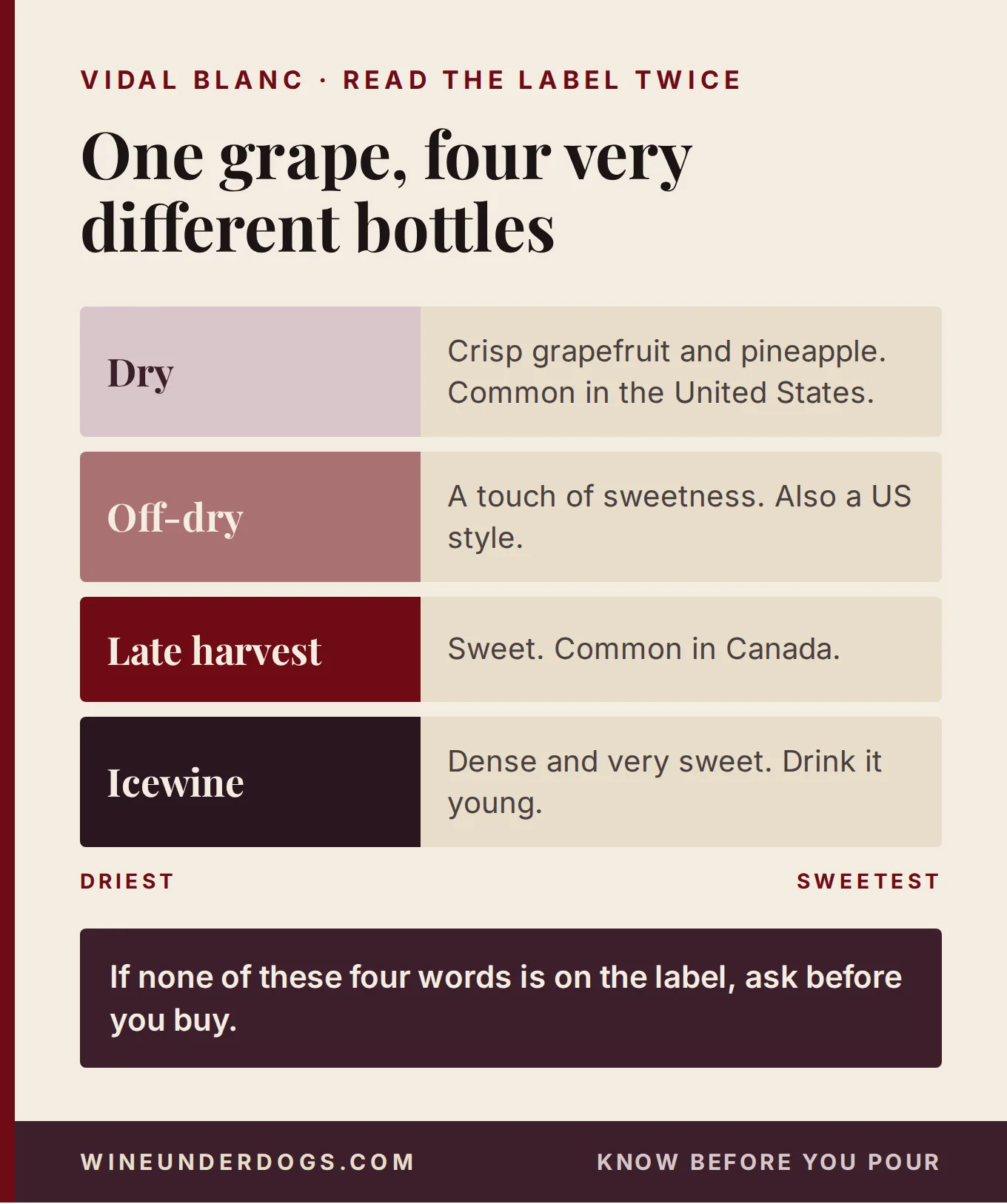
The style depends on where you are. In Canada it is mostly icewine and late harvest, dense and very sweet with acidity keeping it from cloying. In the United States it is more often a dry or off-dry white, and in Missouri the dry versions can be fuller and rounder than you would guess.
The catch
Vidal Blanc icewine does not age well. It is at its best young, when the fruit is loud, and it has little of the long cellaring life that Riesling icewine can have. Buy it to drink, not to keep. For an icewine from somewhere far less expected, there is one from Georgia, made from a red grape.
The second catch is the label. Because Vidal is made in every sweetness level, "Vidal Blanc" alone tells you almost nothing about what is in the bottle. Look for the words dry, off-dry, late harvest or icewine before you buy, and ask if none are there.
The vine has its weaknesses too. It is somewhat resistant to downy mildew but very susceptible to powdery mildew and to poor fruit set, so good years and bad years can taste noticeably different.
Where to find a bottle
In Canada, Vidal icewine is easy to find in any provincial liquor store. In the United States the dry versions are sold mostly at the winery and in their home states. No buy link sits on this page yet, because none has been checked in stock.
Start with a dry Vidal if you have only met the grape as icewine. Pour it cold next to spicy food, fried fish or a plate of soft cheese. Then, if a half bottle of icewine crosses your path, open it young and serve it with something less sweet than itself: blue cheese or a fruit tart.
What to take from it
Vidal Blanc was designed for a French brandy still and ended up in a frozen Ontario vineyard. It is a reminder that a grape's best job is not always the one it was bred for. The cold places that cannot grow the famous white grapes found theirs. If Vidal's French-hybrid cousin interests you, Chambourcin made a similar crossing to America.
New to wine? Start here
Wine Match
Five guilty pleasures, yes or no. Ben finds the wine you’d actually like. You don’t need to know anything about wine. Ben certainly doesn’t.
Wine Underdogs is for readers of legal drinking age.
BenFive things. Yes or no. I'll do the rest.
Every wine fact here comes from the grape guides on Wine Underdogs. Ben has never opened a bottle, and neither does this game. For readers 21 and over.
Frequently asked questions
What kind of wine is Vidal Blanc?
A white wine made in every style from bone dry to icewine. In Canada it is best known as icewine; in the United States it is more often a dry or off-dry white with grapefruit and pineapple fruit.
Where does Vidal Blanc come from?
It was bred in France in the 1930s by Jean-Louis Vidal, who wanted a grape for Cognac. It is no longer authorised for planting in France and is now grown mostly in Canada and the eastern United States.
Does Vidal Blanc icewine age well?
Not for long. It is intensely fruity when young but has little ageing potential, so drink it within a few years of the vintage.
JOIN THE PACK
Whatever you drink now, there's an underdog you'd like more.
One overlooked wine at a time: what it tastes like, the famous one it can replace, and the catch. Free.