
 Chris BerryFounder, Wine Underdogs — chasing the world’s overlooked grapes
Chambourcin is the red grape to ask for when you visit a winery anywhere between New Jersey and Missouri. It is French by birth, American by address, and it makes a dark, fruity red that most wine drinkers outside those states have never tried.
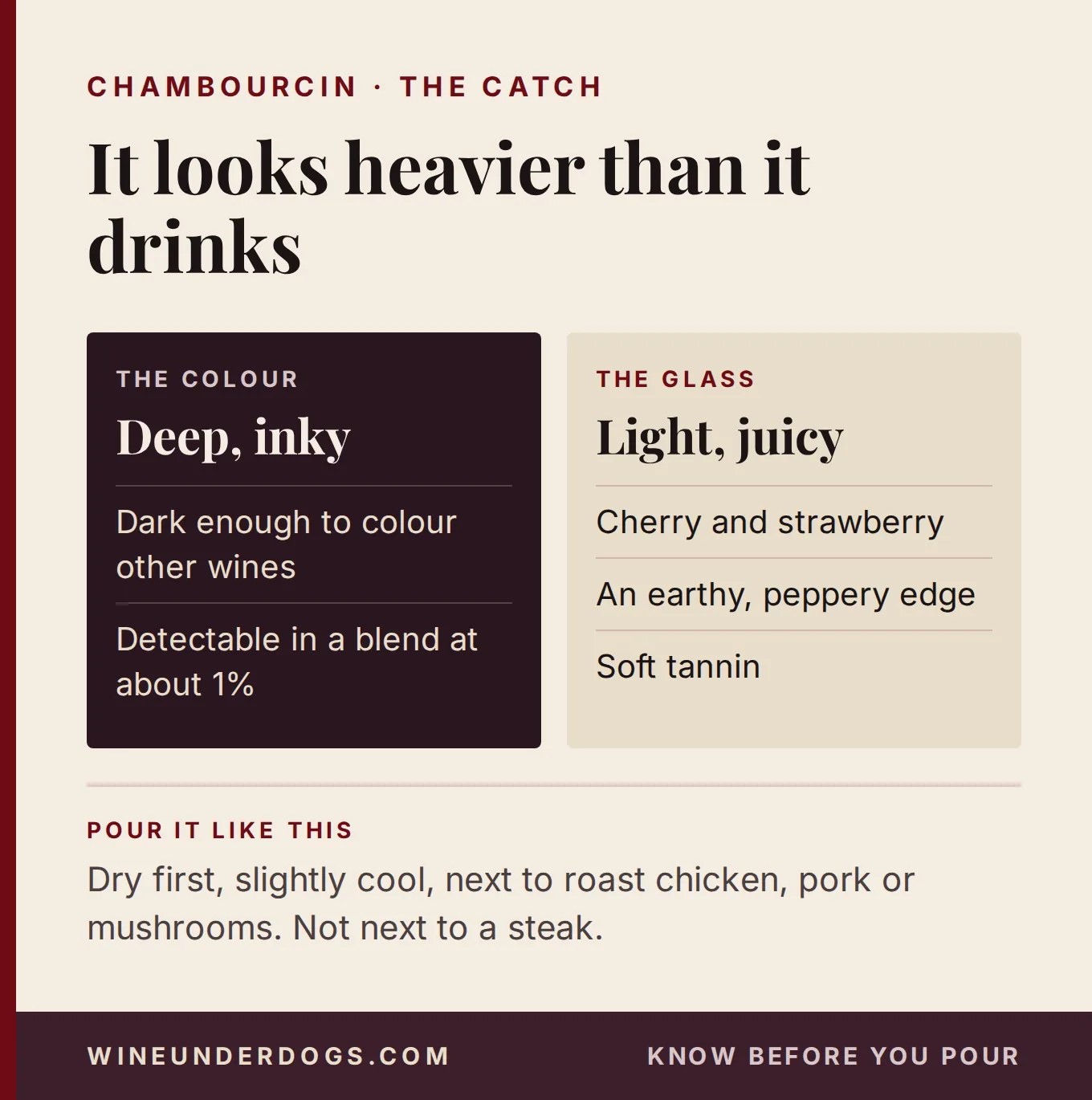
The short version: expect cherry and strawberry, an earthy edge, and a colour that looks heavier than the wine drinks. That last part is the catch, and it is worth knowing before you pour.
A French grape France let go
Chambourcin was bred by Joannès Seyve, a private breeder in France, and it became available in 1963. It started life as a number, Joannes Seyve 26-205, which is how French hybrid breeders labelled their seedlings before anyone gave them a name.
Seyve left little paperwork behind. His recorded pedigree for the grape was Seyve-Villard 12-417 crossed with Seibel 7053. When the Vitis International Variety Catalogue tested it with DNA markers, the parents came back as Joannes Seyve 11369 and Plantet instead. So the family story on file was wrong, and the grape kept growing anyway.
France never embraced it. Hybrids fell out of favour in French vineyards through the twentieth century, and Chambourcin is barely planted there today. It found its future on the other side of the Atlantic.
Why it took in the eastern United States
The eastern states are hard on European vines. Humid summers bring fungal disease, and the famous vinifera grapes struggle in them. Chambourcin was bred for exactly that problem: it carries American vine species in its ancestry and has good general resistance to fungal disease.
It is not bulletproof. WineMaker magazine's grower profile calls it highly susceptible to black rot, moderately susceptible to botrytis and downy mildew, and sensitive to sulfur sprays. It buds late and needs a long season, about 150 days, which is why it does better in the Mid-Atlantic than in the colder Finger Lakes.
Today you will find it in New Jersey, Pennsylvania, Virginia, Maryland, Ohio, Indiana, Illinois, the Carolinas and Missouri, among others. Australia grows some too, mostly in warm, humid parts of New South Wales where the same disease pressure applies.
What is in the glass
Chambourcin makes a deeply coloured wine with red fruit at the front, cherry and strawberry, and an earthy or peppery note behind it. Producers make it dry and off-dry, as a rosé, and in blends. Some serve it with a light chill, the way you might serve a Beaujolais.
Its colour is so distinctive chemically that a lab can detect it in a blend at around one percent. For decades, growers used it as a colour booster for thinner reds.
The catch
The colour promises more structure than the wine delivers. Chambourcin's tannins are hard to get from the grape into the wine, so a glass that looks inky can drink light and juicy. That is fine if you expect it and disappointing if you poured it for a steak.
There is a second, quieter catch. The vine crops heavily. One university trial cited by WineMaker averaged about six tons per acre, while growers aiming for quality hold it to three or four. Two bottles with the same grape on the label can come from very different philosophies, and the price is often the only clue.
Where to find a bottle
Honestly, the best place to find Chambourcin is at the winery. Most of it is made in small quantities and sold in the state where it was grown. No buy link sits on this page yet, because none has been checked in stock.
If you live in the Mid-Atlantic or the Midwest, there is almost certainly a producer within a drive. Ask for a dry version first, drink it slightly cool, and put it next to something that does not need big tannin: roast chicken, pork, a mushroom dish. Judge it as its own grape, not as a lighter Cabernet.
What to take from it
Chambourcin is what happens when a grape bred for one country's problem solves another country's instead. France set it aside. The eastern United States quietly built a wine culture around it. If you want to know what your region tastes like when it is not imitating California, this is one of the first bottles to open. For the native grapes that came before it, Norton, Catawba and the muscadines, read the American grapes that saved wine.
New to wine? Start here

Wine Match
Five guilty pleasures, yes or no. Ben finds the wine you’d actually like. You don’t need to know anything about wine. Ben certainly doesn’t.
Wine Underdogs is for readers of legal drinking age.
BenFive things. Yes or no. I'll do the rest.
Every wine fact here comes from the grape guides on Wine Underdogs. Ben has never opened a bottle, and neither does this game. For readers 21 and over.
Frequently asked questions
Where does Chambourcin come from?
It was bred in France by the private breeder Joannès Seyve and became available in 1963. Today it is grown far more in the eastern United States, from New Jersey and Pennsylvania through Virginia, Ohio and the Carolinas to Missouri, than in France.
What does Chambourcin taste like?
Deeply coloured, with red fruit such as cherry and strawberry and an earthy, spicy edge. It is usually lighter in tannin than its colour suggests, and some producers serve it slightly chilled.
Is Chambourcin a hybrid grape?
Yes. It is an interspecific cross, meaning its family tree includes American vine species as well as the European Vitis vinifera. Its exact parentage was recorded one way by its breeder and turned out different when tested with DNA markers.
JOIN THE PACK
Whatever you drink now, there's an underdog you'd like more.
One overlooked wine at a time: what it tastes like, the famous one it can replace, and the catch. Free.