
 Chris BerryFounder, Wine Underdogs — chasing the world’s overlooked grapes
Squeeze almost any red grape and the juice runs clear. The color in your glass comes from the skins, so the red in nearly every red wine you've poured is, quite literally, a costume. A few grapes don't bother with one, because their flesh is red all the way through. The one to open this Halloween is Saperavi.
A white wine in a red coat
Cut a Cabernet Sauvignon grape in half and the juice inside is clear. The same goes for Merlot, Pinot Noir, Grenache and nearly every red grape you know by name. The pigments that make red wine red, called anthocyanins, sit in the skin. A winemaker gets them into the wine by leaving the juice on its skins while it ferments, for days or for weeks.
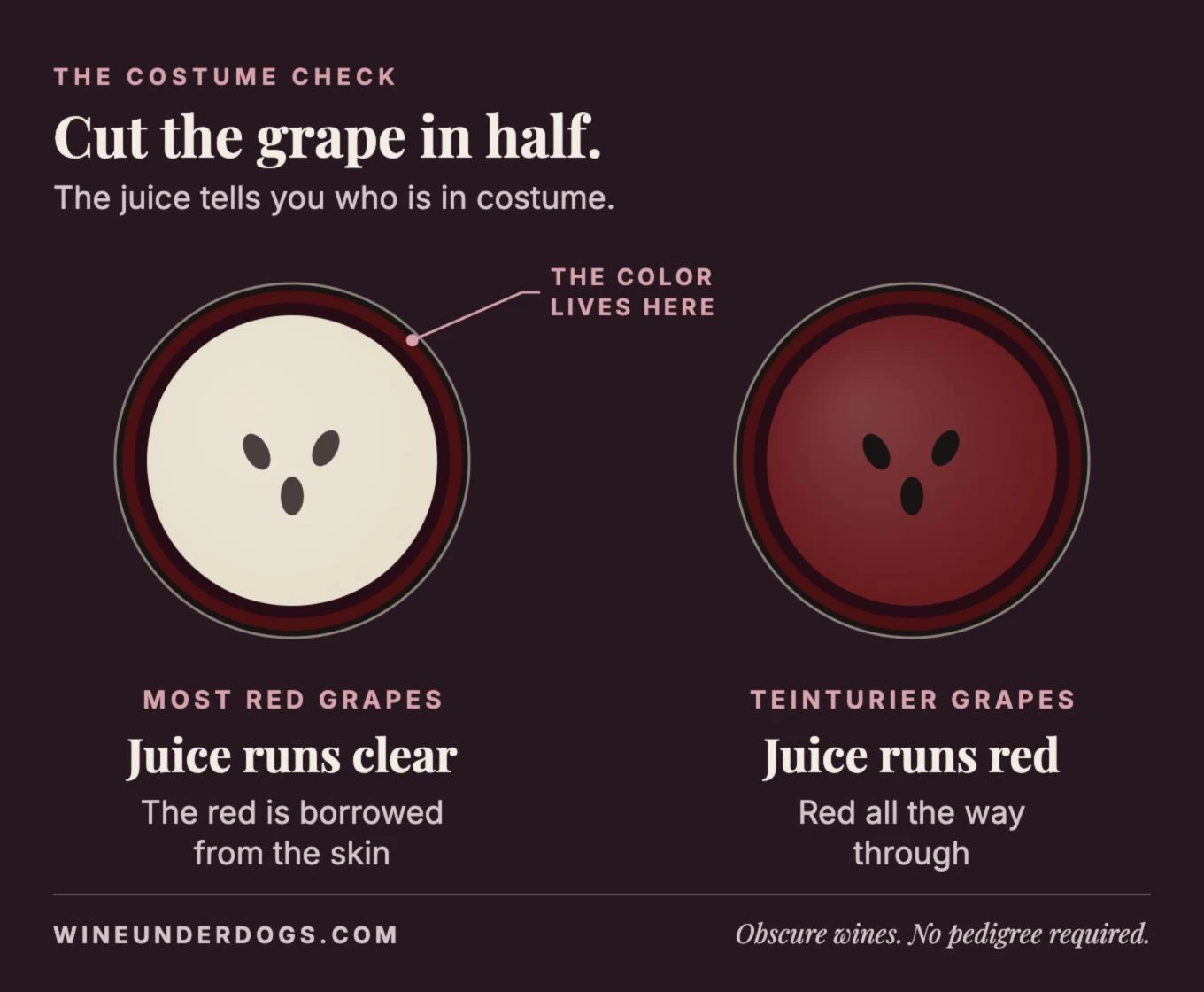
So most red wine spends its first week in a dark tank, quietly getting into costume, with the dedication of the neighbor who started building a front-yard graveyard in the first week of September.
Who's dressed as what
Once you know the color is borrowed, the famous names start to look like party guests.
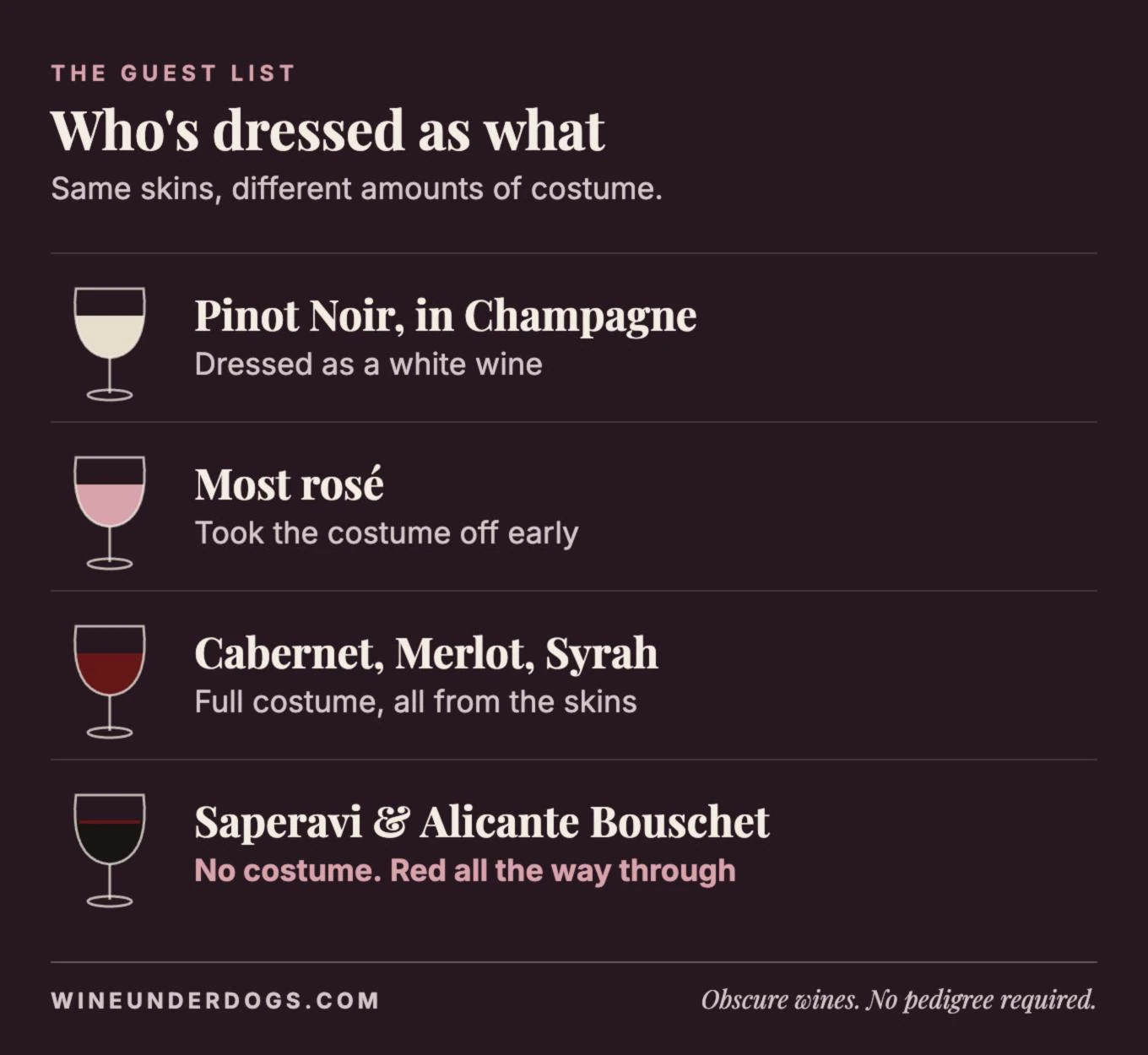
Pinot Noir goes to Champagne as a white wine. Pressed gently and quickly, its clear juice stays pale, and it ends up in some of the most expensive white wine in the world. A Champagne labeled blanc de noirs, "white from blacks," is made entirely from black grapes. The most celebrated red grape in Burgundy spends a good part of its career in Champagne dressed as a white wine, and gets through the whole evening without a single guest asking to see some ID.
Most rosé is the same red grape with the skins taken away early. A few hours of contact instead of days or weeks, and the wine comes out pink. It isn't a separate kind of grape.
Cabernet, Merlot and Syrah are the guests who went all in. Long soaks, deep color, every bit of it pulled from the skins.
The ones who came as themselves
A small family of grapes skips the whole business. They're called teinturiers, French for "dyer," and their flesh is red as well as their skin, so the juice comes out red the moment the grape is pressed.
The two most often bottled on their own are Saperavi, from Georgia, and Alicante Bouschet, which a Frenchman named Henri Bouschet bred in 1866 and which this site is more or less built around. The rest are mostly blending grapes, used in small amounts to deepen the color of wines that never mention them. The full field guide to teinturier grapes has the whole cast.
At a costume party, the guest who turns up as themselves is either the most relaxed person in the room or the most unsettling, and a grape that bleeds when you cut it has made its choice.
One honest caveat before anyone gets carried away: red flesh makes a wine darker, not better. Color is a fact about the grape, not a verdict on the bottle.
Why Saperavi gets the porch light
Saperavi, said sah-peh-RAH-veerecorded by Tamari Araviashvili, is Georgia's signature red grape. It makes wine that is nearly black, with high acidity and the structure to age, which is a better description of a Halloween wine than anything on a novelty label. The guide to Georgian wine covers where it grows and how it's made there.
The bottle in the box above comes from somewhere else: it's made in New York's Finger Lakes. Standing Stone Vineyards calls it a Teinturier Saperavi on the label, and the winery describes black and red fruit, lively acidity and a fine, gentle grip.
Honesty first: I haven't opened this one. I'm pointing you at it because it's a single-varietal Saperavi you can order online today, and because the grape is the right one for the night. It almost certainly won't reach your door by Saturday, though. For a bottle tonight, ask a local wine shop for a Georgian Saperavi. The availability record on this page shows which importers bring it into the country, and a good shop can often order one through its distributor.
A true ghost story, with a wine in it
Halloween asks for a ghost story. This one happens to be true.
In 1867, an excavation near Speyer, in what is now southwest Germany, opened a Roman tomb. Inside were two stone coffins, one holding a man and one a woman, and around them sixteen glass vessels left for the dead. Fifteen were broken or dry. One was still full.
It's a yellow-green bottle of about a liter and a half, with handles shaped like dolphins, sealed sometime around AD 325 to 350. Whoever filled it poured a thick layer of olive oil over the wine to keep the air out, then closed it with hot wax. It worked. After about 1,700 years in the dark, the liquid is still in there: a clear layer at the bottom and a resin-like mass above it. Analysis suggests at least part of it is wine, flavored with herbs.
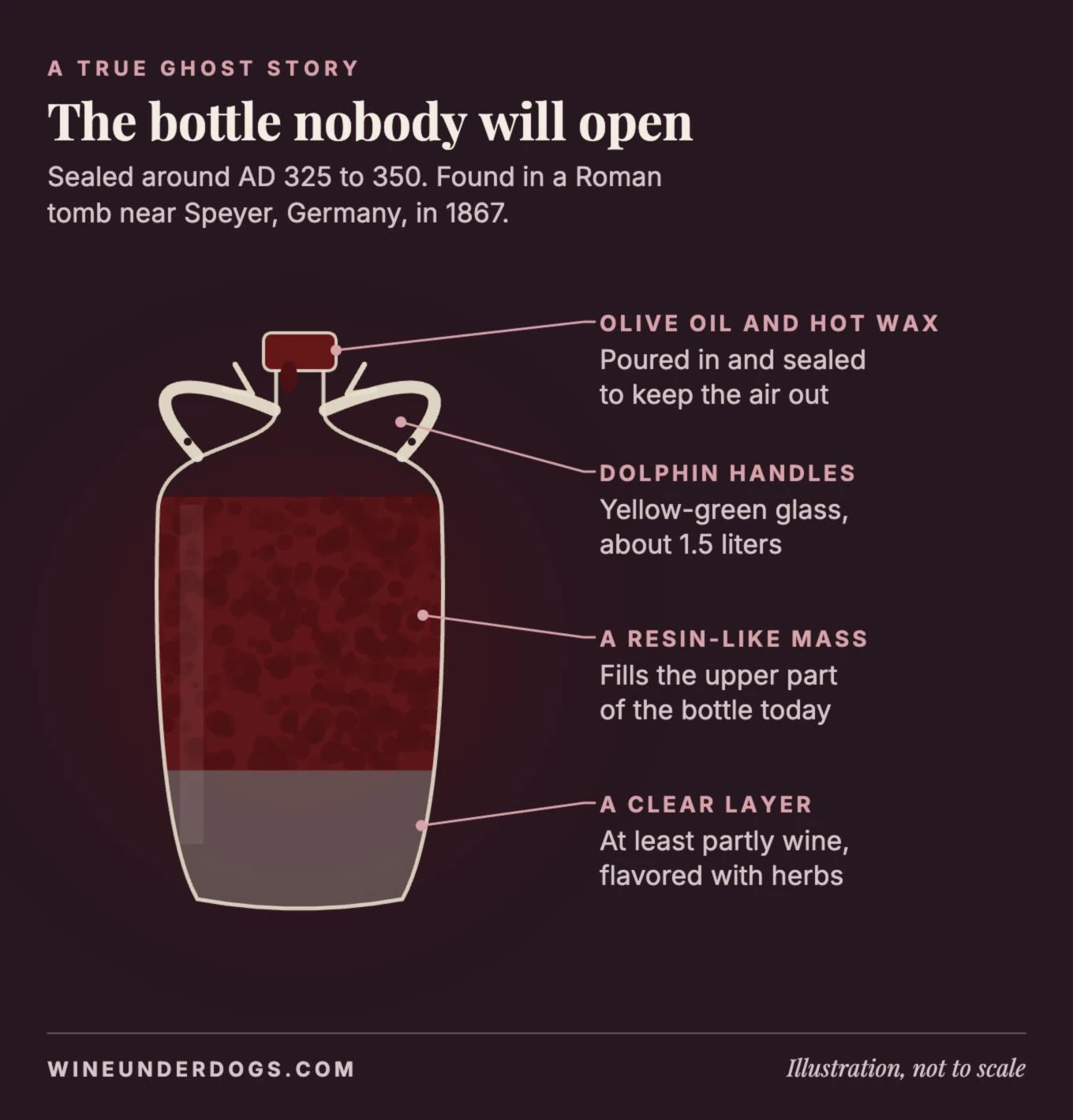
Nobody has opened it. It sits in the Historical Museum of the Palatinate in Speyer, where it has always been displayed, and the museum has declined to open it even for research, because no one is sure what the air would do to it. According to reporting gathered by Atlas Obscura, some of the staff would rather not handle it at all. The curator said in 2011 that he had seen no change in the bottle in twenty-five years.
So the oldest bottle of wine in the world is still sealed, still wearing its layer of oil, still waiting for a glass that never comes. I'd leave it there too.
What to skip
Skip the candy pairing. Sugar makes a dry red taste thin and sour, so keep the candy corn by the door and open the Saperavi with dinner instead.
Skip any bottle you're buying for the skull on the label. The pun isn't the wine.
Skip pouring a good red into a cauldron of punch. Use something cheap for that, and save the Saperavi for the glass.
And skip the white tablecloth. A teinturier stains the way it was named to.
US availability · the federal record
Is Saperavi even in the United States?
Yes, and more easily than you would think.
In the twelve months to 23 October 2026, thirty-seven American importers cleared 108 approved labels across sixty-one brands.
- Geo US TradingLombard, Illinois · permit IL-I-2150719 labels
- Georgian Wines and SpiritsBoca Raton, Florida · permit FL-I-217989 labels
- Parsons Fine ImportsColumbus, Indiana · permit IN-I-210629 labels
- Tsereteli USABoston, Massachusetts · permit MA-I-212896 labels
A shop that cannot find Saperavi can still order it, because it buys from a distributor who buys from one of these companies. The deepest book is Geo US Trading in Illinois.
A label approval is not a bottle on a shelf. It means the wine was cleared to enter the country, not that it reached your state.
All thirty-seven importers
| Importer | Where | Labels |
|---|---|---|
| Geo US Trading | Lombard, IL | 19 |
| Georgian Wines and Spirits | Boca Raton, FL | 9 |
| Parsons Fine Imports | Columbus, IN | 9 |
| Tsereteli USA | Boston, MA | 6 |
| Black Lamb Wine | Lincoln, CA | 5 |
| Van Horn Imports | Schertz, TX | 5 |
| B.G.A. International USA | Staten Island, NY | 4 |
| USA Wine Imports | Manhasset, NY | 4 |
| Nomadic Distribution | Los Angeles, CA | 3 |
| Park Street Imports | Miami, FL | 3 |
| Pirveli Georgian Wine and Spirits | Cranford, NJ | 3 |
| Portal 5 | Philadelphia, PA | 3 |
| Vinoveli | Boston, MA | 3 |
| Affinity Brands | Freeport, NY | 2 |
| Corus Imports | Stamford, CT | 2 |
| Iberian Wines Imports | Brooklyn, NY | 2 |
| Interbalt Products | Rockville, MD | 2 |
| Sani Wines | Brooklyn, NY | 2 |
| Summit Selections | Staten Island, NY | 2 |
| Wein-bauer | Franklin Park, IL | 2 |
| Wine Country Management | Rehoboth Beach, DE | 2 |
| 8000 Vintage Selections | Peekskill, NY | 1 |
| Aral Distributions | Hayward, CA | 1 |
| Bam Wine & Spirits | Brooklyn, NY | 1 |
| Chozen Imports | Brooklyn, NY | 1 |
| Georgian House of Greater Washington | Beltsville, MD | 1 |
| Gilauri Wines | Saint Helena, CA | 1 |
| Honest Makers | Palmetto, FL | 1 |
| Native Selections | Richmond, VA | 1 |
| Palmateer Wine Group | San Anselmo, CA | 1 |
| Regal Wine Imports | Moorestown, NJ | 1 |
| Rolia Global Trade | Brooklyn, NY | 1 |
| Saba Wine Imports | Bethesda, MD | 1 |
| Sada Store | Jenkintown, PA | 1 |
| Saperavi Brothers | Cambridge, MA | 1 |
| Skin Contact Wines | Leonia, NJ | 1 |
| Terraneo Merchants | Skokie, IL | 1 |
Source: TTB Public COLA Registry, approved labels only, origin Georgia, read 24 October 2026. The varietal is recorded on 92% of approved records, so every count here is a floor rather than a total. Company names and cities come from TTB’s own permittee list; no contact details are published.
New to wine? Start here

Wine Match
Five guilty pleasures, yes or no. Ben finds the wine you’d actually like. You don’t need to know anything about wine. Ben certainly doesn’t.
Wine Underdogs is for readers of legal drinking age.
BenFive things. Yes or no. I'll do the rest.
Every wine fact here comes from the grape guides on Wine Underdogs. Ben has never opened a bottle, and neither does this game. For readers 21 and over.
Frequently asked questions
Is the juice of red grapes actually red?
In almost every red grape, no. The pulp and juice are clear, and the color comes from pigments in the skin that the wine soaks up during fermentation. That's why a winemaker can make white wine from a red grape by pressing it gently and taking the skins away.
Which grapes have red juice?
Teinturier grapes, from the French for dyer, have red flesh as well as red skin. Alicante Bouschet and Saperavi are the two most often bottled on their own; most of the others are blending grapes used for color.
Can Champagne be made from red grapes?
Yes. A Champagne labeled blanc de noirs, meaning white from blacks, is made entirely from black grapes such as Pinot Noir and Pinot Meunier, pressed gently so the juice stays pale.
What is a good red wine for Halloween?
Saperavi, a nearly black red from Georgia that is red all the way through the grape. It is one of the few red wines whose color isn't borrowed from the skins.
JOIN THE PACK
Whatever you drink now, there's an underdog you'd like more.
One overlooked wine at a time: what it tastes like, the famous one it can replace, and the catch. Free.