
 Chris BerryFounder, Wine Underdogs — chasing the world’s overlooked grapes
If you want to taste what Florida can do with a grape bred for Florida, open a Blanc du Bois. It's a white wine grape the University of Florida released in 1987, and it exists for one reason: it doesn't die here.
That turns out to be a hard trick. For most of the world's famous wine grapes, Florida is a death sentence.
Florida and the grape, at a glance
- 1562
- The usual date given for the first wine made in what's now the US, near Jacksonville
- 14 acres
- All that was left of Anaheim's vineyards by 1891, after Pierce's disease
- 1945
- The year UF began breeding grapes to survive it
- 13 cases
- The first Florida wine from UC Davis's resistant grapes
The disease that keeps Cabernet out of Florida
The killer is Pierce's disease. It's caused by a bacterium, Xylella fastidiosa, carried from vine to vine by sap-drinking insects, and once inside a vine it chokes the tissue that carries water. Europe's grapes, the Vitis vinifera that gives us Cabernet, Chardonnay and Pinot Grigio, have almost no defence against it. By the University of Florida's account, it has long kept Florida from building a large-scale wine industry.
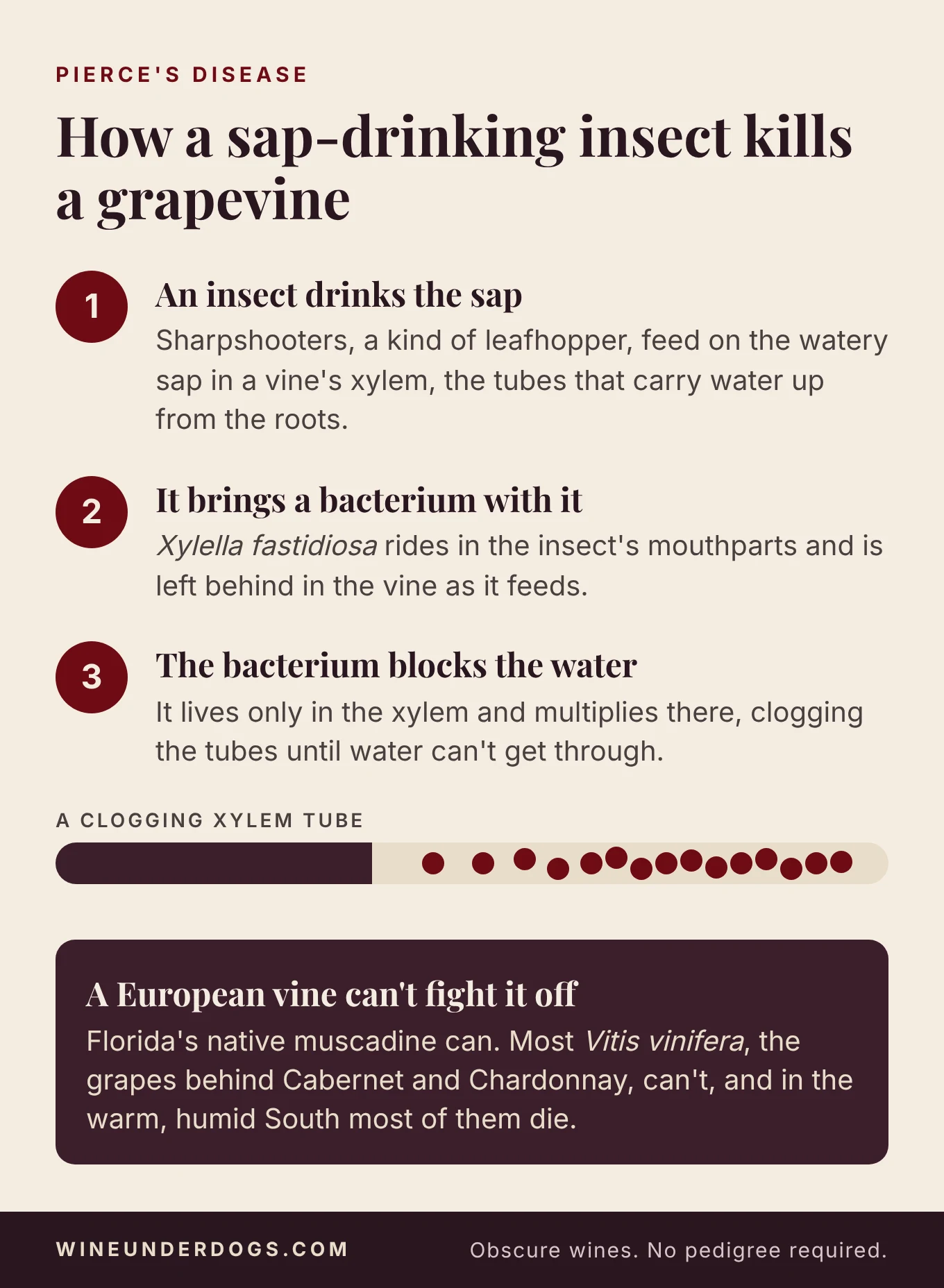
Florida's own grape doesn't have that problem. "Florida's native grape, the muscadine, is resistant to Pierce's disease," says Ali Sarkhosh, who leads the University of Florida's fruit crops programme, in a UF report from 2025. That's why muscadine sprawls across fences from here to the Carolinas, and why so much Florida wine tastes of it: sweet, musky and unmistakable.
It's also where American wine began. The earliest wine made in what is now the United States is usually credited to French Huguenots at a settlement near Jacksonville, between 1562 and 1564, made from Scuppernong, a muscadine. Florida's first wine was a native one, centuries before anyone tried to grow Cabernet here.
Muscadine isn't simply a tougher cousin of the European grape. It's a different branch of the family, down to the chromosome count.
| Muscadine | European grape | |
|---|---|---|
| Home | Southeastern US, from Florida to New Jersey and west to Texas | Europe and western Asia |
| Chromosomes | 40 | 38 |
| Pierce's disease | Resistant | Mostly killed by it in the South |
| Famous names | Scuppernong, Carlos, Noble | Cabernet, Chardonnay, Pinot Grigio |
| In the glass | Sweet, musky, grapey | Everything else on the wine list |
So there have always been two ways to make wine in Florida. Use the grape that survives, or breed one that survives and tastes more like the grapes everyone else drinks.
Florida's insect went west
Pierce's disease isn't only a Southern problem, and the story of how it got to California runs partly through Florida.
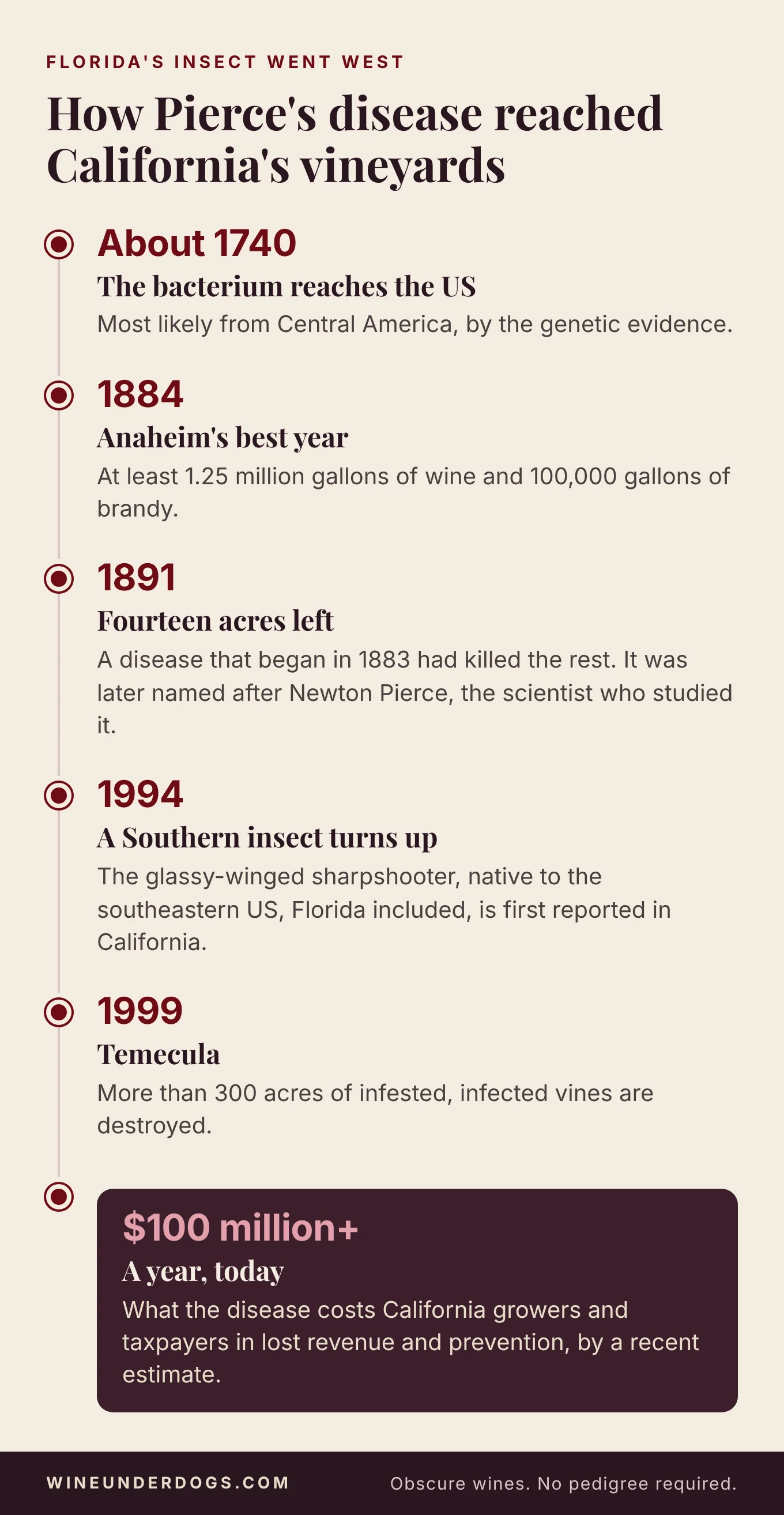
It was first noticed in Anaheim, which in the 1880s was one of California's great wine towns. In 1884 it made at least 1.25 million gallons of wine. A vine disease appeared in 1883, and by 1891 Anaheim had 14 acres of vineyard left. Genetic work suggests the bacterium itself reached the US around 1740, most likely from Central America.
A century later it got a better carrier. The glassy-winged sharpshooter, an insect native to the southeastern United States, was first reported in California in 1994. In 1999 it spread the disease through more than 300 acres of vines in Temecula, all of which were destroyed. Florida has lived with the insect all along. California is still paying for its arrival.
Florida's own answer: Blanc du Bois
Florida started breeding its way around the disease early. The University of Florida's grape programme began in 1945 at its research centre in Leesburg, built around one goal: grapes that could resist Pierce's disease. It has released a string of grapes since.
| Grape | Released | Colour | What UF recommends it for |
|---|---|---|---|
| Lake Emerald | 1954 | Light green | Wine, juice and jelly |
| Blue Lake | 1960 | Purple | Juice and jelly |
| Stover | 1968 | Light green | Wine, and eating fresh |
| Blanc du Bois | 1987 | Light green | Wine, and UF's best bunch grape for it |
Release years from UF's own 1981 cultivar review and the Blanc du Bois release; uses from UF's current growing guide, which also names Conquistador as its best purple grape for both wine and eating.
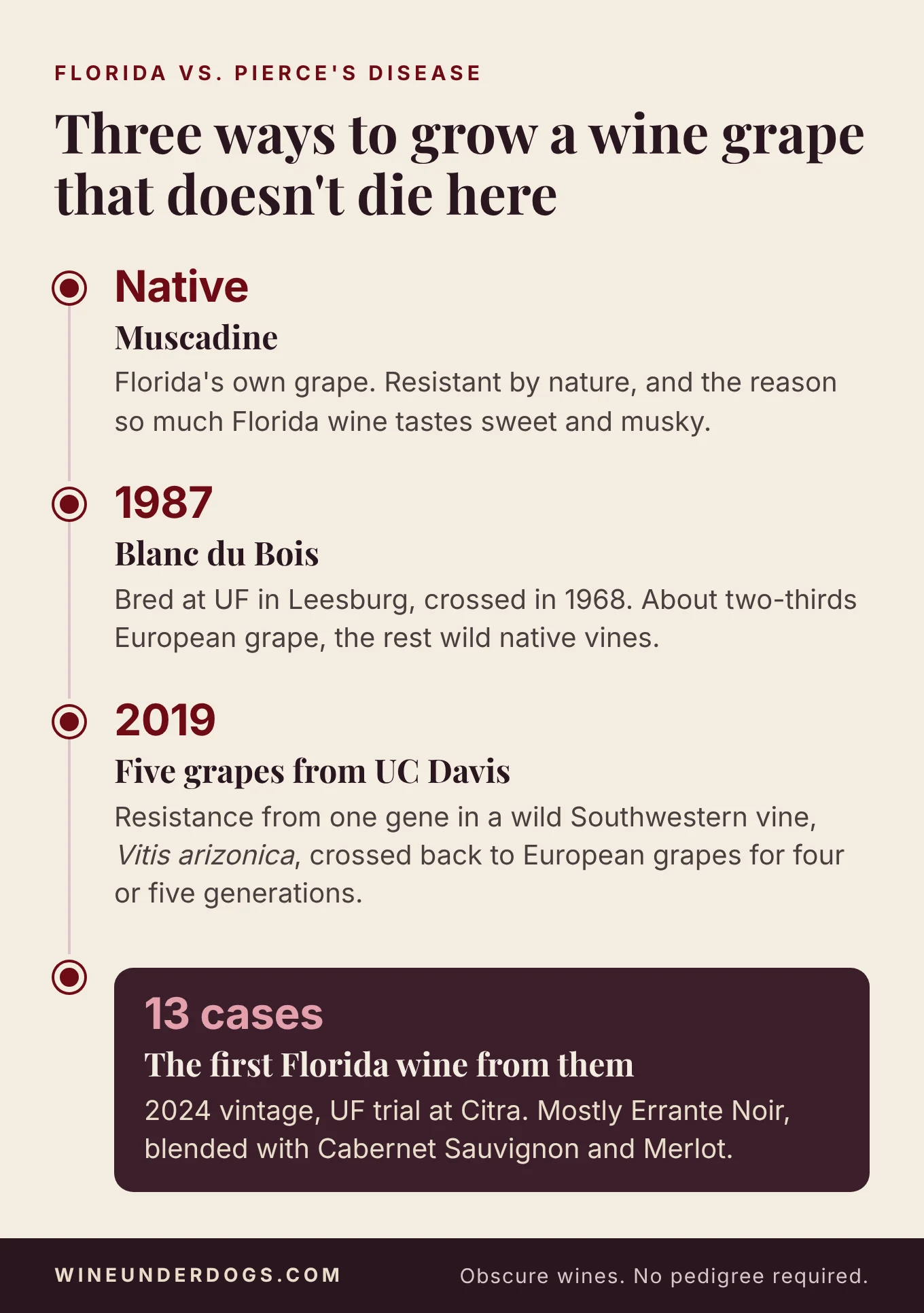
John Mortensen crossed Blanc du Bois at Leesburg in 1968, and the university released it in 1987. It's about two-thirds European grape, mostly Cardinal, with the rest from wild grapes native to Florida and a trace of the American labrusca. It's named after Emile DuBois, who grew grapes and made wine near Tallahassee.
Lakeridge Winery in Clermont was the first to grow it and the first to make wine from it. The grape's biggest success, though, came in Texas, where more of it is now grown than in any other state. Florida bred it, and Texas took it furthest.
California's answer: five grapes from a desert vine
The newest attempt came from the other side of the country. In December 2019, the University of California, Davis released five wine grapes resistant to Pierce's disease, the first new wine grapes from UC Davis since the 1980s. Three are red, Camminare Noir, Paseante Noir and Errante Noir, and two are white, Ambulo Blanc and Caminante Blanc.
The breeder, Andrew Walker, spent about twenty years on them. Their resistance comes from a single gene in Vitis arizonica, a wild grape of the American Southwest and northern Mexico, which he crossed back to European varieties over four or five generations. Each round keeps the gene and dilutes everything else the wild parent brought with it, until what's left is 94 to 97 per cent European.
Look inside
What's in each new grape
Pick one of the five. The bar is its family tree, by share.
Errante Noir is a red grape, 97% European and 3% wild.
- 50% Sylvaner
- 12.5% Cabernet Sauvignon
- 12.5% Carignane
- 12.5% Chardonnay
- 9.5% Other European grapes
- 3% Wild American vine, where the resistance comes from
How UC Davis describes the wine: Plum, herbs and earth. A big, dense red, tannic yet balanced, rated highly for blending with Cabernet Sauvignon.
The grape in Florida's first wine from these vines. Half its family tree is Sylvaner, a white grape best known in Germany and Alsace.
Source: UC Davis Foundation Plant Services, release descriptions for the five varieties (December 2019). Tasting notes are UC Davis panel descriptions, not mine; I haven't tasted any of them.
That dilution is the argument. To their breeders, the result is a grape that tastes like a classic and survives like a native. To a sceptic, it's a grape with no voice of its own, a watered-down echo of its famous parents.
The first Florida wine: 13 cases
The University of Florida has been testing these grapes at its research station in Citra, near Ocala. The 2024 vintage became the first wine: a red made mostly from Errante Noir, about 75 per cent Florida fruit blended with Cabernet Sauvignon and Merlot, 13 cases in all. Château Le Coeur, a winery in DeFuniak Springs in the Panhandle, made it with UF and named it Genial. Early tastings, by UF's account, point to a dark, fruit-forward wine.
There's a curiosity in that choice. Errante Noir is a red grape, but half its family tree is Sylvaner, a white grape best known in Germany and Alsace. Florida's first wine from the new grapes is, at one remove, partly German.
Thirteen cases is a proof of concept, not a wine industry, and I haven't tasted it. Château Le Coeur is now planting the vines itself and plans to test more of them.
There's one more catch, and it's an important one. Surviving Pierce's disease isn't the same as thriving in the South. When the University of Georgia grew Camminare Noir, the vines still picked up heavy downy mildew and bitter rot, and the researchers concluded it would need a full spray programme like any European vine. UF's own growing guide goes further: it calls fungal disease, not Pierce's disease, the principal cause of poor results with bunch grapes in Florida. Solving one problem isn't the same as solving the climate.
Built for the place
Blanc du Bois worked because it was bred for here. The UC Davis grapes may yet work too, if they can be kept clear of the fungus as well as the bacterium. Either way, eighty years of Florida grape breeding teach the same lesson: the grape has to be built for the place, because the place won't change for the grape.
New to wine? Start here

Wine Match
Five guilty pleasures, yes or no. Ben finds the wine you’d actually like. You don’t need to know anything about wine. Ben certainly doesn’t.
Wine Underdogs is for readers of legal drinking age.
BenFive things. Yes or no. I'll do the rest.
Every wine fact here comes from the grape guides on Wine Underdogs. Ben has never opened a bottle, and neither does this game. For readers 21 and over.
Frequently asked questions
Why can't Florida grow European wine grapes?
Mainly because of Pierce's disease, a bacterial infection spread by insects that blocks a vine's water-conducting tissue. European (Vitis vinifera) vines have little defence against it, and by the University of Florida's account it has long kept the state from building a large-scale wine industry. Florida's native muscadine grape is resistant to it.
What is Blanc du Bois?
A white wine grape bred by John Mortensen at the University of Florida's research center in Leesburg, crossed in 1968 and released in 1987. It resists Pierce's disease and is named after Emile DuBois, a grapegrower and winemaker in the Tallahassee area.
What are the UC Davis Pierce's disease resistant grapes?
Five wine grapes released by the University of California, Davis in December 2019 after about twenty years of breeding by Andrew Walker: Camminare Noir, Paseante Noir and Errante Noir (red), and Ambulo Blanc and Caminante Blanc (white). Their resistance comes from a wild grape, Vitis arizonica, crossed back to European varieties over several generations.
Where was the first wine in the United States made?
The earliest wine made in what is now the United States is usually credited to French Huguenot settlers near Jacksonville, Florida, between 1562 and 1564. They made it from Scuppernong, a muscadine grape native to the Southeast.
Has anyone made wine from them in Florida?
Yes, in a small way. A University of Florida trial at Citra produced 13 cases of a red made mostly from Errante Noir, blended with Cabernet Sauvignon and Merlot. Château Le Coeur in DeFuniak Springs named it Genial.
JOIN THE PACK
Whatever you drink now, there's an underdog you'd like more.
One overlooked wine at a time: what it tastes like, the famous one it can replace, and the catch. Free.