
 Chris BerryFounder, Wine Underdogs — chasing the world’s overlooked grapes
A qvevri goes into the ground at about twenty centimetres a day.
You will see it spelled kvevri too. Same Georgian word, romanised two ways. The churi of western Georgia is something else: a different word for a related vessel, usually smaller than a Kakhetian qvevri. Georgian regions have several more of these names, among them qotso, lagvani, kvibari and lakhuti.
Not the burying. The building. The vessel is coiled by hand from the bottom up, and only fifteen to twenty centimetres of clay can be added before the maker has to stop and let it dry. Ring, wait a day, ring, wait a day. A mid-sized qvevri takes roughly ninety days to reach full height, and it has not been anywhere near a fire yet.
That is the fact that reorganises everything else about these vessels. They are slow in a way nothing else in a modern cellar is slow.
Building one
The clay is local and every maker has a pit they prefer. Sergo Bozhadze in Imereti quarries his about thirty kilometres from the workshop; a Kakhetian maker takes his from the Shuamta mountains twenty minutes away. Two types of red clay get blended with water, and the consistency is judged by touch rather than by a recipe. For a vessel about 1.2 metres tall, that is up to 1.3 tonnes of clay.
Then the coiling, which in Kakheti is done from inside the vessel as it rises around the maker. The previous ring gets scored with a cross-hatch so the next one grips. No templates, no wheel, no forms. Jamie Goode watched Zaza Kbilashvili in Vardisubani, a fourth-generation maker producing around fifty qvevri a year, doing it by hand and by eye.
The drying interval varies by who you ask. Twenty-four hours between rings in Imereti; two days at the low end of the official Georgian guidance; several days according to Decanter. The whole build runs two to three months, and then the finished shell sits another three or four weeks before firing.
They are made eight at a time, and the reason is plain: that is what fits in the kiln.
The kiln, and a number you should not trust
The kiln is a brick room with three walls. The qvevri go in, the fourth wall is bricked up with small vents, and the fire is fed with wood, continuously, for about a week. Somebody stays with it around the clock. Two truckloads of logs. Makers judge readiness by colour, and by sound: one says a finished qvevri sings.
The firing temperature is where the published accounts fall apart, and it is worth knowing that before you read anyone's confident number. Georgian makers and visiting journalists mostly say 1200 to 1300°C. The Georgian National Wine Agency says 1000 to 1300°C. A 2018 mineralogy dissertation from Telavi State University says the optimum is 950 to 1050°C, that 750 to 850°C leaves the clay wet and gives salty off-flavours, and that above 1200°C the clay stops influencing the wine at all. One American magazine prints 1,000°F, which is 538°C and would not vitrify anything; that is a units slip that got past an editor.
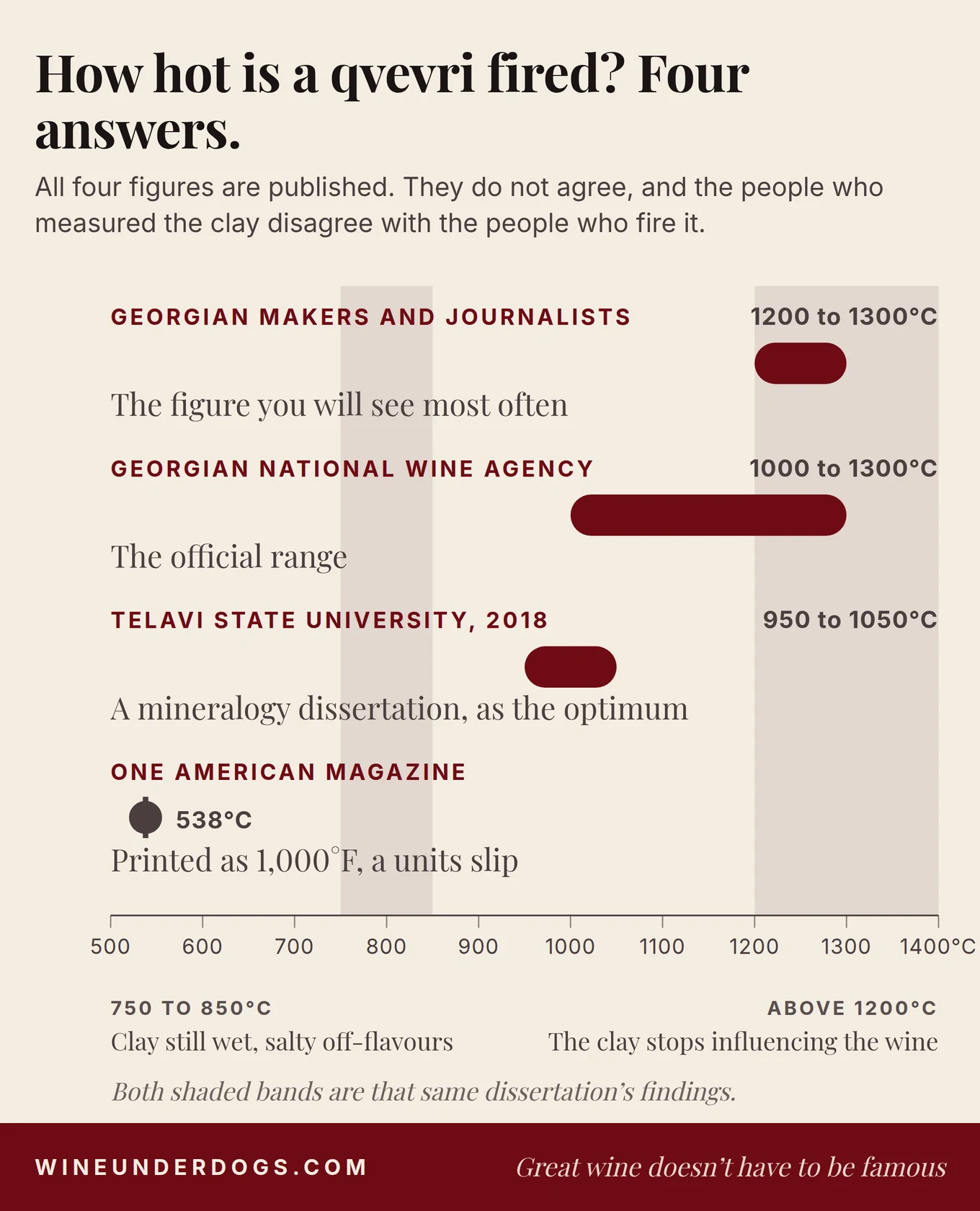
So: somewhere between 900 and 1300°C, and the people who have actually measured it disagree with the people who fire them. I would rather tell you that than pick the roundest figure.
The beeswax, and the argument underneath it
While the vessel is still hot, or reheated with a fire of dried vine cuttings inside it, beeswax goes on. The wax is melted at 110 to 120°C, the qvevri is brought to around 70°C so it will absorb, and a cloth tied to a long stick is dipped and worked around the walls in circles from the bottom up. A thousand-to-fifteen-hundred-litre vessel takes roughly 1.5 to 2 kilos of wax. Before beeswax, Georgians used goat fat.
Every popular account says the wax sterilises the vessel. I could not find a single test behind that claim.
What has been tested is less romantic and more interesting. A 2021 study in Foods measured oxygen transmission through earthenware including Georgian qvevri material and found untreated samples had very high rates and were, in the authors' words, completely inappropriate for storing wine. Successive wax treatments on the same samples brought the rate down. A separate trial found the wax absorbs β-linalool, geraniol and two methoxypyrazines out of the wine sitting against it, and recorded that the same vessel leaked before it was waxed.
Put those together and the usual story inverts. The romance is that clay breathes and the earth and the vessel shape the wine. The measurement says raw clay is far too leaky to hold wine at all, that wax is the thing that makes a qvevri work, and that the wax both cuts the oxygen the romance celebrates and absorbs aromatics on its way.
Georgian winemakers say this out loud. Some hold that wine made in a qvevri coated in a thick layer of wax can hardly be called qvevri wine, because the wax stands between the wine and the clay that is supposed to be doing the work. Goode heard the same thing put positively: the wine needs contact with the clay for the proper qvevri experience.
That is a live disagreement inside the tradition, not a foreign criticism of it.
Into the floor
The hole is dug, the qvevri goes in, and sand and earth are packed tight on every side. Before or during burial the outside gets a jacket, most often lime and sand in roughly one to two parts with rubble and sandstone fragments worked in, at ten to twenty-five centimetres thick. Some makers add iron wire. The jacket is not decoration. It is there for transport and for earthquakes.
The neck finishes flush with the floor. Every source agrees on this and it is the detail that makes a marani photograph the way it does: you walk into a room and see openings, not vessels. The floor around them is usually brick, often with a brick collar ringed around each mouth. When a qvevri is closed, wet clay is coiled around the lid and a heavy stone set on top.
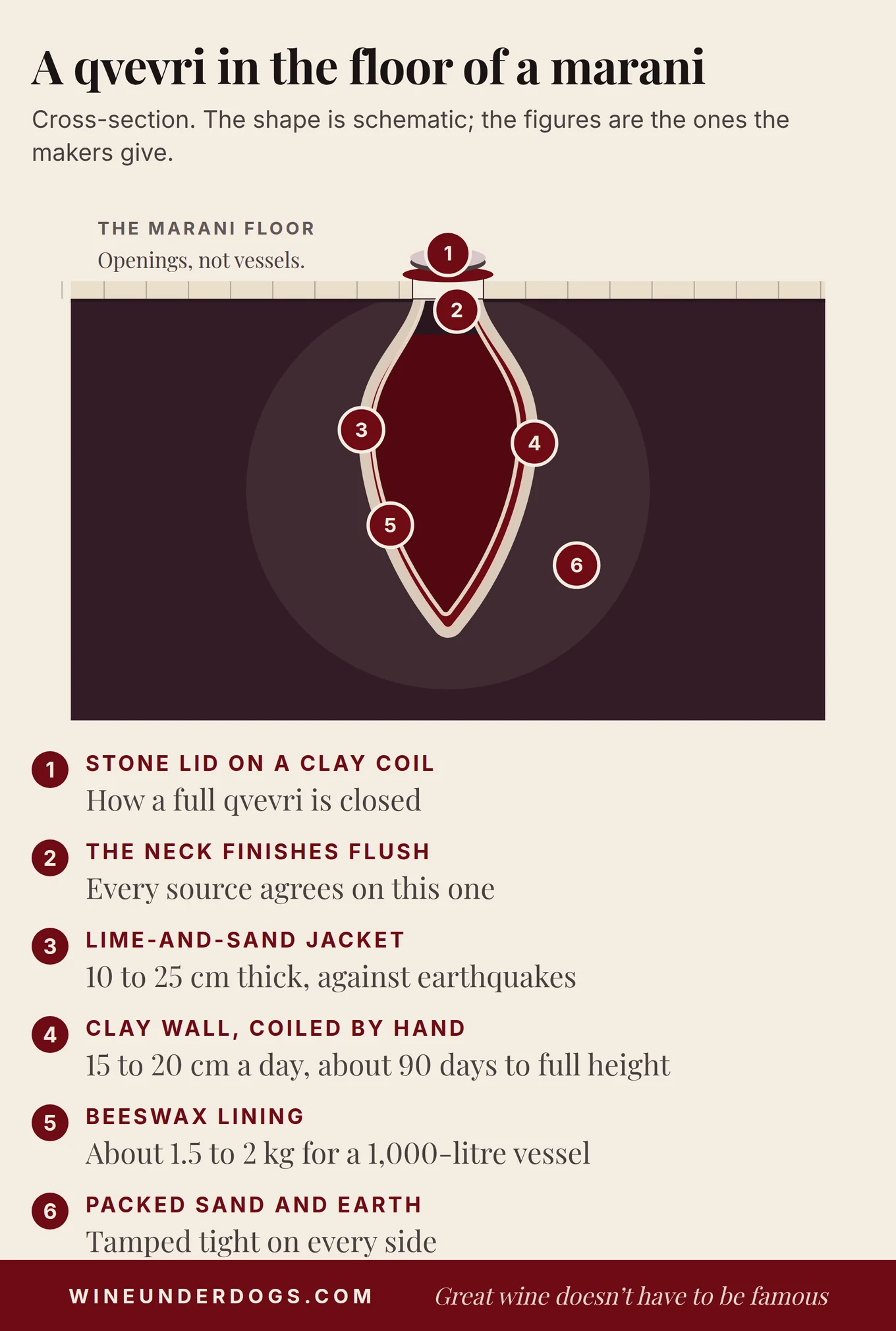
Marani is the word for the cellar, and UNESCO's own text says wine cellars are still considered the holiest place in the family home.
Now the part everybody explains and nobody has measured properly. The standard answer for why a qvevri is buried is temperature: the earth holds it steady through fermentation. The only specific figure I could find is 13 to 15°C, stated once by the Georgian National Wine Agency, undated, with no measurement behind it and no control. I am not going to repeat it as a physical constant, because it is not one.
There is also a second explanation that gets far less attention. As these vessels grew, they became unstable under their own weight and under fermentation pressure, and burying them solved a structural problem. On that reading the cooling is a happy consequence rather than the purpose.
And burial is not even universal inside Georgia. In Kakheti the qvevri goes under the cellar floor. In western Georgia, by the Wine Agency's own account, winemakers keep sealed qvevri in the open air. A practice that half the country does without rather undercuts the idea that the earth is the essential ingredient.
Size matters more than the ground does, in fact. A 2,000-litre qvevri can hit 28 to 30°C at the peak of fermentation. A 200-litre one peaks around 22 to 24°C. The earth is doing less work than the volume is.
What happens when one breaks
It is a loss. Goode puts it flatly: if broken, they cannot be repaired, and well maintained they can last for centuries. Decanter is more conservative and says decades. Leakage is a real risk if the clay was badly mixed or the firing was off, and one named cause is cleaning: hot water under pressure can crack a qvevri, which is why Gogi Dakishvili cleans his with limestone ash and water instead, and calls cleaning the most important job in the cellar.
What nobody publishes is what a winemaker actually does with the vintage inside a qvevri that fails in the ground. I looked. That is a question for a Georgian cellar, not for the literature, and if I get an answer I will come back and add it.
Back in the day
The famous claim is 8,000 years, and it comes from two Neolithic mounds about fifty kilometres south of Tbilisi, Gadachrili Gora and Shulaveris Gora. Eight pottery sherds tested positive for tartaric acid, along with malic, succinic and citric acid. Radiocarbon dates the context to roughly 6000 to 5800 BC. One reconstructed jar is about a metre tall and a metre wide, holds around 300 litres, and has what look like grape clusters modelled around the mouth.
Be careful how you carry that. Tartaric acid is a marker for grape, not for wine. It shows grape material was in the pot. The wine reading rests on the combination of four acids together with grape pollen, starch and skin remains in the surrounding contexts and the climate reconstruction, which is a strong circumstantial case rather than a direct observation. A 2020 review in STAR is blunter still: currently none of the proposed chemical biomarkers for wine provide unequivocal evidence. Tartaric acid occurs in other fruits and migrates into buried pottery from the soil around it, and the authors document a published case where it turned out to be Viburnum.
And Georgia is not the only country in this argument, which is the part English writing about qvevri usually leaves out. Armenia has Areni-1, a cave in Vayots Dzor dated to around 4100 BC, holding a clay basin press, a fermentation vat and storage jars of its own tradition, called karases rather than qvevri. That is not the oldest wine residue. It is the oldest winemaking facility anybody has found, which is a different title in a different country. Anatolia has the küp, a clay wine vessel running from forty litres to four thousand.
Oldest residue and oldest winery are two claims measured two ways. No country holds both, and each national export body quotes the one it wins.
The other thing worth noticing is what the ancient vessels were not. That 300-litre jar is a quarter the size of a working cellar qvevri today, and a twentieth of the biggest in Kakheti. They were decorated, where modern ones are plain. And whether they were buried is an inference from their rounded bases rather than something anybody dug up in situ, which is how the excavators phrase it and how you should too.
The century that nearly ended it
Here is the part the 8,000-year line skates over, and it is the reason I wanted to write this piece.
Georgia was annexed in 1921 and winemaking was collectivised into a handful of state factories. Steel replaced clay. In Kakheti officials uprooted hundreds of native varieties in favour of a few high-yielding ones. By the 1980s Georgia was making enormous volumes of commercial wine, most of it going north, and virtually none of it in qvevri. At one winery the state decided in the 1980s that qvevri were too costly, and had most of them pulled out and sold.
Whether qvevri making was actually illegal is disputed and I am not going to resolve it. One account says it was never illegal, just economically dead, done in people's spare time because there was no money in it. Another says private production was forbidden outright and that vessels found in homes were destroyed. Those cannot both be true as written, and no source I read reconciles them.
What is not disputed is the shape of it. Simon Woolf put it as plainly as anyone: the qvevri died out in commercial winemaking during the late twentieth century. It survived in basements. Ramaz Nikoladze's line is the one to keep: we never stopped making wine in qvevri.
So the honest version is not an unbroken 8,000-year tradition. It is an 8,000-year practice that the commercial industry abandoned for roughly seventy years while households kept it alive, and which has been rebuilt commercially since the 2000s. I think that is a better story, and I am correcting our own Georgia piece, which says the tradition never stopped. It did, in the place where most wine is actually made.
UNESCO inscribed the method in 2013, on the Representative List of the Intangible Cultural Heritage of Humanity. Not the World Heritage list, which is a different instrument, and which even the Georgian Wine Association's own site gets wrong. In 2021 the vessel itself was granted a Georgian Protected Geographical Indication, the first non-agricultural product ever entered on that register, which means a qvevri made outside Georgia is not a qvevri in Georgian law.
One number I will not give you
How many qvevri makers are left. You will see two, three, four, five, a handful, seven or eight families, fewer than a dozen. Those come from Newsweek, Decanter, an MW, Jamie Goode and several travel sites, across twelve years. Not one of them traces to a registry, a census or a trade body.
The craft is clearly small and clearly fragile. Goode is the only writer I read who says plainly that he does not know how far his own count reaches. It might be the whole country. It might be the region he was standing in. That admission is why his is the number I would trust. If you see a confident one, ask who counted.
If you want to taste what all this is for, start with Saperavi and the Georgian reds, or with the whites the method suits best: Rkatsiteli, Kisi and Mtsvane.
Fair warning before you go looking. I did not open a retailer for this piece, so I am not going to tell you what is on the shelf this month, and I am not going to send you to a search page and call it a recommendation. When I check, it goes in the piece with the date I checked it.
The thing I can point you at without hedging is a book.
Disclosure: some links here are affiliate links — if you buy through them I may earn a small commission, at no extra cost to you. As an Amazon Associate I earn from qualifying purchases. Learn more You must be 21+ to buy alcohol in the United States.Wine.com is the seller: they take the payment, ship the bottle and handle returns, and what's available depends on the state you pick at checkout. I never see your order.
Alice Feiring spent her odyssey in exactly these cellars, and the qvevri makers are in it as people rather than as a technique. It is the closest thing in English to standing in a marani, and it is where a lot of what is above came from originally.
Alice Feiring, For the Love of Wine (opens on Amazon) Hardback, Potomac Books 2016 · price checked September 2026The catch: it is a travel memoir, not a manual. If you came here for kiln temperatures you will not find them, and Feiring is openly partisan about natural wine, which colours who she visits and who she does not.
And if you want somewhere to start drinking rather than reading, the Underdog Starter List is ten bottles under twenty-five dollars with what each one tastes like and what famous wine it replaces.
— Chris Berry
Frequently asked questions
What is a qvevri?
An egg-shaped earthenware vessel, buried to its neck in the floor of a Georgian cellar, used to ferment, age and store wine. Also romanised kvevri. Western Georgia's churi is a different word for a related and usually smaller vessel. The UNESCO listing covers the winemaking method rather than the pot itself.
How long does it take to make a qvevri?
Around ninety days for a mid-sized vessel. Only 15 to 20 centimetres of clay can be added at a time and each ring needs at least twenty-four hours to dry before the next one goes on.
Why is a qvevri buried in the ground?
The usual answer is temperature: the surrounding earth buffers swings during fermentation. A second explanation is structural, that big clay vessels are unstable under their own weight and under fermentation pressure, and the cooling was a side effect. Both are argued and neither is settled.
Why is a qvevri lined with beeswax?
Because raw earthenware is too porous to hold wine. Testing has shown untreated material lets through far too much oxygen and liquid, and that wax treatment cuts it. Wax also absorbs some aroma compounds, which is why some Georgian winemakers argue a heavily waxed vessel is barely a qvevri at all.
FREE DOWNLOAD
Get the Underdog Starter List
10 lesser-known bottles under $25 worth chasing — plus the weekly underdog read. No snobbery, just good wine.