
 Chris BerryFounder, Wine Underdogs — chasing the world’s overlooked grapes
Brachetto is pronounced brah-KET-toh; Kabinett, KAB-ih-net.
If you want less alcohol and still want wine, buy a wine that was made light, not one that was stripped. Moscato d'Asti, Brachetto d'Acqui and a Mosel Riesling Kabinett are low in alcohol because their makers stopped fermentation early, and nothing was taken out of them afterwards. If you want no alcohol at all, buy it sparkling. That's the short version, and it will save you from most of the disappointing bottles in this aisle.
Two different products wearing one shelf
"Low and no" gets sold as a single category. It isn't. One half is ordinary wine that happens to be light. The other half is wine that was made at full strength and then had its alcohol pulled out by a machine.
The first kind is old, and in the case of Moscato d'Asti it's written into law. The second kind is newer, and it's the one crowding the end caps.
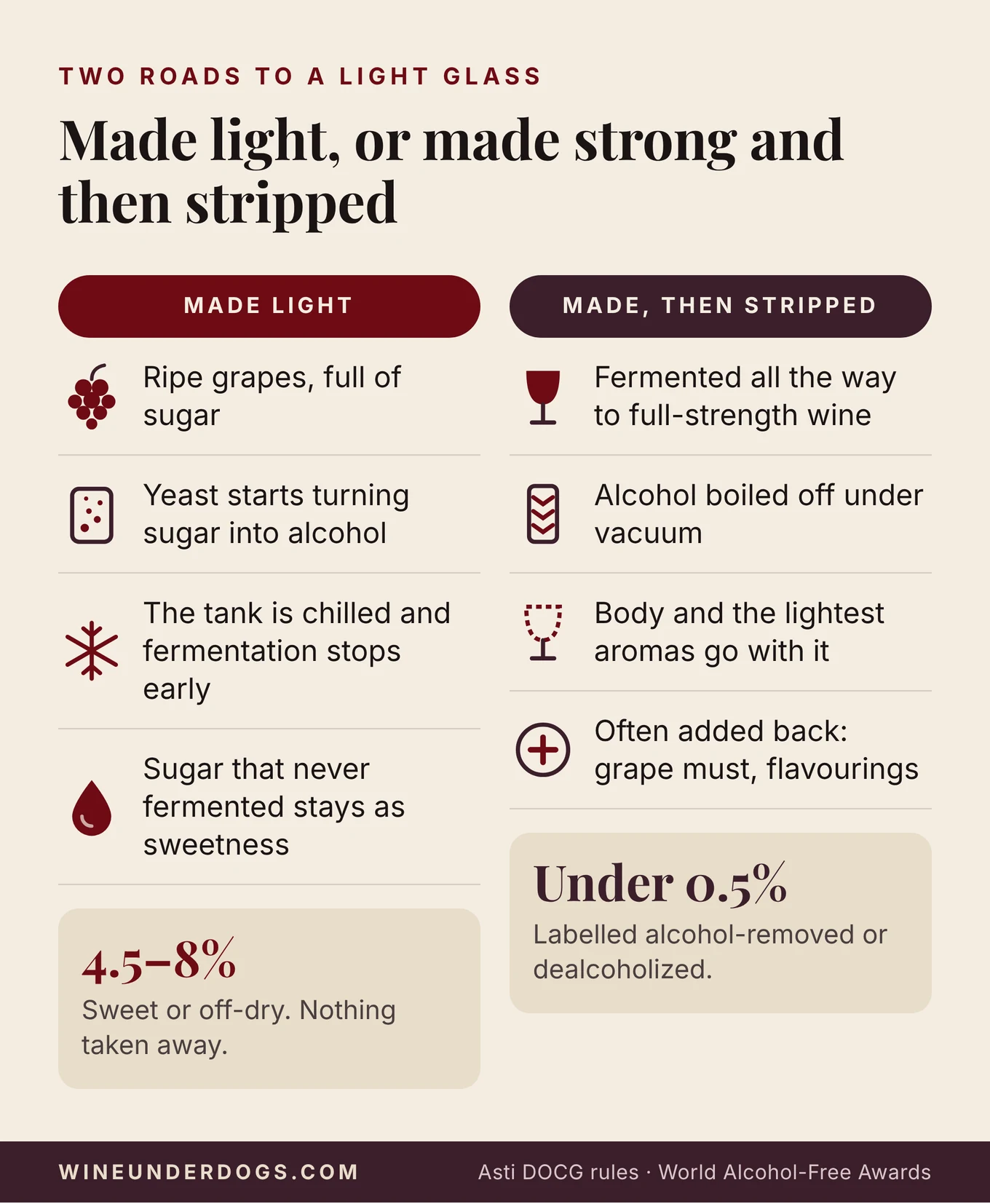
Neither is a lesser drink. They're just different, and the label tells you which one you're holding if you know where to look.
What the label words mean
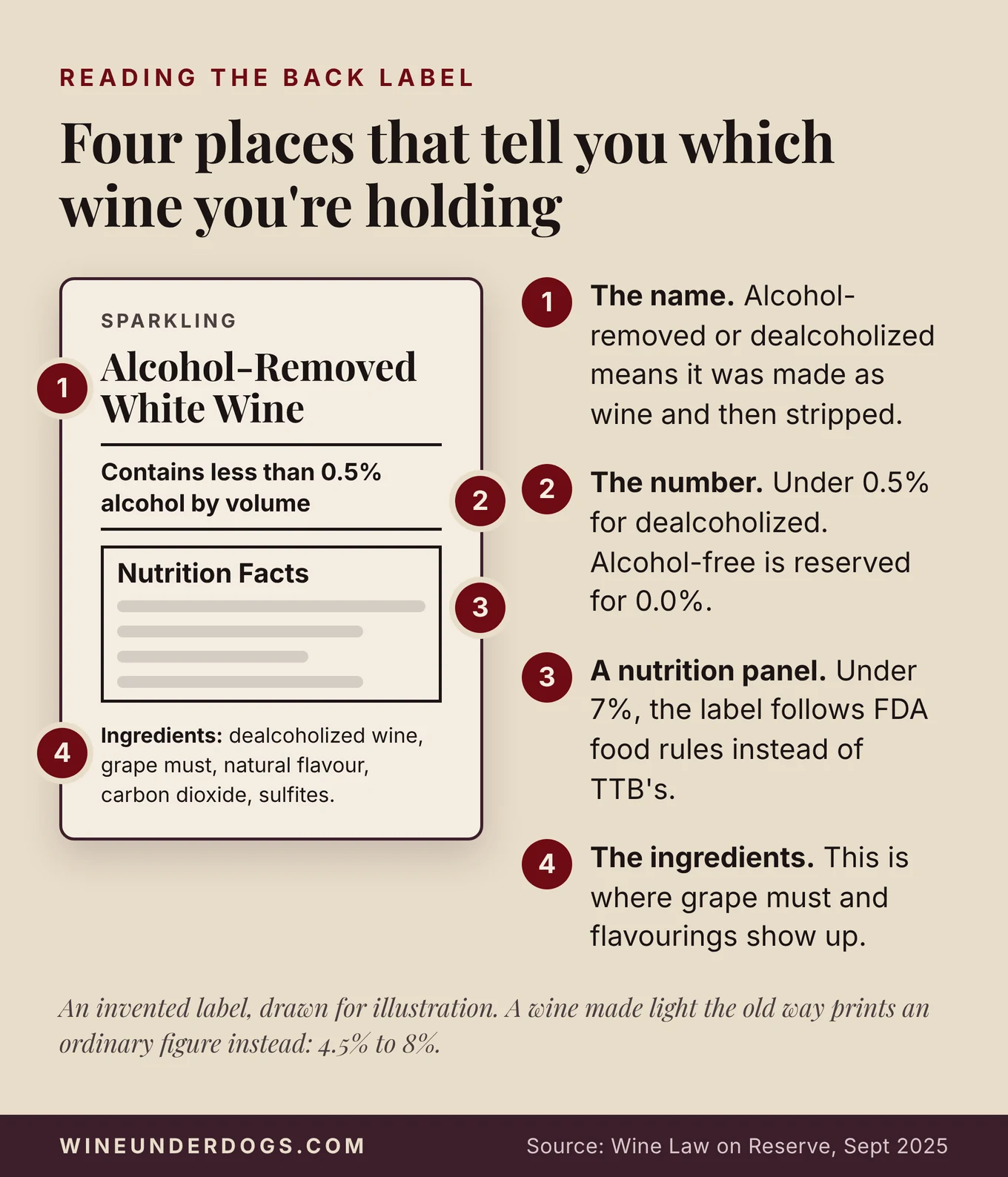
In the US, the alcohol line on the bottle also decides who writes the rules for the label. Wine at 7% and above is labelled under the federal alcohol regulator, TTB. Below 7%, labelling moves to the FDA, which treats it more like a food. Wine lawyer Lindsey Zahn set out the split in September 2025, and the three terms you'll meet break down like this:
| On the label | Alcohol | What it tells you |
|---|---|---|
| Alcohol-free | 0.0% | Nothing left at all |
| Alcohol-removed, dealcoholized | Under 0.5% | Made as wine, then stripped |
| A normal ABV figure under 7% | 4.5% to 7% | Made light, usually by stopping fermentation |
Read the back label too. A bottle sold under the FDA's rules usually carries a nutrition panel and an ingredient list, which is where you'll see whether grape must or flavourings went back in.
How the alcohol comes out, and what goes with it
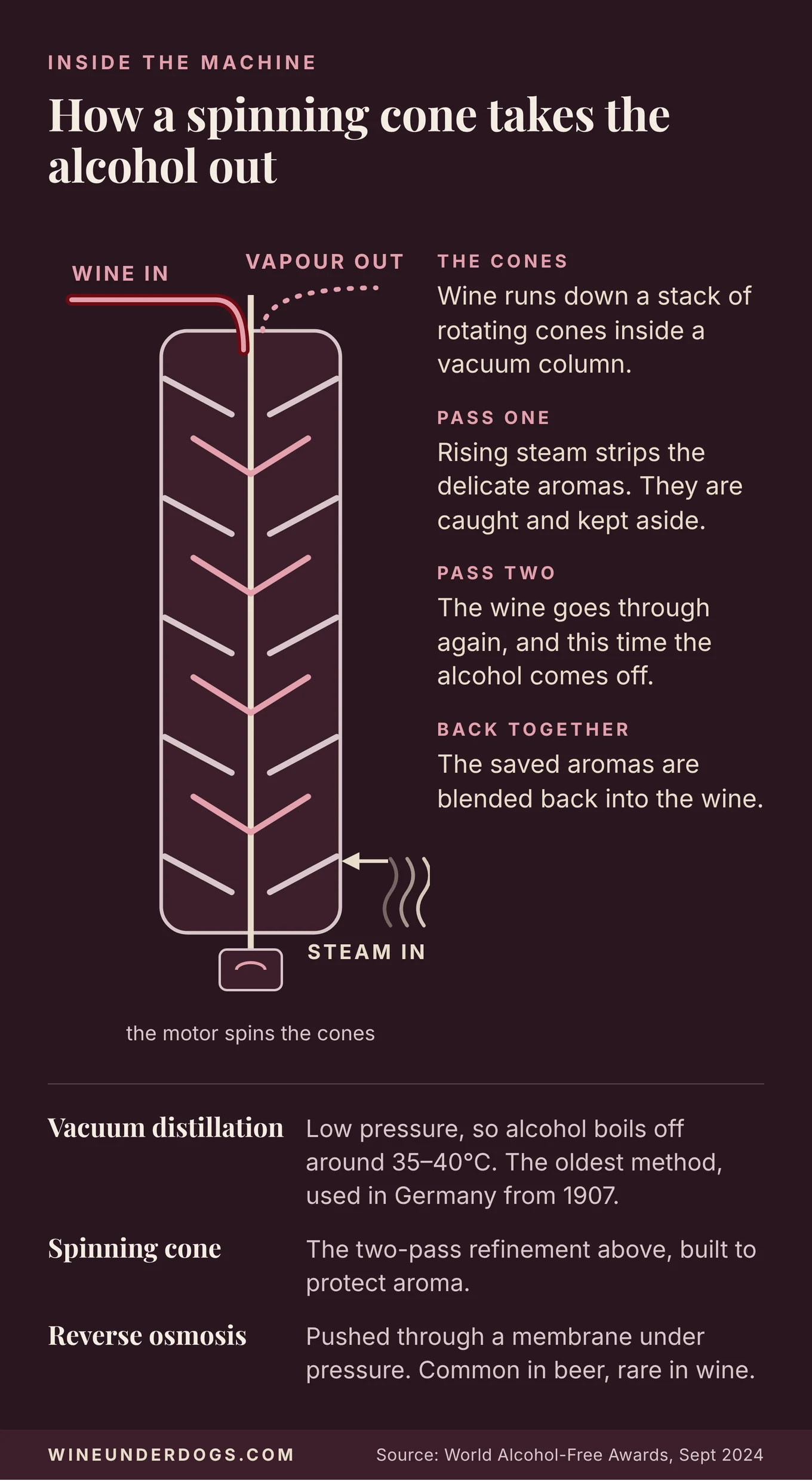
Most dealcoholized wine is made one of two ways. Vacuum distillation lowers the pressure so alcohol boils off at a lukewarm temperature, often 35 to 40°C, and the method dates to Germany in 1907. A spinning cone column is the refined version: the wine runs down rotating cones under vacuum, the delicate aromas are stripped and saved on a first pass, the alcohol comes off on a second, and the aromas are blended back. Reverse osmosis, which pushes alcohol through a membrane, is common in beer and rare in wine. The World Alcohol-Free Awards' primer lays all three out plainly.
The brochures skip the cost. Alcohol is part of a wine's body, not just its strength, so taking it out leaves the wine thinner. The lightest aromas, the citrus and the grassy notes, are the easiest to lose. And tannin barely moves, which is why a dealcoholized red can end up all grip and no flesh. Producers patch the gap with unfermented grape must for body and, increasingly, with added flavourings.
That's my case for bubbles, and it's a judgment rather than a measurement. Carbon dioxide gives the palate something to hold onto when the alcohol is gone, so a sparkling non-alcoholic wine has less to hide than a still one.
The wines that were made light
The trick behind every naturally low-alcohol wine is the same. Yeast turns grape sugar into alcohol, and if the winemaker chills the tank and stops it partway, the sugar that wasn't converted stays in the wine as sweetness.
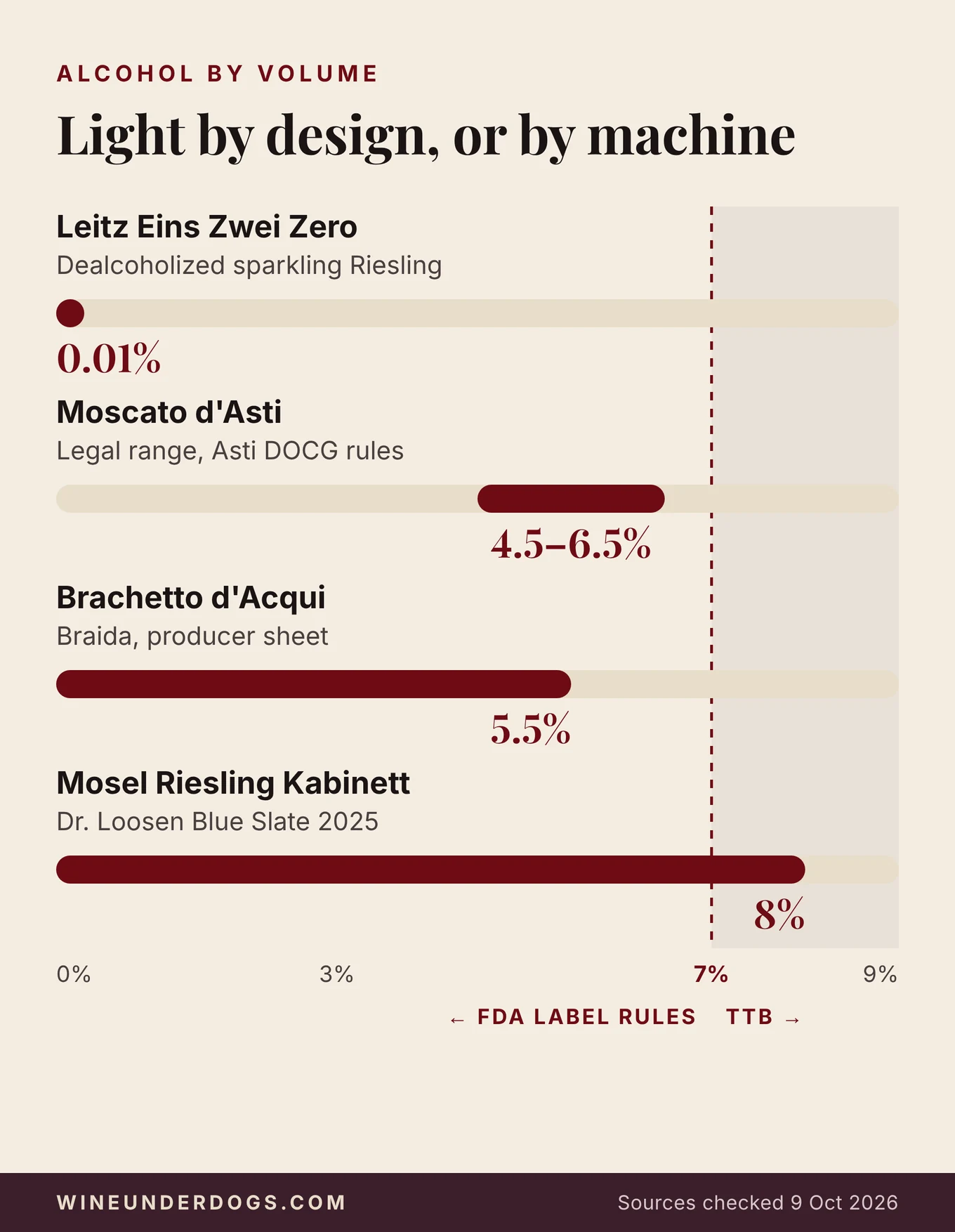
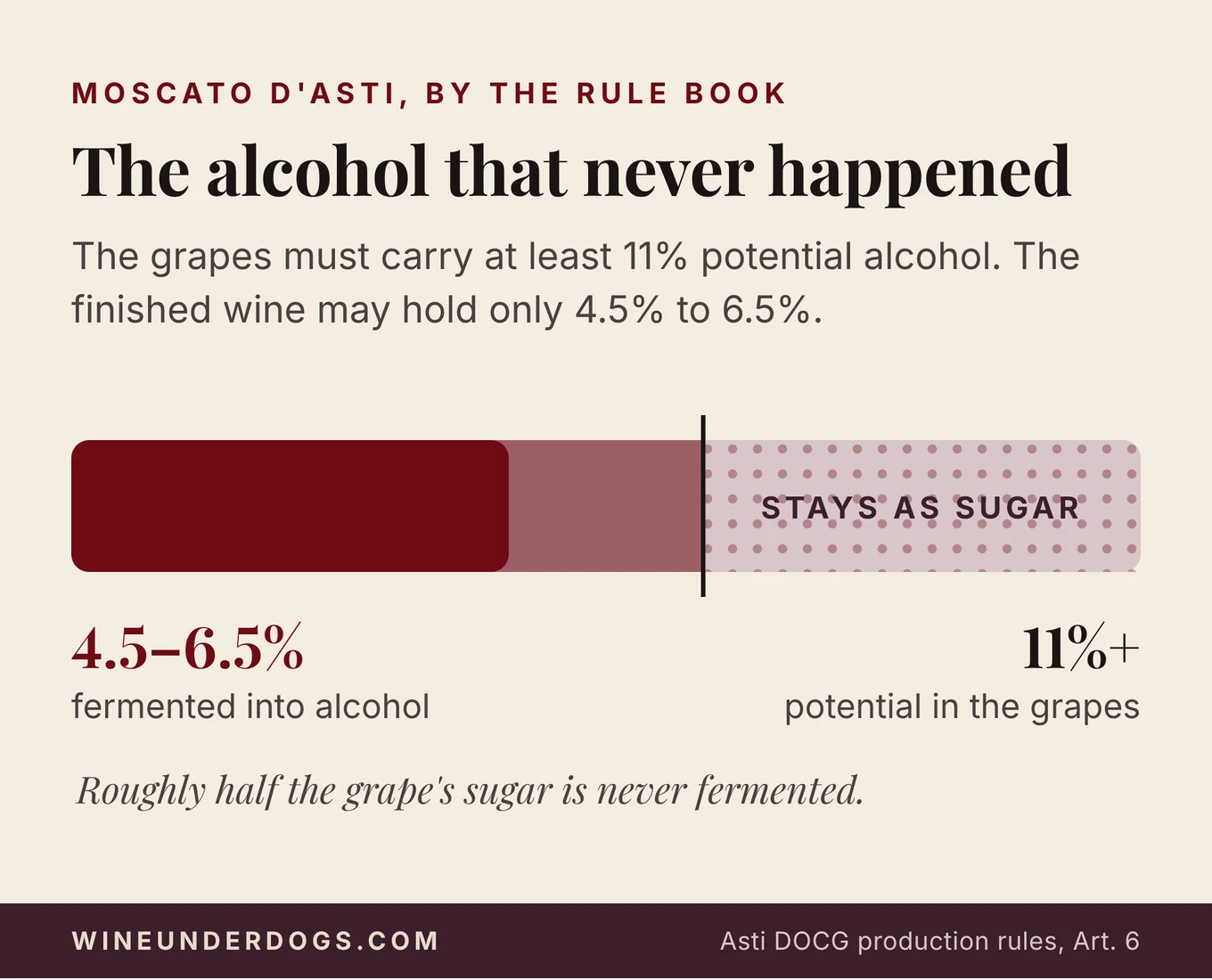
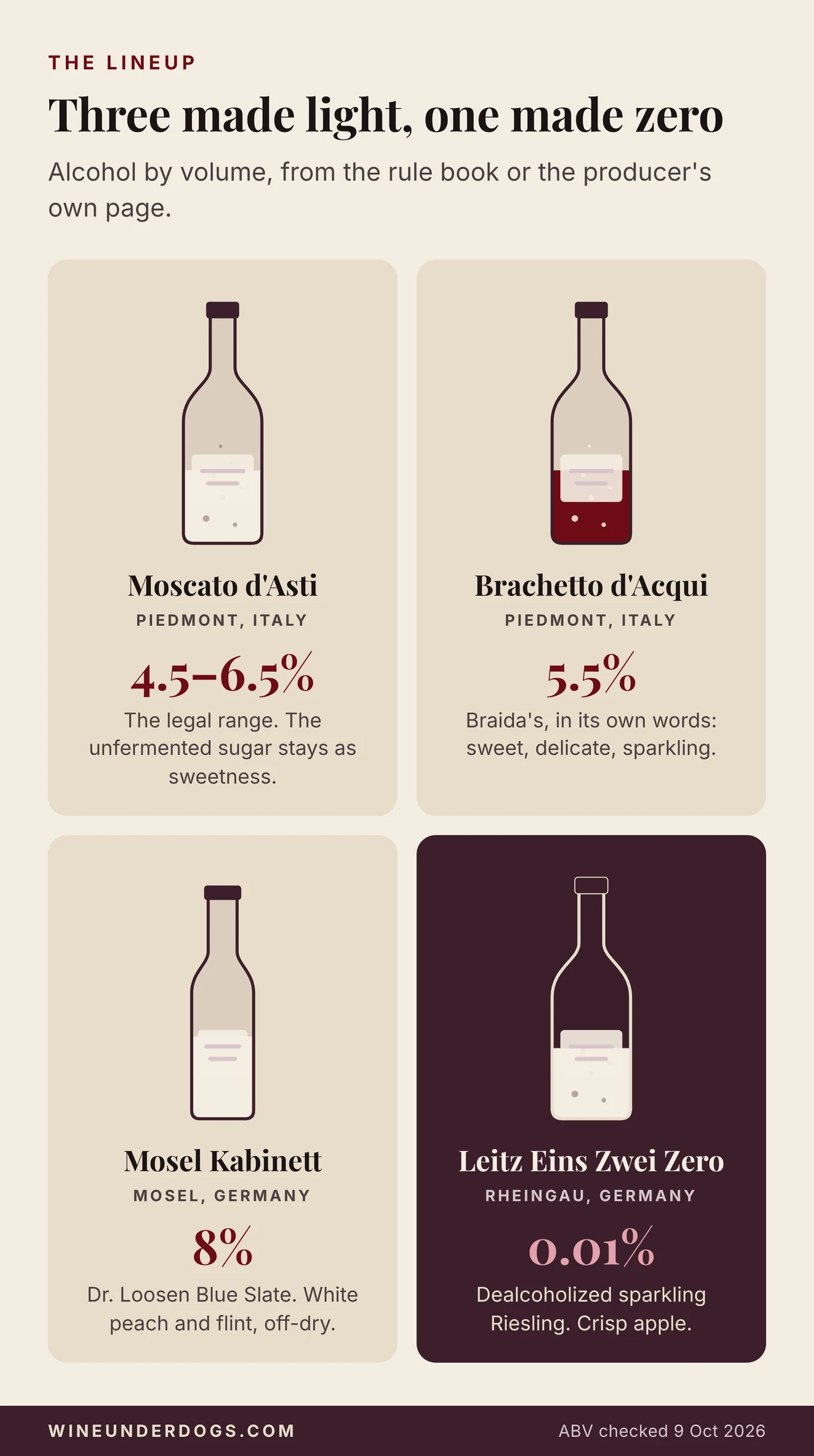
Moscato d'Asti shows it in black and white. The appellation rules require the finished wine to hold between 4.5% and 6.5% alcohol while its grapes carry a potential of at least 11%, according to the Asti DOCG production rules published by the Piedmont region. Roughly half the alcohol those grapes could have made was never made at all. It's still in the glass as sweetness.
Brachetto d'Acqui is the underdog of the three, and the one I'd put in front of a red-wine drinker. It's a sparkling red from the same corner of Piedmont, made from the aromatic Brachetto grape. Braida's version is listed at 5.5%, with fermentation stopped shortly before the end to keep its sweetness. The producer's own words for it are sweet, delicate and sparkling.
Mosel Riesling Kabinett is the most familiar of the three. Kabinett is the lightest of Germany's ripeness levels, and on the Mosel it's usually made off-dry: Flatiron Wines lists the 2025 Dr. Loosen Blue Slate as off-dry at around 8%. If Riesling is already your grape, our wines like Riesling guide picks up from here.
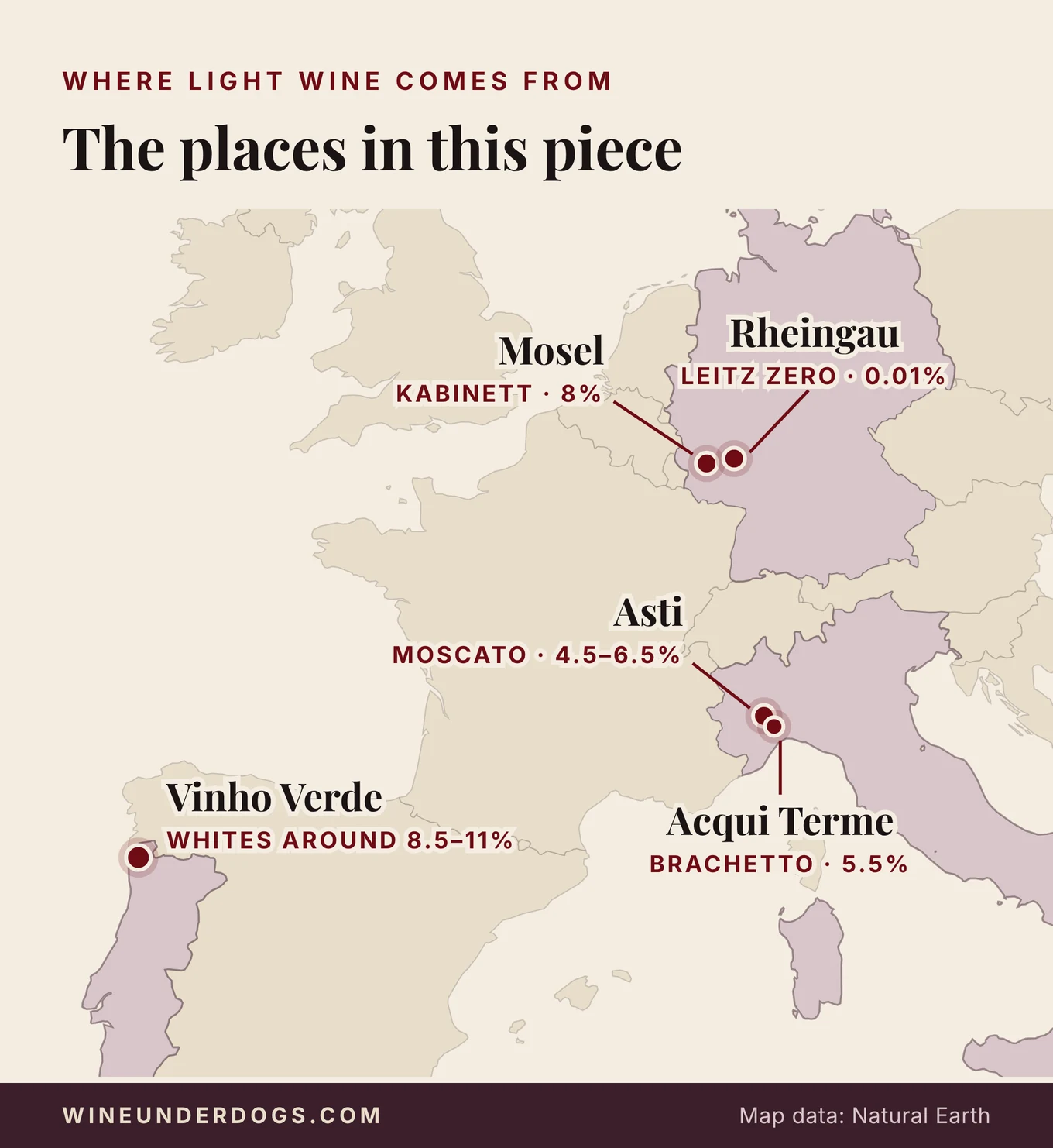
And if you want light without the sweetness, read the alcohol line rather than the style name. Vinho Verde's whites typically run around 8.5% to 11%, and Portugal's 2016 regulation lets its grapes be picked at as little as 8.5% potential alcohol. Some are made with a touch of sweetness, so check the back label. Skip the Alvarinho if you're counting, since its grapes must reach 11.5% before they're picked.
What to skip
Skip still red dealcoholized wine for now. The tannin stays and the body goes, and it's the style the process treats worst. Skip any low-alcohol bottle that hides its ABV, because a light wine has every reason to print the number. And skip the expectation that a 5% wine will drink like a dry 13% one with the volume turned down. It won't. It's a different wine, built on sweetness, and it's best taken on its own terms: cold, early in the evening, with something salty.
Where to buy
I chose these by one test: which bottle shows its category at its best and can actually be ordered in the US. I haven't tasted the current vintages, so the notes come from the producers' and retailers' own pages, checked on 9 October 2026. Both links go to Wine.com, which sells and ships the order; Wine Underdogs never handles it.
Disclosure: some links here are affiliate links — if you buy through them I may earn a small commission, at no extra cost to you. Learn more You must be 21+ to buy alcohol in the United States.Wine.com is the seller: they take the payment, ship the bottle and handle returns, and what's available depends on the state you pick at checkout. I never see your order.
Buy the Dr. Loosen Blue Slate Riesling Kabinett 2025 (opens on Wine.com) Around $22 · checked October 2026Mosel Riesling at 8%, from one of Germany's best-known estates, and the cleanest introduction to light wine that isn't a dessert. Its catch: it's off-dry. If you want bone dry, this isn't it, and nothing at 8% will be.
For a no-alcohol bottle, Leitz Eins Zwei Zero Sparkling Riesling comes from a Rheingau Riesling house and is listed at 0.01%, around $26 when checked. Its catch: it's still a dealcoholized wine, so expect crisp apple and bubbles rather than the depth of the estate's full-strength Riesling.
The honest gap is the Brachetto. I couldn't confirm a Braida bottle in stock at a US retailer on 9 October 2026. Ask a good Italian-leaning shop for Brachetto d'Acqui by name, and you'll learn fast whether they know it.
— Chris Berry
If you're cutting back
Start with the Kabinett at dinner, where its sweetness can meet spice or salt. Keep the non-alcoholic sparkling for the nights you want none, and pour it in a proper flute so it gets treated like wine. For more swaps outside the famous names, see Wines Like Prosecco.
Part of Lesser-Known Wines: 17 Obscure Grapes Worth Switching To, the full underdog-swap guide.
New to wine? Start here

Wine Match
Five guilty pleasures, yes or no. Ben finds the wine you’d actually like. You don’t need to know anything about wine. Ben certainly doesn’t.
Wine Underdogs is for readers of legal drinking age.
BenFive things. Yes or no. I'll do the rest.
Every wine fact here comes from the grape guides on Wine Underdogs. Ben has never opened a bottle, and neither does this game. For readers 21 and over.
Frequently asked questions
What is the difference between non-alcoholic and alcohol-free wine in the US?
Wine under 7% alcohol is labelled under FDA rules rather than TTB's. A wine may be called alcohol-free only at 0.0%. A wine that has had its alcohol taken out but still carries a trace under 0.5% should be called alcohol-removed or dealcoholized instead.
How is alcohol removed from wine?
Mostly by vacuum distillation, which boils alcohol off at low temperature, or by a spinning cone column, which strips the aromas first and blends them back after the alcohol is gone. Reverse osmosis, which filters alcohol through a membrane, is used more for beer than wine.
Which wines are naturally low in alcohol?
Wines whose fermentation is stopped early so grape sugar stays in the bottle: Moscato d'Asti (4.5% to 6.5% by rule), Brachetto d'Acqui (around 5.5%) and Mosel Riesling Kabinett (often around 8%). All three are sweet or off-dry, which is the trade-off.
What is the best style of non-alcoholic wine?
Sparkling, in our view. Removing alcohol takes body and some of the lighter aromas with it, and bubbles give the palate something to hold onto. Still reds have the hardest time, because their tannin stays while the body that balanced it goes.
JOIN THE PACK
Whatever you drink now, there's an underdog you'd like more.
One overlooked wine at a time: what it tastes like, the famous one it can replace, and the catch. Free.