
 Chris BerryFounder, Wine Underdogs — chasing the world’s overlooked grapes
Bring Petit Verdot. Most Hanukkah tables will get a kosher Cabernet this year, because that's what the kosher shelf mostly holds. Petit Verdot is the grape Bordeaux adds to Cabernet by the splash, for color and spine, and almost never bottles on its own. In Israel's heat it ripens all the way, and a handful of kosher wineries now let it stand alone.
The bottle I'd bring is Shiloh's Secret Reserve Petit Verdot 2020: dark and full-bodied, with black plum and spice in the producer's own notes. I haven't opened one yet, so I'm recommending the grape and the style rather than a glass I've poured. When I do open it, this page will say what I found.
Why Petit Verdot, and why Israel
The name means "little green one," and in Bordeaux that's the problem. It ripens so late that in a cool Bordeaux year it barely ripens at all, so it lives as a seasoning: a few percent in the blend, never the headline.
Give it a long, hot season and it changes character. Israeli winemakers found that their warm climate softens the grape's hard edges and brings out licorice and dark fruit. Over the last decade, single-varietal Petit Verdot has gone from a curiosity to something several kosher wineries make on purpose.
That's the swap. If your table usually gets Cabernet, Petit Verdot gives you the same depth and structure from a grape most of the guests have only ever drunk as a footnote.
The one to ask your shop for: old-vine Carignan
The bottle I wanted to put first is Israeli old-vine Carignan, from the same grape I've written about in the Languedoc and Priorat. Before Israel's modern wine boom, a lot of its everyday red was Carignan, and it wasn't good. When the industry rebuilt itself on Cabernet and the Bordeaux grapes, some producers kept their oldest Carignan vines anyway, cut the yields and started treating the wine seriously. Kosher bottlings come from the Galilee, the Carmel slopes and the Judean Hills.
Here's the honest part: when I checked on October 26, every kosher Carignan on Wine.com was sold out, thirteen listings across two producers. Ask a kosher wine shop. It's worth the request.
Read the label for two words
The first is the kosher certification symbol. The second is mevushal, or its absence.
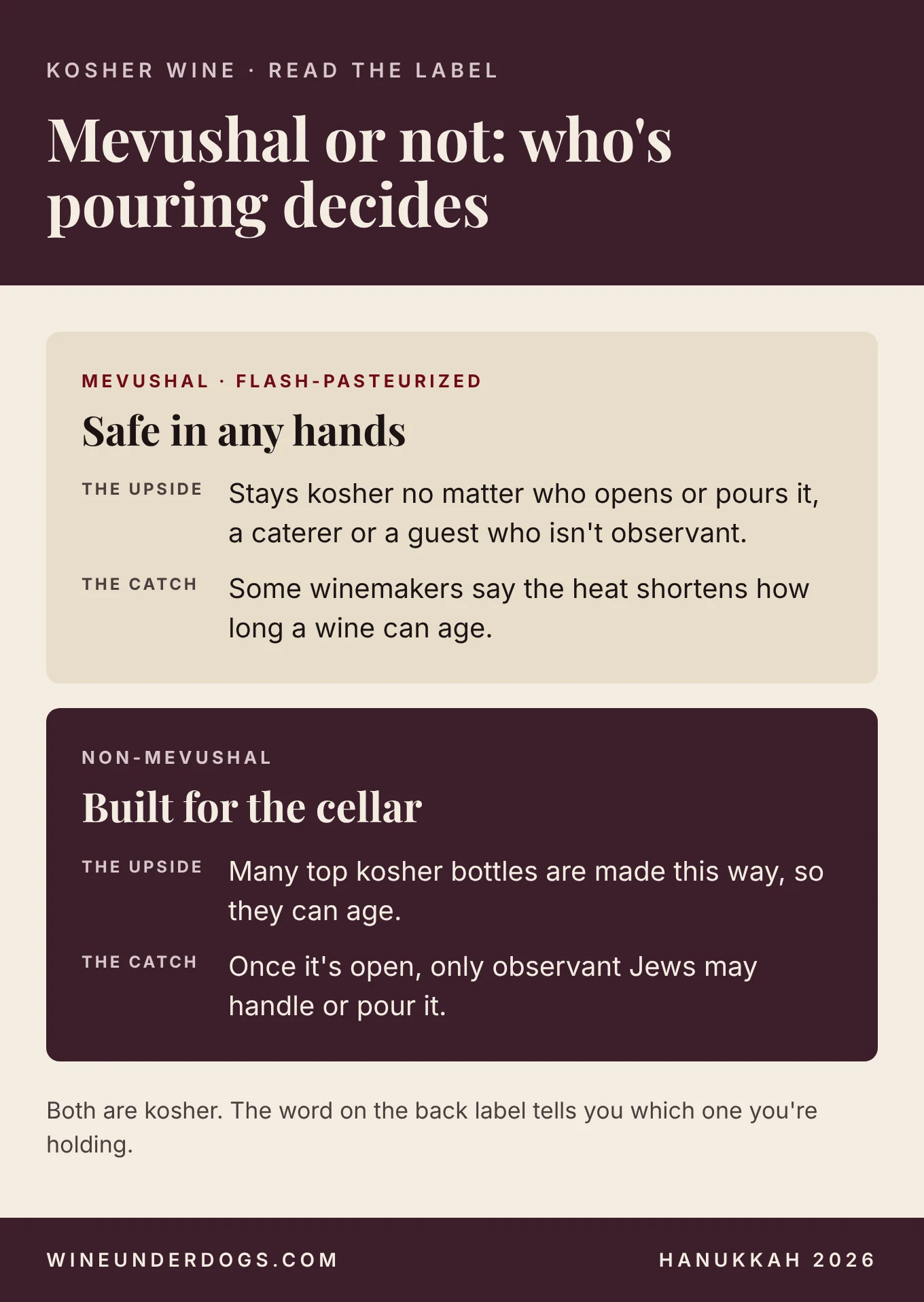
Mevushal means cooked. Today it almost always means flash pasteurization: the wine is heated for a moment and cooled again. Rabbinic authorities disagree about whether that truly counts as cooking, which is why some bottles say mifustar (pasteurized) instead. What it does in practice is simple. A mevushal wine stays kosher no matter who opens or pours it, so if a non-observant guest or a caterer will be pouring, mevushal is the safe choice. A non-mevushal bottle must be handled by observant Jews once it's open. Check the back label of any bottle you buy, the Shiloh included.
Does the heat hurt the wine? Winemakers disagree, and the honest answer is that it depends on how it's done. Plenty of serious kosher wineries flash their wines. Many of their top bottles are left non-mevushal so they can age. For a bottle you're opening in December, choose by who's pouring, not by worry.
The deep end: Israel's own grapes
If you want the truly obscure bottle, Israel has a short list of grapes that exist almost nowhere else.
- Argaman is Israel's own red, a cross of Carignan and the Portuguese Souzão bred at the Volcani Institute in 1972. For decades it was filler. A few wineries now bottle it on its own, from bright and crunchy to oak-aged.
- Marawi, also called Hamdani, is a white grape that survived as a table grape. The first modern wine from it was Recanati's 2014.
- Dabouki is a white that may have its roots in Armenia. One Israeli winery makes a naturally sparkling pét-nat from it.
I haven't found any of these three on an American shelf for this December. They're worth asking a kosher wine shop about. Don't count on finding them the week before the first candle.
The catch
Petit Verdot made in a hot place is big wine. The Shiloh runs 14.5% alcohol and leans ripe, so it wants brisket, not latkes alone. And if your host keeps a strictly kosher table, check with them on certification before you buy. Some households hold to specific certifying agencies.
Hanukkah 2026 starts at sundown on Friday, December 4, the same evening as Shabbat. Shipping slows in December, so order early.
One reader is already ahead of me. Marissa Kaczmarek of Temple Israel of Brevard passed this page on before I'd poured a drop. "I've already sent it to my favorite tribe people," she told me. She's also said she'll get the Shiloh herself and follow up, so the first word on how it drinks may come from her table rather than mine. Either way, it goes here.
— Chris Berry
If you're switching from a famous grape
If Cabernet Sauvignon is the kosher bottle you always bring, Petit Verdot is the grape Bordeaux tucks into its Cabernet blends, finally given the whole stage. See Wines Like Cabernet Sauvignon for the full swap, and Order This Instead for the short version.
Part of Lesser-Known Wines: 17 Obscure Grapes Worth Switching To, the full underdog-swap guide.
New to wine? Start here

Wine Match
Five guilty pleasures, yes or no. Ben finds the wine you’d actually like. You don’t need to know anything about wine. Ben certainly doesn’t.
Wine Underdogs is for readers of legal drinking age.
BenFive things. Yes or no. I'll do the rest.
Every wine fact here comes from the grape guides on Wine Underdogs. Ben has never opened a bottle, and neither does this game. For readers 21 and over.
Frequently asked questions
When is Hanukkah in 2026?
Hanukkah 2026 begins at sundown on Friday, December 4, and ends at nightfall on Saturday, December 12. The first candle falls on a Friday evening, at the start of Shabbat.
What does mevushal mean on a kosher wine label?
Mevushal means cooked. Today it almost always means flash pasteurization: the wine is heated quickly and cooled again. A mevushal wine stays kosher even when someone who isn't an observant Jew opens or pours it, which is why caterers and restaurants ask for it. Non-mevushal wine must be handled only by observant Jews once opened.
Does mevushal wine taste worse?
Opinions differ. Some winemakers and critics say flash pasteurization is hardly noticeable; others say it shortens a wine's ageing potential, which is why many high-end kosher wines are made non-mevushal. For a bottle you'll open this December, it matters less than who will be pouring it.
Is all Israeli wine kosher?
No. Not all kosher wine is made in Israel, and not all Israeli wine is kosher. Look for a kosher certification symbol on the label, and check whether it also says mevushal.
JOIN THE PACK
Whatever you drink now, there's an underdog you'd like more.
One overlooked wine at a time: what it tastes like, the famous one it can replace, and the catch. Free.