 Chris BerryFounder, Wine Underdogs — chasing the world’s overlooked grapes
If you like a red with grip and you are tired of paying Barolo money for it, try Lagrein, the dark grape from the valleys around Bolzano. That is the useful thing a new grape chemistry atlas has to say to a drinker. Scientists in Trentino measured the molecules in 126 grape varieties, and Lagrein landed among the richest in tannin building blocks, next to Nebbiolo and Aglianico.
The atlas in 51 seconds
If you'd rather watch than read, Ben and Sadie walk through the map: what the islands are, why Gewürztraminer sits with the Muscats, and where Lagrein lands.
What the scientists actually did
The atlas comes from Fondazione Edmund Mach, the research institute at San Michele all'Adige, a short way down the Adige valley from where Lagrein grows. It was published in the Journal of Agricultural and Food Chemistry in August 2026, and it is free to read.
The team took grapes from 126 grape types in the institute's own collection, three vines apiece, all grown the same way, on the same trellis, in rows facing the same direction. They picked each variety at the same sugar level, about 18 degrees Brix, in four vintages from 2007 to 2010. Then they ran 462 samples through a mass spectrometer and let a clustering method arrange the varieties by how alike their chemistry is.
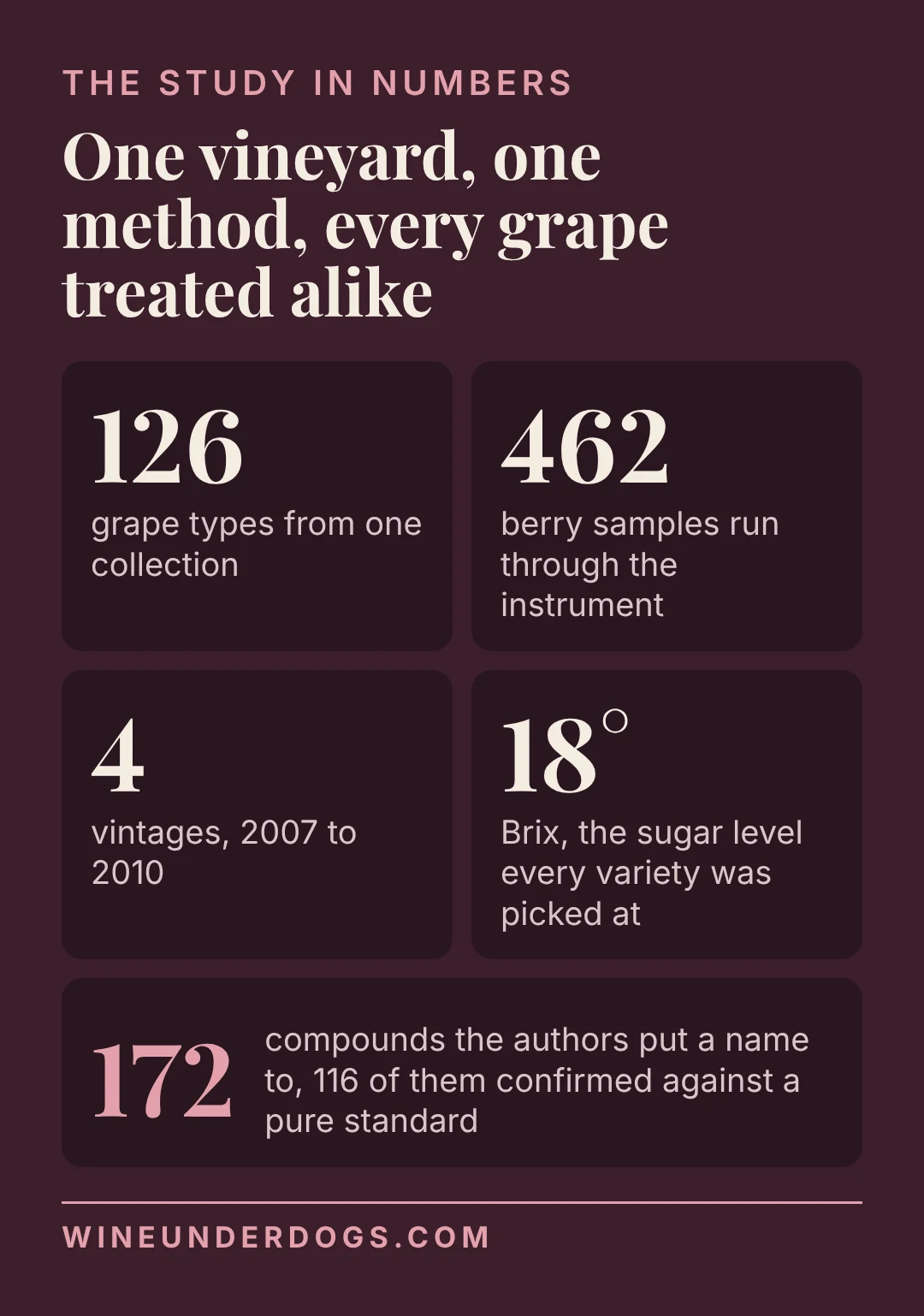
Grape family trees are usually drawn from DNA. This map groups varieties by what the berry is made of. It's a different question, and the answers mostly line up with the family trees, which is a useful check in itself.
Twenty-one of our grapes are on the map
The panel is mostly Italian, which makes sense for a collection in Trentino, but it reaches well past Italy. Twenty-one grapes from this site's own guides are in it.
The figure below sets the study's own two kinds of family side by side. Each grape sits on an island for its DNA family, from an earlier genetic study of the same vineyard collection that the paper uses to pick its panel. The chemistry clusters are the groups the molecules drew. Pick one and watch where it reaches: the Aromatic cluster pulls Gewürztraminer in from the Central European island to sit with the Muscats.
Grape chemistry atlas · 126 grapes, two family trees
Grouped by DNA. Connected by chemistry.
Each dot is a grape in the study, on an island for its DNA family. Pick a chemistry cluster to see which grapes the molecules put together, wherever their DNA sits.
Pinch or use the buttons to zoom. Tap a dot.
Pinch or use the buttons to zoom. Tap a dot.
Ringed dots are grapes this site covers; a dashed ring means not yet. Tap any dot to see its DNA family and its chemistry cluster.
Our grapes on the figure: DNA family and chemistry cluster
- Aglianico · Mediterranean wine and table grapes · no named cluster
- Alicante Bouschet · Mediterranean wine and table grapes · no named cluster
- Bianchetta Trevigiana (not covered yet) · Central European wine grapes · Bianchetta cluster
- Blaufränkisch · Mediterranean wine and table grapes · no named cluster
- Cannonau (Garnacha) · Mediterranean wine and table grapes · no named cluster
- Carmenère · Mediterranean wine and table grapes · no named cluster
- Catarratto · Mediterranean wine and table grapes · no named cluster
- Cesanese · Mediterranean wine and table grapes · no named cluster
- Debina (not covered yet) · Mediterranean wine and table grapes · no named cluster
- Erbamat (not covered yet) · Mediterranean wine and table grapes · no named cluster
- Frappato · Mediterranean wine and table grapes · no named cluster
- Gaglioppo · Mediterranean wine and table grapes · no named cluster
- Greco · the wild European vine (sylvestris) · no named cluster
- Grignolino · mixed ancestry, with no single group above 80% · no named cluster
- Lagrein · Mediterranean wine and table grapes · no named cluster
- Nosiola (not covered yet) · mixed ancestry, with no single group above 80% · no named cluster
- Piedirosso · Muscat-flavored grapes · no named cluster
- Refosco · Mediterranean wine and table grapes · no named cluster
- Ribolla Gialla · Mediterranean wine and table grapes · no named cluster
- Saperavi · Mediterranean wine and table grapes · no named cluster
- Schiava Grossa · Muscat-flavored grapes · Schiava cluster
- Schiava Lombarda · Mediterranean wine and table grapes · Schiava cluster
- Schioppettino · Mediterranean wine and table grapes · no named cluster
- Tannat · the wild European vine (sylvestris) · no named cluster
- Teroldego · mixed ancestry, with no single group above 80% · no named cluster
- Verdicchio · Mediterranean wine and table grapes · no named cluster
- Xarel·lo · Mediterranean wine and table grapes · Xarel·lo–Vermentino cluster
Saperavi is there as well, along with a few grapes this site hasn't covered yet: Erbamat, Debina, Nosiola and the four Bianchetta Trevigiana types.
What the map found
At the widest view the varieties fall into three regions: white grapes, red grapes, and a separate island of aromatic grapes. Wild American vines and rootstocks sit at the edge of the red region rather than off on their own.
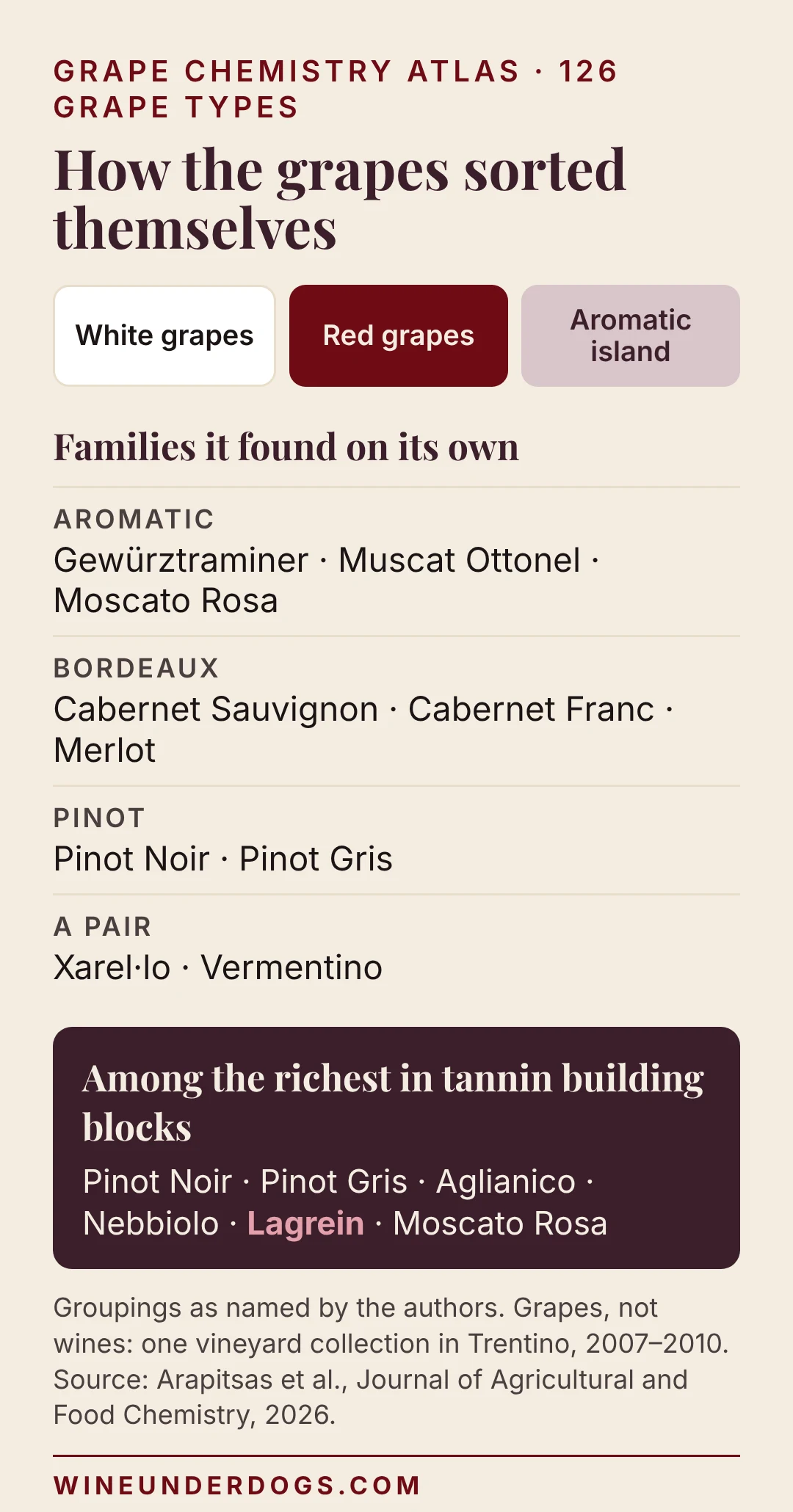
The aromatic island ignores skin color. Gewürztraminer, Muscat Ottonel and the pink Moscato Rosa cluster together because they share a block of bound aroma compounds, the precursors that turn into perfume in the glass. Color, which drives most of the map, loses to aroma here.
Aleatico carries Muscat-type aroma without joining the club. The red grape from Elba, Lazio and Puglia shows high levels of the same aroma precursors, but its overall chemistry keeps it outside the aromatic cluster. If you drink Moscato and wondered what a red version might be, the map points at Aleatico.
The tannin builders. Among the wine grapes, the authors name Pinot Noir, Pinot Gris, Aglianico, Nebbiolo, Lagrein and Moscato Rosa as among the richest in procyanidins, the compounds grape tannin is built from. Croatina and Lambrusco del Casetta scored high on both procyanidins and a second family of tannin precursors. That is the line that put Lagrein in the box at the top of this page.
Families show up without being told. The clustering found a Bordeaux group of Cabernet Sauvignon, Cabernet Franc and Merlot. It also found a Lambrusco group, a Bianchetta group, a Rhône group among the whites, and a tight pairing of Xarel·lo and Vermentino, a Catalan grape and a Mediterranean one sitting side by side.
Pinot Noir and Pinot Gris stayed close. Pinot Gris is a color mutation of Pinot Noir, and the berries look nothing alike. Their chemistry barely noticed.
Cabernet Franc had a quirk. It stood out on one tannin precursor, trigalloyl glucose. The authors say it is the first time that has been reported.
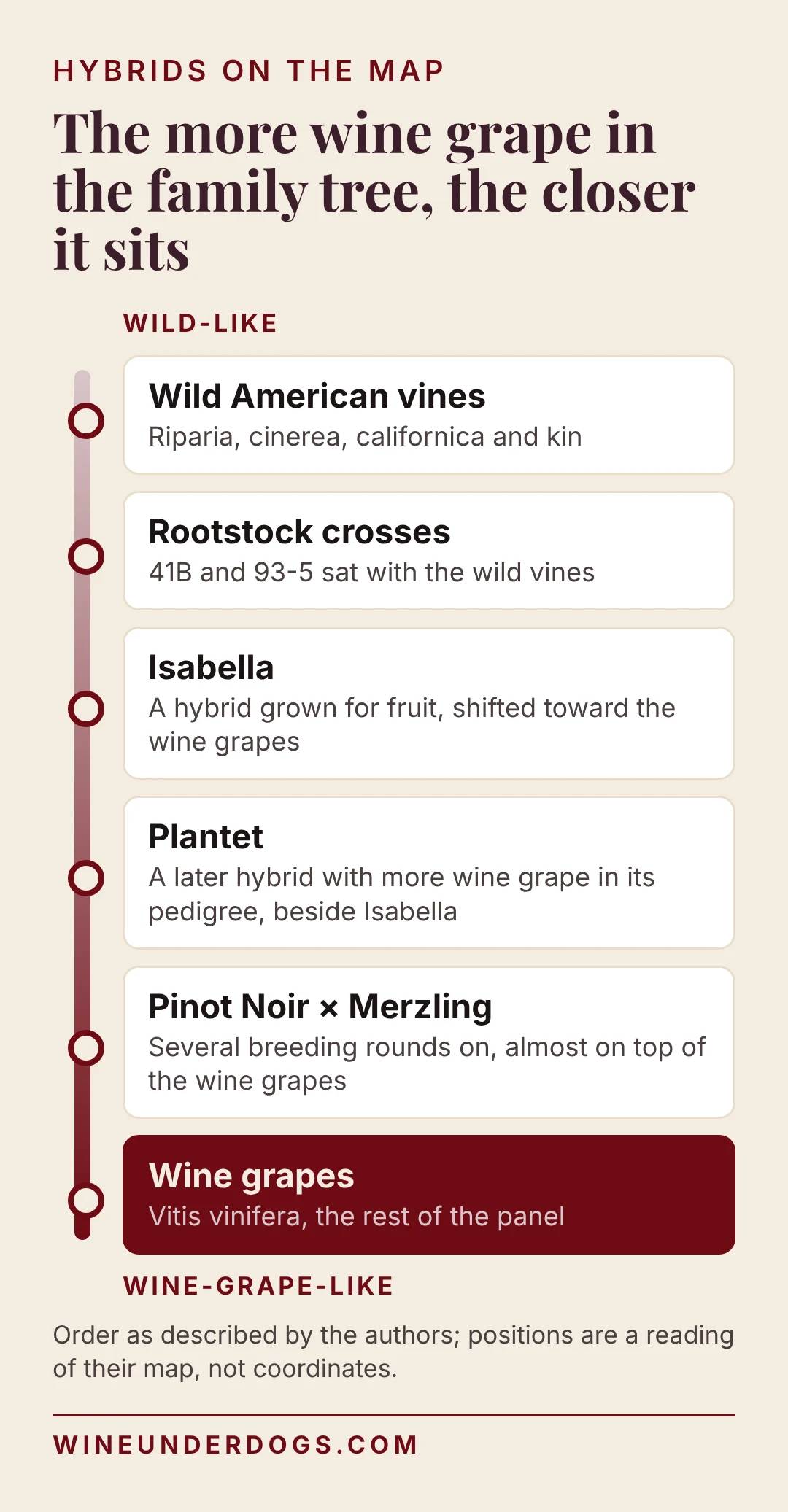
Hybrids slide toward wine grapes. Rootstock crosses sat with the wild American vines. Isabella, a hybrid grown for fruit, shifted toward the wine grapes, and a later-generation cross of Pinot Noir landed almost on top of them.
If you drink this, the map points here
This is the part to take shopping. Each row pairs a familiar wine with an underdog the map put nearby, and says which finding put it there.
| If you like | Try | Why |
|---|---|---|
| Moscato | Aleatico | Muscat-type aroma |
| Gewürztraminer | Moscato Rosa | Same aromatic cluster |
| Barolo | Lagrein | Tannin-rich group |
| Barolo | Aglianico | Tannin-rich group |
| Vermentino | Xarel·lo | Paired by the map |
Treat every row as a lead, not a promise. The next section says why.
What it can't tell you
Here is the honest part. This is a map of grapes, not wines, and of one vineyard, not the world. Every sample came from a single collection in Trentino, grown one way and picked by sugar level rather than by when each variety tastes ripe. Gaglioppo from Calabria and Cannonau from Sardinia were grown in the Alps for this study, which is very good for a fair comparison and says little about how they taste at home.
The map also shows similarity, nothing else. Two grapes near each other have alike molecules. Whether you would like both is a question for the glass. Read Lagrein's place beside Nebbiolo as a reason to try one bottle, not as proof you will like it.
Why it matters for underdogs
Most of the grapes on this map will never get a study of their own. Here they got the same instruments, the same vintages and the same vineyard as Cabernet and Pinot Noir, which is about as level a field as an obscure grape ever gets. The authors built the dataset to be reused, and the raw data is public.
That is the part worth rooting for. The next time someone says a little-known grape is just a lesser version of a famous one, there is now a map that can check.
— Chris Berry
New to wine? Start here

Wine Match
Five guilty pleasures, yes or no. Ben finds the wine you’d actually like. You don’t need to know anything about wine. Ben certainly doesn’t.
Wine Underdogs is for readers of legal drinking age.
BenFive things. Yes or no. I'll do the rest.
Every wine fact here comes from the grape guides on Wine Underdogs. Ben has never opened a bottle, and neither does this game. For readers 21 and over.
Frequently asked questions
What is the grape metabolome atlas?
It is a study from Fondazione Edmund Mach in San Michele all'Adige, Italy, published in the Journal of Agricultural and Food Chemistry in August 2026. The team analyzed 462 berry samples from 126 grapevine accessions over four vintages with liquid chromatography and mass spectrometry, then arranged the varieties on a map by how similar their chemistry is.
Does the atlas tell you what a wine will taste like?
No. It measured grapes picked at about 18 degrees Brix from one vineyard collection in Trentino between 2007 and 2010, before any winemaking. It shows which varieties are chemically alike. Taste depends on ripeness, site and the cellar, none of which the study varied.
Which grapes in the atlas are richest in tannin building blocks?
Among the wine grapes, the authors name Pinot Noir, Pinot Gris, Aglianico, Nebbiolo, Lagrein and Moscato Rosa as among the richest in procyanidins, the compounds that make up grape tannin.
JOIN THE PACK
Whatever you drink now, there's an underdog you'd like more.
One overlooked wine at a time: what it tastes like, the famous one it can replace, and the catch. Free.